The Woman Who Erased Herself: Norway's Isdal Mystery
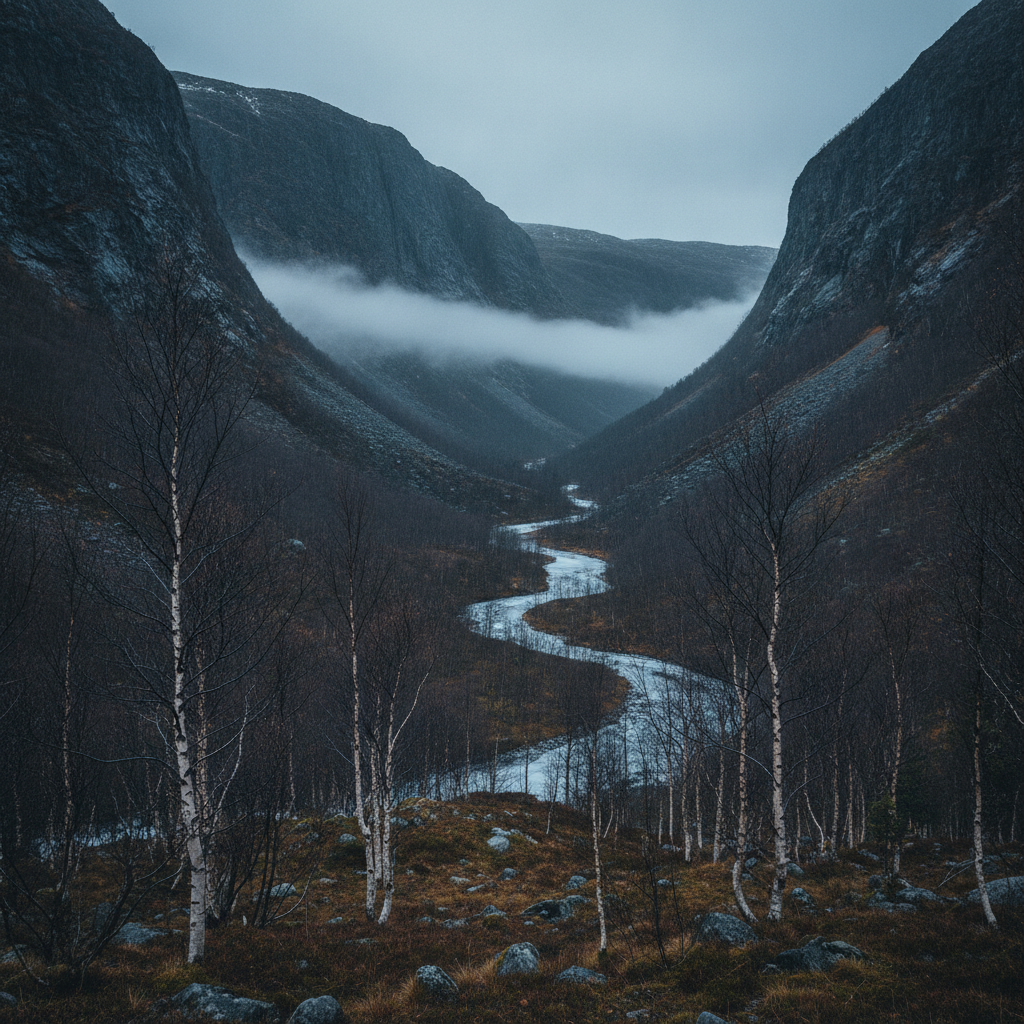
On a gray Sunday, the 29th of November 1970, a university professor walked into Isdalen with his two young daughters. Isdalen is a steep, rock-walled valley below the north face of Ulriken, just outside Bergen on Norway's western coast, and it had carried a grim old nickname long before that day: the Valley of Death, for the medieval travellers and later the despairing who had died among its cliffs. Wedged between scorched stones the family came upon the partly burned body of a woman. Her front was charred almost to nothing and her face was destroyed beyond any hope of recognition.
Police recorded what lay scattered around her: sleeping pills, a packed lunch, an empty quarter-bottle of St. Hallvard liqueur, a broken umbrella, rubber boots, a fur hat that carried the faint smell of petrol, and melted plastic bottles that had held, it seemed, some flammable liquid. Then came the detail that set the case apart from an ordinary death in the mountains. Every label had been cut out of her clothing, and the identifying marks had been scraped or rubbed from her belongings. This was not the disorder of an accident. It was patient, deliberate work.
Within days the investigation, filed at Bergen as case 134/70, opened outward. Detectives traced two suitcases she had checked into the left-luggage office at Bergen railway station. Inside was the wardrobe of a woman who travelled not to be remembered: wigs, a pair of glasses fitted with plain non-prescription lenses, a tube of eczema cream, banknotes in German, Norwegian, Belgian and Swiss currency, cosmetics with the maker's names sanded away, and a small notepad filled with columns of cryptic letters and numbers. Cryptographers eventually broke it. The code was a compressed travel log, dates and places, a private shorthand for a journey that wound back and forth across Europe.
Hotel registers filled in the rest. She had moved through Norway and beyond under at least eight different names, among them Geneviève Lancier, Claudia Tielt, Claudia Nielsen, Alexia Zarna-Merchez, Vera Jarle, Fenella Lorck and Elisabeth Leenhouwer, most of them claiming Belgian nationality. That paper trail would have required several forged passports and the nerve to use them. In her last days she had stayed at the Hotel Hordaheimen in Bergen, in room 407, checking out on the 23rd of November, six days before she was found. Staff who remembered her described an elegant, cultivated woman in her thirties who spoke French, German, English and Flemish, who sometimes changed rooms without obvious reason, and who left an impression of guardedness beneath the charm.
The autopsy added weight rather than clarity. In her body pathologists found the residue of a great many sleeping pills, later reckoned at somewhere between fifty and seventy Fenemal tablets, a barbiturate, with a further dozen found near the body. But there was also soot in her airways and carbon monoxide in her blood, which established one fact beyond dispute: whatever the pills had done to her, she was still breathing when the fire took hold. Her neck showed bruising, which pathologists noted as consistent with a blow, with pills being forced down, or with nothing sinister at all.
Within weeks the Bergen police formally shelved the file as a probable suicide. Several of the original detectives never privately accepted that verdict. On the 5th of February 1971 she was buried in a Catholic service at Møllendal cemetery in Bergen, in a sealed zinc coffin chosen for one reason above all: so that her remains might one day be exhumed and examined again by science not yet invented. The police photographed the funeral in case anyone who had known her came to stand at the grave. No one they could identify ever did.
Two further threads entered the record. In those same years Norway was conducting secret trials of its new Penguin anti-ship missile off that stretch of coast, and researchers who later matched her documented movements against the declassified trial schedule found that her journeys coincided closely with the tests. Separately, years afterward, a man came forward to say that as a young hiker in 1970 he had passed a woman on a trail on the Fløyen hillside above Bergen five days before the discovery, dressed for a city street rather than a mountainside, and followed at a distance, he thought, by two men in coats. When he tried to tell the police at the time, he was advised to let it go. Neither thread has ever been shown to connect her to any intelligence service, and it has never been established that she carried secrets for anyone.
In 2016 the file came back to life. Prompted in part by the rediscovery of the woman's effects gathering dust in a police archive, the Norwegian broadcaster NRK joined forces with the Kripos national crime unit and the University of Bergen and reopened the investigation with tools the detectives of 1970 could only have dreamed of. Her jaw had been preserved all those years precisely because her dental work was so unusual: gold crowns of a style rarely seen in Norway, and fourteen teeth showing root-canal treatment far more extensive than was common, the kind of costly, careful dentistry that spoke of money and of a life lived somewhere on the continent. DNA extracted from the teeth placed her maternal line in the mitochondrial haplogroup H24, a lineage that led nowhere in the databases and matched no relative who ever came forward.
Then came the finding that felt like a door swinging open. Isotope analysis of her tooth enamel, which locks in a chemical signature of the water and food of childhood, indicated that she had most likely been born around 1930, give or take four years, and had spent her early years in or near Nuremberg, in southern Germany, before moving as a girl toward the French-German border region. Handwriting specialists studying her coded notes concluded she had probably learned to write in France. A generation's worth of guesswork suddenly had a shape: a central-European girl, born between the wars, carried westward across a border in the years when that border meant everything.
And there the investigation stopped. No relative recognised the reconstruction of her life. No name ever came. More than half a century after a family found her among the scorched stones, and after everything modern forensic science has been able to do, no one has been able to say for certain who she was. She lies in a marked grave in Bergen under no name at all.
Conclusions and Open Questions
Every theory built to hold this case leaks somewhere.
The plain-suicide reading is the tidiest and the least dramatic, and it was the verdict of the Bergen police in 1970. The soot in her lungs is often taken to support it: she took the pills, lit the fire, and death came before the flames had fully done their work. Its weakness is everything around the body. The surgically stripped labels, the wall of aliases and the forged travel are not things a grieving private person has any reason to construct.
The espionage reading answers the aliases and the erasure with a single stroke, and some argue that the coincidence with the Penguin missile trials is too close to be a coincidence. Its weakness is that after decades of opened archives it has never produced one verifiable thread connecting her to any intelligence service, and that absence grows heavier rather than lighter with time. The hiker's account of two men following her was given long after the fact and was never corroborated.
A third reading splits the difference. One theory holds that she was indeed a clandestine traveller of some kind, a smuggler perhaps, or a woman entangled in the grey economy of forged documents rather than in statecraft, and that she took her own life when a life on the run became unbearable: the tradecraft real, the spying imagined. It asks us to invent the least, which is its strength. Its weakness is that it explains her by making her smaller than the evidence of her competence suggests.
Some argue that the isotope map is the thread worth pulling hardest, on the grounds that a woman born around 1930 near Nuremberg and moved as a child toward the French border had exactly the upbringing that produced people fluent in several languages and comfortable across frontiers, and that some such people were available to the services which fought the long quiet war that followed. That does not make her a spy. It makes her the kind of person from whom that world recruited, and it cannot bridge the gap no theory bridges: the missing name.
What remains unexplained is not the choice between theories but a handful of hard facts that no theory absorbs cleanly. Someone removed every label from her clothes and every mark from her jars of cream, and it has never been established whether that hand was her own. She had swallowed dozens of barbiturate tablets and was still alive when the fire started, in the open air, in a remote valley, on a freezing November night. Her neck was bruised, and the bruise has never been explained one way or the other. Her mitochondrial line has no living match anywhere in the databases, and a woman with expensive continental dentistry and four languages left no one behind who reported her missing.
The open questions are still the first ones. Who was she? Why was every trace of identity stripped from a single human life? Did she die by her own hand, or was the fire meant to make certain she would never speak? Somewhere in Europe, if the isotopes are right, a family may still carry the shape of a daughter or a sister who walked out one year and never came back, never knowing that she lies in Bergen, cared for by strangers, and still unnamed.