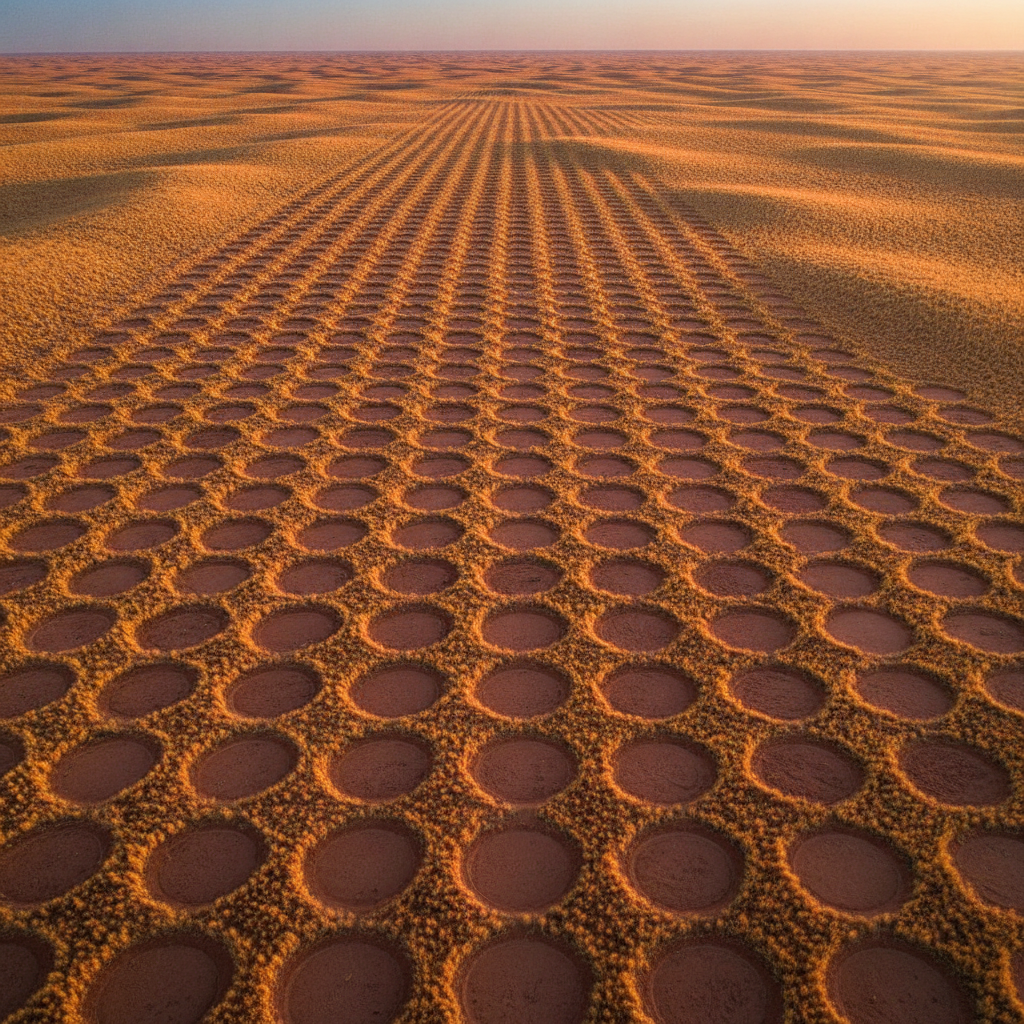
The Desert's Perfect Polka Dots: Who Draws the Fairy Circles?
Fly low over the grasslands at the edge of the Namib Desert and the ground looks stitched by hand. Millions of bare, reddish circles pepper a sea of golden grass, each ringed by a fringe of taller stalks, each held apart from its neighbours with almost mathematical regularity. From the air the effect resembles the hide of some vast, spotted animal. On the ground it is stranger still. Step inside a circle and the earth is simply, stubbornly bare, while the grass beyond the rim grows thick and tall. There is no fence, no rock, no visible reason for the line where life stops and the bald red disk begins.
The circles run from about two to fifteen metres across, and they are not fleeting. Researchers estimate that an individual circle can persist for decades, being born, maturing and fading over the span of a human life, only to have a new one open elsewhere in the field. The line at its edge is sharp, and it holds, year after year, through drought and flood alike.
They occupy a narrow band of the map, and rainfall is what defines it. Too dry and the circles vanish; too wet and they vanish as well. The pattern exists only on the knife's edge of scarcity, so finely tuned that a few extra millimetres of annual rain wipe it off the landscape altogether. Whatever makes the circles is therefore tuned with extraordinary precision to how little water is available, and that tuning is one of the few facts every side of the argument accepts.
The people who lived with them longest had their own account. The Himba of north-western Namibia long held that the circles were the footprints of gods, the tread of a great serpent moving under the sand, or the breath of a subterranean dragon. Those accounts were recorded by outsiders long before the first soil sample was ever taken.
Science wanted a mechanism, and for decades the search stayed inside one desert, because the circles were thought to be uniquely Namibian. That changed in 2016, when the ecologist Stephan Getzin and colleagues reported strikingly similar patterns in the arid outback near Newman, in Western Australia, publishing the find in the journal PNAS. A regional oddity had become an intercontinental one. The Australian circles sat in a different soil, under a different sky, on the far side of the Indian Ocean.
By then two research programmes had been running for years, each producing hard field data. The first belonged to the German ecologist Norbert Juergens, who went looking underground. Working with Alexander Groengroft, he reported sand termites at more than 1,700 circles across Namibia, Angola and South Africa. In a 2023 paper the pair took the argument further, measuring soil down to a depth of about 90 centimetres and reporting that water genuinely lingers in the subsoil beneath the bare patches. In their reading the insects chew away the grass roots under a patch, kill the vegetation, and open a bare disk where rain sinks straight down instead of being drunk by plants, leaving a cool, moist underground reservoir that carries the colony through the dry season.
The second programme was Getzin's own, and it went looking at the grass. His team planted soil-moisture sensors in the Namib circles and logged readings at 30-minute intervals from 2020 through 2022. After the rare rains they watched grasses inside the circles germinate and then die of water stress within weeks, and they found no sign of root-chewing termites at work in those plots. They described the circles as ecohydrological engineering by the plants themselves: bare reservoirs that soak up scarce rain and feed the ring of tall grass around the rim, buffering the whole system against a drying climate.
A third result arrived between the two. In 2017 the mathematical biologist Corina Tarnita, with Juan Bonachela and colleagues, published a model in the journal Nature laying out a theoretical foundation for multi-scale regular vegetation patterns. Their simulation reproduced the fairy-circle landscape only when two forces ran at the same time: territorial competition between subterranean insect colonies, which set the large-scale spacing of the circles, and plant self-organisation, which generated a finer pattern of vegetation in the matrix between them.
Then Australia produced a twist. A 2023 study drawing on the knowledge of the Martu, the Aboriginal traditional owners of that country, reported that First Peoples had long known these bare disks as linyji, the hard-baked pavement homes of harvester termites of the genus Drepanotermes, insects the Martu dig for and eat. Excavation of circles east of Newman turned up termite chambers and stored grass chaff beneath the crust, and some of the nests may date back to the Pleistocene, tens of thousands of years old.
A 2024 reply complicated even that. It argued that the Australian bare gaps are not built by the termites living in them at all, but weathered open by the baking of a clay crust that will not let grass take root, with the termites moving into ground that was already bare. On this reading the linyji and the fairy circle are two different things that happen to overlap.
Behind these live arguments lies a graveyard of earlier answers, each of which once looked plausible. The circles were blamed on radioactive patches in the soil, on seeping natural gas that poisoned the roots, on the residue of long-dead termite mounds, and even on meteor impacts. One researcher argued into the 2020s that the culprit was the toxic, milky latex of Euphorbia bushes, which had once grown on the spots and left the ground sterile after they died. Each of those theories could point to a circle or two that fitted it. Each foundered on the circles that did not: no consistent radiation, no gas where the pattern was densest, no dead Euphorbia at the centre of most disks.
Decades of fieldwork have therefore produced an unusual situation. The termites are real and can be dug up by the handful. The water stress is real and was recorded minute by minute by instruments. The mathematics is elegant, the traditional knowledge is old and detailed, and the pattern itself is unchanged. What does not exist, after all of it, is agreement.
Conclusions and Open Questions
The termite hypothesis, argued most forcefully by Norbert Juergens, has the great advantage of physical evidence you can hold in your hand. Sand termites really are present at more than 1,700 circles across three countries, and the subsoil moisture his team measured is exactly what an engineered reservoir should look like. Its weakness is the exceptions. Critics note that termites are not found beneath every circle, that other bare patches contain termites but form no circle, and that correlation is not construction. Finding an insect at the scene does not prove it built the house.
The self-organisation hypothesis, associated with Stephan Getzin, holds that no engineer is needed at all. Grasses compete so fiercely for scarce water that the survivors draw moisture toward their own roots from every direction, killing the vegetation between them and carving out evenly spaced gaps. It is a living instance of the Turing patterns that Alan Turing predicted in 1952 could emerge from nothing more than activation nearby and inhibition at a distance, repeated across a surface. Its strength is quantitative: the sensors caught the grasses dying of thirst. Its weakness is subtler but real. A model can reproduce a pattern without proving it is the pattern's true cause, and self-organisation still has to explain away the termites that Juergens keeps digging up.
Corina Tarnita's synthesis suggests the two need not be rivals: termites carve the big dots, thirsty grasses sculpt the fine texture around them. Its strength is that it dissolves a false either-or and matches several scales of structure at once, which neither single theory does cleanly. Its weakness is the mirror image of that virtue. Reconciling everyone can also mean convicting no one, and a model flexible enough to accommodate both mechanisms is harder to falsify than one that bets everything on a single cause.
The Martu account, and the excavations that followed it, made the insects look less like a fringe theory in Australia than like an answer the traditional owners could have supplied decades before any ecologist arrived with sensors. The 2024 weathering reply is its direct challenge, and it is not easily dismissed either: a baked clay crust that refuses grass would produce bare disks with or without tenants.
What remains unexplained is uncomfortably basic. How can the soil beneath a single bare patch be too dry at the surface for any seedling to survive and moister than its surroundings further down, unless the two teams are measuring different depths, different circles, or different moments in the fickle window after rain? Why are termites present at 1,700 circles and absent under others that look identical? Why does the pattern collapse if a few millimetres of extra rain fall? And why should a Namibian circle and an Australian one look so nearly identical if they are not made the same way at all?
Some argue that the search for a single verdict was the mistake from the start. On this view Namibian circles may be largely plant-driven while Australian ones are largely termite-inhabited or crust-baked, more than one mechanism may operate in each place in different proportions, and the eerie sameness of the pattern may reflect no shared cause at all. Physics does not care whether the thirst belongs to a grass root or an insect colony; scarcity plus feedback yields spots and stripes in systems that share nothing else. That would be a less satisfying answer than a single villain unmasked, and closer to how nature usually works, which is rarely tidy and almost never monocausal. It remains, for now, an open theory rather than a finding, and the grasslands keep their perfect dots.