The Spy in the Bag: The Death That Britain Ruled Two Ways
On the afternoon of 23 August 2010, two police officers let themselves into the top-floor flat at 36 Alderney Street in Pimlico, central London. It was a little before five o'clock. The address was not an ordinary London home. It was a property linked to the Secret Intelligence Service, a discreet base a short walk from the riverside headquarters of MI6, and the man who lived there had not answered his phone or appeared at work for days.
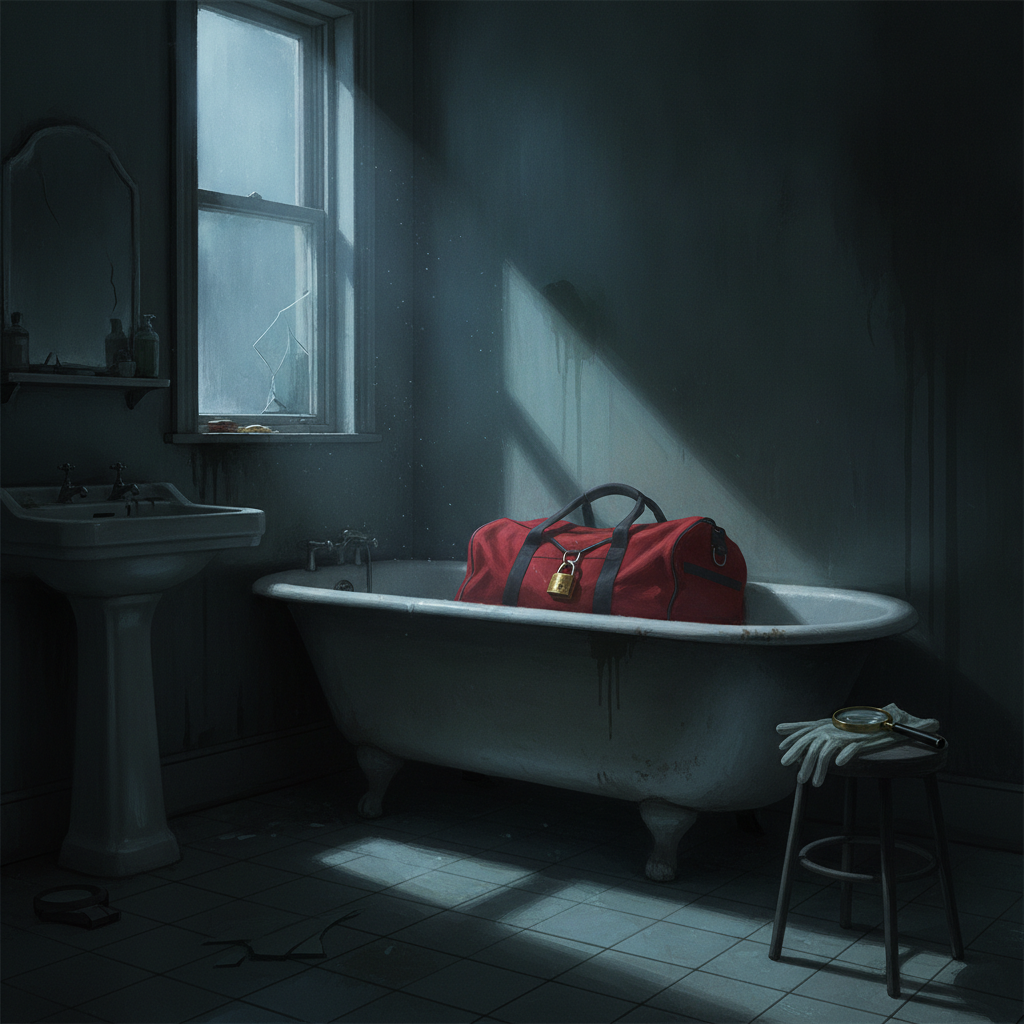
In the small en-suite bathroom, resting in the bath, sat a red North Face holdall. It was zipped shut and secured with a padlock, and the padlock was fastened on the outside. Inside, folded into a space that should never have held a grown man, naked, lay the body of Gareth Williams, thirty-one years old, a mathematician who broke codes for GCHQ and had been seconded to Britain's foreign intelligence service. The single small key that fitted the padlock lay inside the bag, tucked beneath his body.
The pathologists judged that he had been dead since the early hours of 16 August, a full week before anyone opened that door. Williams was on annual leave and was not due back at GCHQ's base in Cheltenham until early September, and so for seven days no colleague, friend or neighbour raised the alarm. When MI6 finally did, it was late, and the service afterwards offered a formal apology for the delay.
The scene itself gave investigators very little. There were no signs of forced entry. There was no sign of a struggle, no wound and no bruise. Toxicology found no alcohol and none of the common recreational drugs. And in the height of a London August, the heating in the flat had been left running. The warmth hurried decomposition along, and by the time specialists examined the body they could not say how Williams had died. Suffocation was possible. Poisoning was possible. Neither could be proved and neither could be ruled out, and no medical cause of death was ever established.
The man in the bag did not fit the setting. Williams had been a prodigy, racing through school and reaching university while still a boy, and he had grown into someone shy, meticulous and intensely private. He cycled long distances and kept himself very fit. According to accounts given later, he found the swagger of London and the culture of the secret services distasteful, and his sister told the inquest that he had been thinking of stepping back from that world and returning to plainer work near the family home in Wales.
His work was not routine analysis. Two senior police sources indicated that some of it concerned Russia, and that Williams had helped the American National Security Agency trace money laundering routes used by organised crime, including networks based in Moscow. He was, in the language of his trade, an operational asset rather than a desk clerk, and the flat in which he died was accommodation supplied by the service he had joined on secondment.
Detectives also documented a private life that his colleagues had known nothing about. Williams owned roughly twenty-five thousand pounds' worth of high-end women's clothing and had an interest in fashion. He had occasionally visited bondage websites, although investigators found nothing resembling an obsession and no evidence of a partner. Several years earlier, a landlady in Cheltenham had reportedly found him tied to his bed. None of this was linked forensically to the bathroom at Alderney Street, but all of it was placed before the court.
The inquest opened in the spring of 2012 before the Westminster coroner Dr Fiona Wilcox, and the forensic evidence proved more troubling than anything the newspapers had printed. The pathologist Richard Shepherd concluded that Williams had most likely been alive when he entered the bag, because a lifeless body is extraordinarily difficult to arrange in so tight and folded a posture. Another expert calculated that anyone sealed inside would be overcome by carbon dioxide, by hypercapnia, within two or three minutes. Specialists in confined spaces then attempted, by one account around four hundred times, to lock themselves into an identical bag in the same position from the inside. They failed on every attempt, though one witness allowed that a slim chance of success could not be entirely excluded.
There were also no fingerprints. None on the padlock, none on the rim of the bath, and not even Williams's own prints on the zip of his own bag. The heating was still set to run. Nothing had been taken from the flat, his work was not obviously compromised, and no note or message of any kind was found.
On 2 May 2012, Dr Wilcox delivered a narrative verdict that stopped just short of the word murder. Williams's death, she found, was unnatural and likely to have been criminally mediated. On the balance of probabilities another person had placed the bag in the bath and locked it, Williams had probably been alive when he was put inside, and he had died either of asphyxia or of a short acting poison. She said plainly that it remained a legitimate line of inquiry that the secret services had been involved, while cautioning that there was no evidence he had been killed by one of his own colleagues.
Eighteen months later the Metropolitan Police reached the opposite conclusion. In November 2013, after a further re-investigation, Deputy Assistant Commissioner Martin Hewitt announced that the most probable scenario was that Williams had died alone, having somehow locked himself inside the bag by accident. Part of what shifted the picture was a forensic correction. A trace of DNA found on Williams's hand, long treated as the mark of an unidentified person, was shown to belong to a scientist who had worked on the case. The forensic firm LGC apologised, explaining that the error had come from a mistyped numerical code. The unknown third party in the file had turned out to be a clerical mistake.
The family rejected that finding. They alleged that crucial DNA evidence had been interfered with and that fingerprints had been removed from the scene, and they spoke of someone versed in the tradecraft of the secret world. They have never accepted the accident conclusion, and they have said repeatedly that they believe Williams was killed.
Two later reviews changed nothing. In 2021 an independent forensic review was commissioned and passed to the police. It produced no new DNA and no sign that a third party had been present. A further review in 2024 reached the same result. More than a decade after the flat was opened, the file still holds two official conclusions that cannot both be true: a coroner satisfied that Gareth Williams was probably unlawfully killed, and a police force satisfied that he was probably alone.
Conclusions and Open Questions
Three broad explanations compete for the bathroom at Alderney Street, and each carries a weakness that its supporters have never resolved.
The first, adopted by the Metropolitan Police and set out by Martin Hewitt in 2013, is that Williams died alone in a private act that went wrong. It rests on documented material: the women's clothing, the fashion interest, the occasional visits to bondage sites, the earlier report from the Cheltenham landlady, and the absence of any forensic trace of another person. Its weakness is physical rather than psychological. It has to account for a padlock closed from the outside without a single fingerprint on it, for Williams's own prints missing from his own zip, and for roughly four hundred failed reconstructions by trained specialists. It also has to set aside the judgment of the coroner who heard all of the evidence in open court and rejected accident outright.
The second explanation is that an intelligence service killed him. In 2015 the former KGB officer Boris Karpichkov claimed that sources in Russia had told him the SVR was responsible, and that Williams had been killed with an untraceable poison introduced into his ear after he threatened to expose a Russian agent inside GCHQ. Some argue that this is the only reading that fits the scene, because a professional killing would explain the wiped surfaces, the absent traces and the staged bag, and because Williams's documented work on Russian money laundering supplies a motive. Its weakness is equally plain. Karpichkov offered no verifiable evidence, no such poison was ever found, and a claim relayed from anonymous foreign sources cannot be tested. The coroner herself, while keeping the possibility open, said there was no evidence pointing to it.
A third theory holds that the truth is no longer recoverable, and that the case sits permanently in the gap between the two official verdicts: an accident so improbable that it looks staged, or a killing so clean that it looks like an accident. On this reading the decisive fact is the heating, because the decomposition it caused is the reason the cause of death could never be established. Whether that was deliberate is unknown and unprovable, and this remains a hypothesis rather than a finding.
What is not explained by any of the three is a short list that has not moved in fifteen years. Why was the heating left on in a London August? Why were there no fingerprints at all, including his own? How did a punctual and disciplined officer go missing for seven days from a property tied to the intelligence services without anyone checking? And why, in a building connected to the very organisations trained in surveillance, was there no camera, no witness and no useful record of who had entered or left?
The open questions follow from that. Was Williams alive and conscious when the bag was closed, as the pathologist believed? If another person was in the flat, how did they enter and leave without a trace? If the police are right and no one else was there, what explanation covers the padlock and the missing prints? And can a state that produced two contradictory official findings about the death of one of its own codebreakers ever close the matter without a third?