Skyquakes: The Cannon Fire That Comes From a Clear Blue Sky
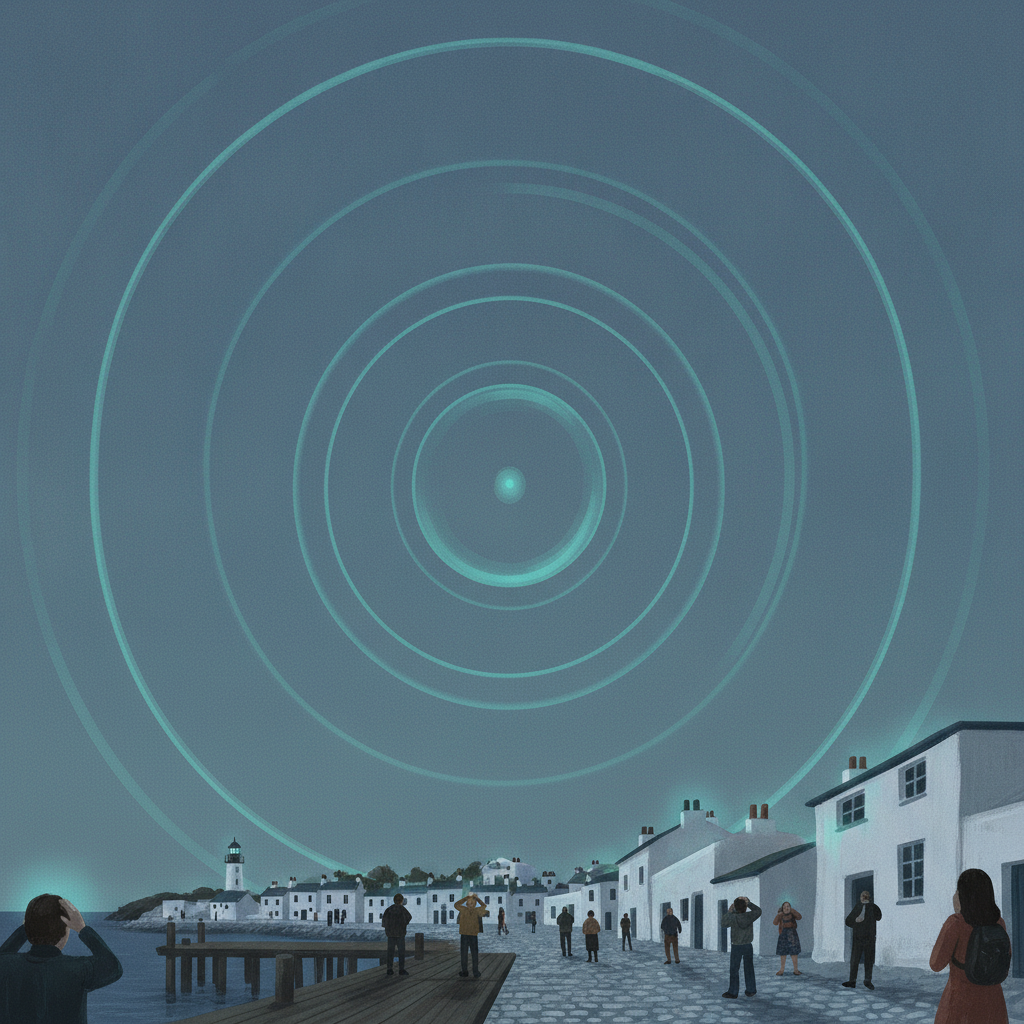
The sound arrives without warning. A deep, concussive boom, like distant cannon fire or a heavy door slammed by a giant, rolls in off the water under a cloudless sky. Windows rattle in their frames. Dogs lift their heads and bark at nothing. People step out onto their porches and scan the horizon for the storm, the explosion or the low-flying jet that must have caused it, and they find nothing at all. No smoke. No wake. No aircraft. Just the sea, the sky and the slowly fading memory of a noise that should not have been there. Then, a month or a year later, it happens again.
The phenomenon is old enough and widespread enough to have collected names on three separate continents. Along the coast of North Carolina, where the booms are reported often enough to reach the local newspapers every summer, they are called the Seneca Guns. The name was borrowed from James Fenimore Cooper's 1850 short story 'The Lake Gun', which described mysterious detonations heard around Seneca Lake in upstate New York. In the delta country of what is now Bangladesh, British colonial officials of the nineteenth century recorded the Barisal Guns, phantom artillery booming out over the flat waterways near the town of Barisal, usually toward the south and southeast, and often in damp or foggy weather.
Those Bengal reports were not campfire talk. They were taken seriously enough to reach the pages of the scientific journal Nature in the 1890s, where readers wrote in with their own accounts and correspondents tried to pin the sound down. The geologist T. D. LaTouche presented a paper titled 'On the Sounds Known as Barisal Guns' to the British Association for the Advancement of Science. In that correspondence the Victorians put forward almost everything they could think of: fireworks, bamboo stems bursting in distant jungle fires, ordinary thunder heard from over the horizon, landslips and the collapse of undercut river banks, faint earthquakes, and even ball lightning. Each was proposed by a serious observer, and each was quietly set aside, because none of them was present often enough, or loud enough, to account for a sound heard again and again in fine, still weather.
The naming did not stop in Bengal. On the Belgian and Dutch coast, fishermen had their own word, mistpouffers, roughly 'fog belches', for the same low booming out of a calm sea. The Italians called them brontidi. The Japanese spoke of uminari, the 'cries of the sea'. The Filipinos, the Haitians and the people of the Ganges and the Great Lakes all had their version. Different languages, different centuries, the same reported experience: guns firing where there are no guns.
For most of that history the reports were easy to file away as folklore, the sort of thing that thrives in fishing villages and gets embroidered in the retelling. What changed the conversation was not a new argument but a new set of instruments. Between 2013 and 2015 a remarkable piece of scientific infrastructure crawled across the eastern United States: the EarthScope Transportable Array, a rolling grid of roughly 400 seismic and atmospheric sensors that were picked up and re-planted farther along every couple of years, blanketing the country in overlapping ears. It was never built to chase phantom cannon fire. It happened to be listening, in high fidelity, over exactly the coast where the Seneca Guns are heard.
In 2020 a team from the University of North Carolina realised what they had. Led by an undergraduate in geological sciences named Eli Bird, they combed through local news archives and built a catalogue of dated boom reports around the Cape Fear region. Then they went back to the array's recordings to see what the machines had captured at those moments.
They found the events clearly. Each boom showed up as a burst of energy lasting anywhere from about one second to ten, matching the times and places in the news catalogue. The booms were no longer anecdotes; they were recorded, dated and measured signals.
They also found something quieter and far more important. At the instant of each boom there was no earthquake. No slip in the crust, however small, showed up on the seismic channels. The ground was still. Whatever the array had recorded had come through the air, not up through the rock.
Bird and his colleagues presented the work at the American Geophysical Union's annual meeting on December 7, 2020. Their careful conclusion was that the Seneca Guns are, in Bird's words, an atmospheric phenomenon, something propagating through the sky rather than the earth. The oldest folk explanation, that the ground itself was cracking, was off the table. So was any theory that required a hidden tremor.
That is where the confirmed record ends. The booms are real. They have been recorded, timed and measured. Their duration is known. Their arrival times are known. The medium they travel through is known. What produces them is not. Ruling something out is not the same as finding it, and the rigorous work of proving what the Seneca Guns are not left a deeper hole where the answer should be.
Two facts frame everything that follows. The first is that the reports span three continents and at least three centuries, from colonial Bengal to Belgian fishing villages to a modern town in the Carolinas with traffic cameras on every corner. The second is that the oldest accounts predate powered flight, predate the internal combustion engine, and predate almost every human noise that would now be the obvious suspect. Whatever the Barisal fishermen heard in the 1870s, it was not a jet.
Conclusions and Open Questions
No single mechanism has been made to fit every report, and each candidate on the table explains some of the booms while failing on the rest.
The most cinematic candidate is the bolide, a small meteor that detonates high in the atmosphere with a genuine sonic boom. Bolides are real, they happen daily, and they can certainly rattle windows. Their weakness is visibility: a fireball bright enough to boom is usually bright enough to be seen, and the Seneca Guns are overwhelmingly heard under clear skies with nothing overhead.
Atmospheric ducting is the explanation many meteorologists favour, and the UNC team leaned toward it as well. When layers of warm and cold air stack in the right way, they can bend a sound wave back down to the surface and carry it for scores or even hundreds of kilometres with almost no loss. Distant thunder, a storm far out over the Atlantic, naval gunnery exercises, a quarry blast or the crump of surf against a shoal could all be smuggled inland by a temperature inversion and arrive as a boom from a clear local sky. It handles the clear-sky paradox elegantly. Its weakness is that it still needs a source, and many booms occur when investigators can find no storm offshore, no scheduled exercise and no plausible distant bang to be ducted. Ducting explains how the sound travels, not what made it.
Some geologists have suggested very shallow, very small seismic slips, micro-tremors too faint for standard networks yet capable of thumping the air. The trouble is that the transportable array was precisely the kind of instrument that should have caught them, and it did not.
Others point to submarine landslides, the collapse of sediment down the continental slope, or to eruptions of methane gas long trapped in the seabed suddenly breaking free. Both could send a pressure pulse up into the water and air. Both are attractive for coastal cases and useless for a booming inland lake. Waves broken up by local topography, a favourite Victorian explanation for the Barisal Guns, may cover some shoreline reports and nothing further out. And the modern explanation of last resort, the sonic boom of a supersonic military aircraft, is real and documented but arrived a century and a half too late to explain the phantom guns of colonial Bengal.
Some argue, on the strength of that timing, that the question itself has been framed wrongly. One theory holds that skyquakes are not a single phenomenon at all but a convenient net thrown over several unrelated things that merely sound alike, so that the North Carolina booms may be ducted human blasts, some Bengal booms distant storms or escaping seabed gas, and a handful of the strangest reports simply meteors nobody looked up in time to see. On this reading a single word has been hiding three different mysteries, and no unified answer will ever be found because none exists.
A second open theory is harder to test and harder to dismiss. Some researchers suggest that the ocean and atmosphere together are a far noisier machine than we credit, that the sea floor sighs, slumps and vents in ways we rarely instrument, and that on certain days the air is tuned just right to deliver those sighs to a startled village as cannon fire. If that is correct, the booms are not a message and not an anomaly but the sound of ordinary planetary machinery, audible only through a rare alignment of source and sky, and unexplained because the chain from cause to boom is too dull, too diffuse and too intermittent for anyone to have caught it whole.
The open questions are specific. Why has no investigation ever matched a single documented boom to a single identified source event? Why does the same sound appear in regions with no shared geology, no shared weather and no shared industry? If ducting is the mechanism, why do the offshore source hunts so often come up empty? And what would it take to close the case: a denser sensor grid, hydrophones on the seabed, or simply someone willing to sit on a quiet coast for a decade with a microphone running?
For now the file stays open, on three continents and across three centuries, with a source that after all this listening remains officially unknown.