UN CASO REALE
Documentato

The Tic Tac Incident: The Day Navy Pilots Chased Something the Pentagon Still Calls Unidentified

2026-06-09 · Oggetti non identificati (UAP) · 7 min di lettura

For the better part of a week in November 2004, the crew of the USS Princeton tracked objects that had no business appearing on their screens. The Princeton was a guided-missile cruiser sailing off the coast of Southern California, escorting the USS Nimitz carrier strike group through the workup exercises a battle group completes before it deploys. Its Aegis SPY-1 radar had been upgraded shortly before the cruise and was among the most capable sensors in the fleet. In the darkened combat information center, senior radar operator Kevin Day began seeing returns he could not account for.

The contacts first appeared around 10 November. They came in groups, at roughly 80,000 feet, far above any commercial or military traffic in the area. They would hold that altitude for a while and then, according to the operators watching them, descend toward the ocean at a rate that matched no aircraft anyone aboard could name. The crew's first assumption was the sane one: the new equipment was faulty. The radar was checked and recalibrated. The tracks did not go away. Over the following days Day logged scores of them, and the strike group began treating the contacts as a training problem worth intercepting.

On the morning of 14 November the Princeton did something out of the ordinary with one of those tracks. Two F/A-18F Super Hornets from the Nimitz were already airborne on a routine training hop, call signs Fast Eagle 01 and Fast Eagle 02, and the cruiser vectored them toward a contact roughly 100 miles southwest of San Diego. In the lead jet was Commander David Fravor, commanding officer of the Black Aces squadron and a graduate of the Navy Fighter Weapons School. In the second was Lieutenant Commander Alex Dietrich. Each aircraft carried a weapon systems officer in the back seat, so four trained aviators were flying toward whatever was out there.

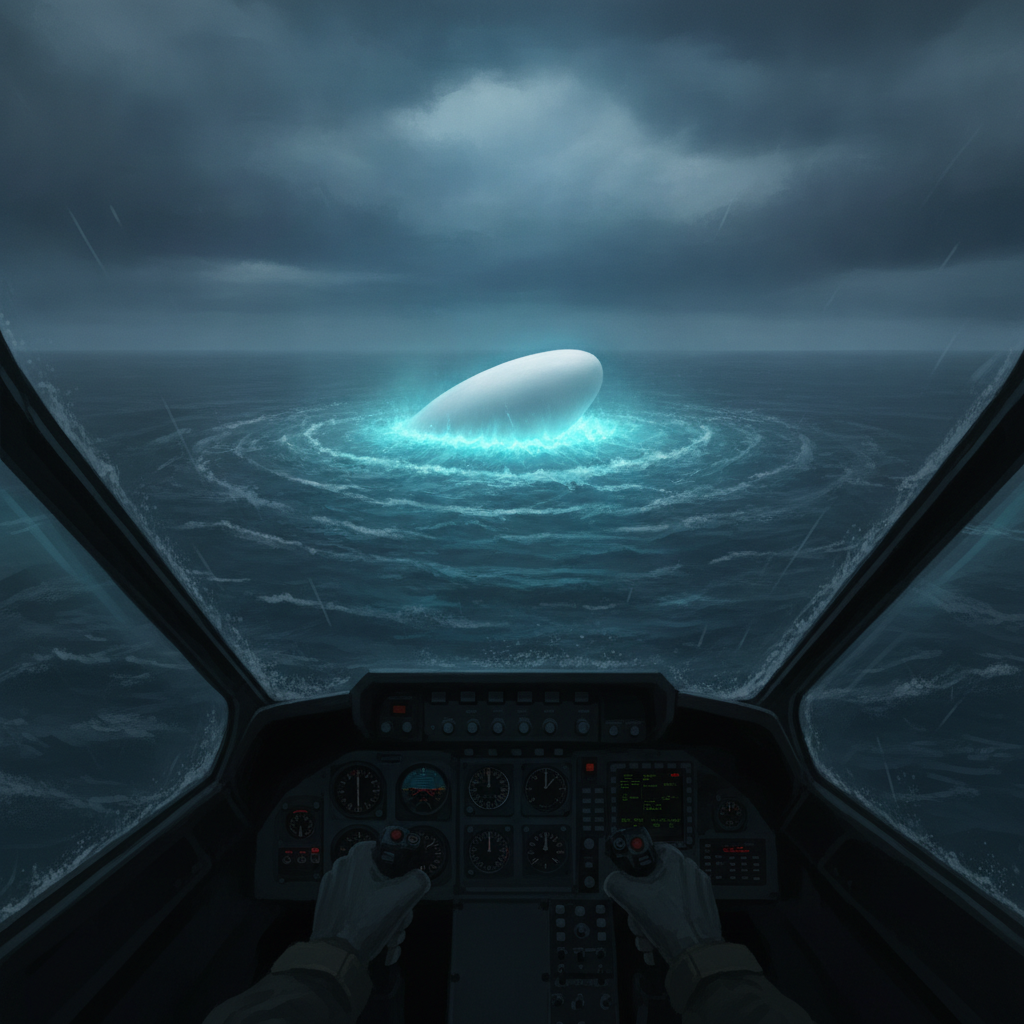
The weather was clear and it was the middle of the day. What the crews noticed first was the water. A patch of ocean below them was churning white, as though something just under the surface were disturbing it. Above that patch hovered a smooth white object, oblong, perhaps 40 feet long, shaped, as Fravor would later put it, like a Tic Tac breath mint. It had no wings, no rotors, no visible engine, no exhaust plume and no markings. It held its position over the disturbance without any of the movement that lift or thrust normally betray.

Fravor began a spiralling descent toward it, cutting across the circle to close the distance. As he came down, he later recounted, the object began to climb toward him, mirroring his movement as if the two of them were on opposite sides of an invisible wheel. When they were close, the object accelerated and was gone. Fravor described it as leaving in an instant, faster than anything he had flown or flown against. Dietrich, holding higher cover above the intercept, saw the same shape and the same departure.

Seconds later the Princeton reacquired a contact. It was not near the intercept. It was sitting at the fighters' assigned rendezvous point, their combat air patrol station, roughly 60 miles away, a distance the object appeared to have covered in under a minute. By the time the two Super Hornets reached that station, the contact was gone again.

A second Super Hornet was launched to follow up. Its weapon systems officer, Lieutenant Commander Chad Underwood, slaved the aircraft's ATFLIR infrared targeting pod onto an object and recorded roughly ninety seconds of video. That clip is now known as FLIR1. It shows a pale, featureless shape with no heat plume, held in the crosshairs, that at the very end darts off the left of the frame. Underwood never saw the object with his own eyes. He saw only what his sensor showed him.

The aircraft landed. Reports were filed. And then the story effectively stopped. There was no public investigation, no press release and no announced conclusion. For thirteen years the encounter circulated as a rumour among naval aviators and almost nowhere else.

It surfaced on 16 December 2017, when The New York Times reported the existence of a Pentagon effort called the Advanced Aerospace Threat Identification Program and published Navy footage alongside the article. Fravor went on the record with his name attached. A clip that had sat inside the Navy for more than a decade became a public document.

On 27 April 2020 the Department of Defense took the unusual step of formally releasing three Navy videos, FLIR1 among them. The department confirmed that the recordings were authentic and unaltered, said it was releasing them to clear up public confusion about whether they were genuine, and stated plainly that the phenomena they showed remained unidentified.

Ad

The subject then moved into the machinery of government. A preliminary assessment published by the Office of the Director of National Intelligence in June 2021 reviewed scores of military reports and concluded that almost none of them could be explained with the data available. The Pentagon later stood up a dedicated office, eventually named the All-domain Anomaly Resolution Office, to collect and investigate such reports. In 2021 Dietrich spoke publicly for the first time, describing the encounter on 60 Minutes and saying she had stayed silent for years partly out of concern for her career.

On 26 July 2023 Fravor repeated his account under oath before a subcommittee of the House Oversight Committee. Asked what he had seen, he told Congress that the object's performance was, in his words, well beyond the material science and the capabilities that we had at the time. Nearly twenty years after the flight, that testimony is where the documented record stops. No agency has since identified the object, and no agency has withdrawn the label it was first given.

Conclusions and Open Questions

Two things about this case are settled. The video is authentic, and the United States government says the object in it has not been identified. Everything else is argument, and the argument has produced four broad positions, each of which explains part of the record and stumbles over the rest.

The leading sceptical account belongs to the analyst Mick West, who has published frame by frame reconstructions of FLIR1. He argues that the dramatic final acceleration is an artefact of the ATFLIR itself: the pod rotates as it tracks, and a fast, turning fighter creates parallax that can make a distant, ordinary aircraft appear to shoot across the frame. Add infrared glare and the quirks of a newly upgraded radar, and on this reading nothing exotic is left. The weakness is that the argument handles the video far better than it handles the men. It does not account for what Fravor and Dietrich say they watched at close range, in good light, for what they describe as minutes rather than seconds.

A second theory holds that the whole episode is a chain of ordinary misidentifications: a distant conventional aircraft, a balloon or a bird, seen under conditions that flattered it, layered on top of radar tracks corrupted by the very equipment the crew first blamed. Its strength is parsimony. Its weakness is the amount of coincidence it demands, since several independent professionals and at least two separate sensor systems would have to be fooled in mutually consistent ways on the same afternoon, and it does not explain an object seen at close quarters with no transponder, no wings and no exhaust.

A third camp, quieter and more strategic, suspects secret hardware, either an American programme the aircrews were never briefed on or an adversary drone. That would explain both the performance and the silence. It runs into the physics: no publicly known craft, then or now, hovers without lift and then accelerates as described. It also has to explain why the government would formally label its own equipment unidentified in a public release.

The fourth position, argued by UFO advocates and by former officials such as Luis Elizondo, once associated with the Pentagon programme, is that the object was something genuinely beyond current human engineering, possibly not of human origin. Some go further and argue that such craft have been observed near military installations for decades and deliberately kept out of public reporting. This reading takes the witnesses and the official label at face value. Its weakness is the oldest one in the field: it rests on testimony and a short, contested clip, with no debris, no high resolution imagery and nothing that can be weighed or measured.

What remains genuinely unexplained is narrower than either side usually admits, and it is not the video. It is the close-range daylight sighting by four people whose profession is the rapid identification of objects in the sky, combined with a radar contact that reappeared at the fighters' assigned station some 60 miles away moments later. One theory holds that the case should be split in two, and that West may be largely right about FLIR1 while the visual encounter remains a separate and open question.

The unanswered questions are practical ones. Were the Princeton's original high altitude tracks a real object or an artefact of the upgraded radar, and can the raw data still be examined? What became of the additional recordings and logs that aircrew have said existed? Why did thirteen years pass before any of it reached the public? And after congressional hearings, a national intelligence assessment and a dedicated Pentagon office, why has no agency been able to move the case off the word it started with, which is simply unidentified?

Letture gratuite rimaste questo mese: 2

Condividi questo articolo:

Commenti dei lettori (0)
Solo gli abbonati attivi con pagamento verificato possono commentare. Accesso completo