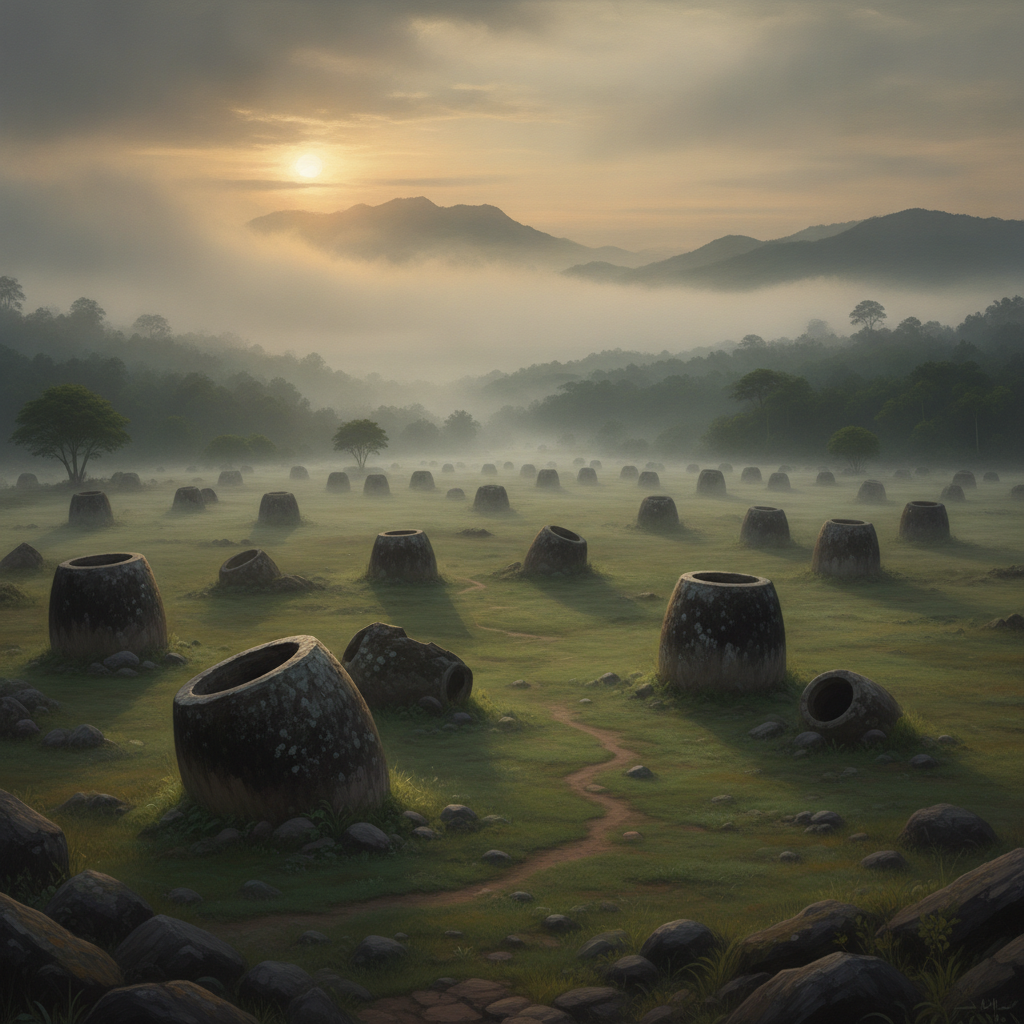
The Plain of Jars: Thousands of Stone Vessels, and a Minefield Over the Answer
On the rolling grasslands of the Xiangkhoang Plateau in northern Laos, stone vessels stand in the open by the hundred. They are cut from solid rock, tapered slightly toward the rim, mostly between one and three metres tall and roughly as wide, and the largest weigh in the region of 14 tonnes. Some sit upright in tight clusters on hillsides, others lie tipped and half sunk in the turf. Surveys have identified well over ninety jar sites across the province, with more than 120 recorded in total, and individual sites range from a single vessel to around 400. The name that stuck, in Lao and in every other language, is simply the Plain of Jars.
The stone is not uniform. Five rock types have been identified in the vessels: sandstone, which is the most common and was used for the largest jars, along with granite, conglomerate, limestone and breccia. Quarry sources have been located near several of the sites, and at Site 1, the most visited group, the jars appear to have been moved roughly 8 kilometres from where the rock was cut. There is no evidence of metal-shod machinery, no wheels in the local record and no draft animals suited to the terrain. The vessels were hollowed with hand tools and dragged into place.
Site 1, known locally as Ban Hai Hin, holds about 316 jars arranged in five clusters on a low ridge. Interspersed among them are more than twenty carved sandstone discs, most of them lying flat on the ground. At the edge of the site is a limestone cave with openings in its roof. That cave became the anchor of the first serious interpretation of the whole landscape.
The archaeologist who produced it was Madeleine Colani, a French researcher working under the École française d'Extrême-Orient. Colani surveyed the plateau in the early 1930s and published her results in 1935 in a two volume work on the megaliths of Upper Laos, documenting 21 sites. She excavated around twenty jars and the ground beside them, and recovered a consistent assemblage: burnt bone, ash, glass beads, spindle whorls, ear discs, and tools of bronze and iron. Inside the cave she found layers containing charred human bone. Colani concluded that the cave had served as a crematorium, that the jars held the remains of the dead, and that the discs were lids or grave markers. Her interpretation of the site as a mortuary landscape has never been overturned.
What she could not do was date it securely. For decades the jars were assigned broadly to the Iron Age of mainland Southeast Asia, roughly 500 BCE to 500 CE, largely on the basis of the metal artefacts and beads found with them. That range was an inference from typology rather than a measurement, and it left the central question, when were the jars actually carved and placed, effectively unanswered.
Then the plateau became a war zone. Between 1964 and 1973, during the conflict in Indochina, the United States conducted one of the heaviest aerial bombardments in history over Laos, and Xiangkhoang province was among the most heavily hit areas. Enormous quantities of cluster submunitions were dropped, and a large proportion failed to detonate on impact. The jar fields were left saturated with unexploded ordnance. Some vessels were shattered outright; bomb craters cut through the archaeological deposits at several sites. For a generation afterwards, walking off a cleared path in the jar fields was a lethal risk, and systematic excavation was simply impossible. Clearance teams have since opened corridors at the main sites, marking safe ground with painted stones, but even now only a small fraction of the recorded sites has been investigated in any depth.
Sustained research resumed in 2016 with the Plain of Jars Archaeological Project, a Lao and Australian collaboration. It has been co-led by Dougald O'Reilly of the Australian National University, Louise Shewan of the University of Melbourne, and Thonglith Luangkhoth of the Lao Department of Heritage, working with local authorities and with clearance operators to make ground safe before any trench was opened. The project combined excavation at Site 1 with mapping, remote sensing and, crucially, laboratory dating.
The results reshaped the timeline. Optically stimulated luminescence, which measures how long buried sediment has been shielded from sunlight, was applied to the ground beneath jars. It indicated that vessels were being placed on the plateau as early as the second and first millennia BCE, far earlier than the Iron Age bracket implied. Radiocarbon dates from human remains around and beneath the jars, however, clustered much later, in the eighth to thirteenth centuries CE. The excavations documented several distinct burial practices in the same ground: primary inhumations, bundles of bones from secondary burial, and ceramic vessels holding infant remains, all placed around the standing jars.
That combination produced the sharpest finding of the project. The jars and the burials found beside them are separated by a very long interval. People were being buried among the jars for centuries, and possibly more than a millennium, after the jars themselves had been set in place. Whatever the vessels were carved for, later communities continued to treat the ground around them as sacred and used it for their dead.
The most direct evidence for the jars themselves as containers came later, and from a site far from the tourist route. Excavations conducted between 2022 and 2024 at Site 75, roughly 70 kilometres northeast of the town of Phonsavan, opened a jar 1.3 metres high and found inside it the disarticulated remains of at least 37 individuals, together with iron tools, earthenware, glass beads and a copper alloy bell. Radiocarbon dating placed the deposits between about 890 and 1160 CE, accumulated in several phases over generations. The arrangement of the bones, and the absence of whole body parts, indicated secondary burial: the dead had decomposed elsewhere before the bones were gathered and placed in the vessel. Published in the journal Antiquity in 2026, it was described as the first substantial find of undisturbed human remains inside a Lao jar.
The site's formal status changed in 2019, when UNESCO inscribed the Megalithic Jar Sites in Xiengkhuang, the Plain of Jars, on the World Heritage List. Eleven component sites were included, covering a core area of about 175 hectares with a much larger buffer zone. The inscription brought protection, funding and international attention, and also a conservation problem that has no easy answer: the property contains ordnance that has not been cleared, and clearance is slow, expensive and dangerous.
Conclusions and Open Questions
The mortuary function of the landscape is no longer seriously in doubt. Human remains, grave goods and burial structures have now been documented at multiple sites by independent teams, and the Site 75 jar showed bones inside a vessel rather than merely around one. The unresolved questions are about the jars themselves.
The strongest interpretation, in a line from Colani through the current project, holds that the jars were mortuary vessels used for the exposure or distillation of the dead, with bones later removed for secondary burial in the surrounding ground. Its weakness is coverage. Only one jar has yielded a substantial undisturbed assemblage inside it, and thousands of vessels have never been excavated. A single confirmed case establishes that the practice existed, not that it explains every jar on the plateau.
An alternative reading treats the jars primarily as monuments or markers, with the burial of remains inside them as a later reuse. The OSL results give this some force, since they place the jars centuries or millennia before the datable burials. The weakness is that the OSL dates concern the sediment under the jars rather than the carving of the stone, and the sample base remains small.
Local tradition offers a different account entirely. Lao oral history credits a giant king, remembered as Khun Cheung, who is said to have had the jars made to brew and store rice wine for celebrating a great victory. Some researchers treat this as a memory of feasting associated with funerary rites, a plausible link but not one that has been tested archaeologically. A related practical theory holds that the jars collected monsoon rainwater for travellers on an overland trade route, an idea sometimes tied to the movement of salt and iron across the highlands. It suffers from the lack of any drainage, lids sealed in place, or water residue evidence, and from the presence of the dead.
Claims that the jars were made by giants, or by visitors from elsewhere, are rejected by archaeologists. Nothing about the vessels lies beyond the capability of Iron Age communities with iron tools, ropes and organised labour, and the quarries with partly finished jars still in them show the work in progress.
What remains genuinely open is large. Who carved the jars, in what language and under what social organisation, is unknown, since no writing and no settlement has been securely tied to the jar builders. Why some sites hold four hundred vessels and others one is unexplained. Whether the sandstone discs are lids, markers or something else is undecided. And the largest obstacle is not intellectual. Fewer than one in ten recorded sites has been properly investigated, and until the ordnance is gone, most of the plain will keep its answers.