11 Days in December: The Disappearance of Agatha Christie
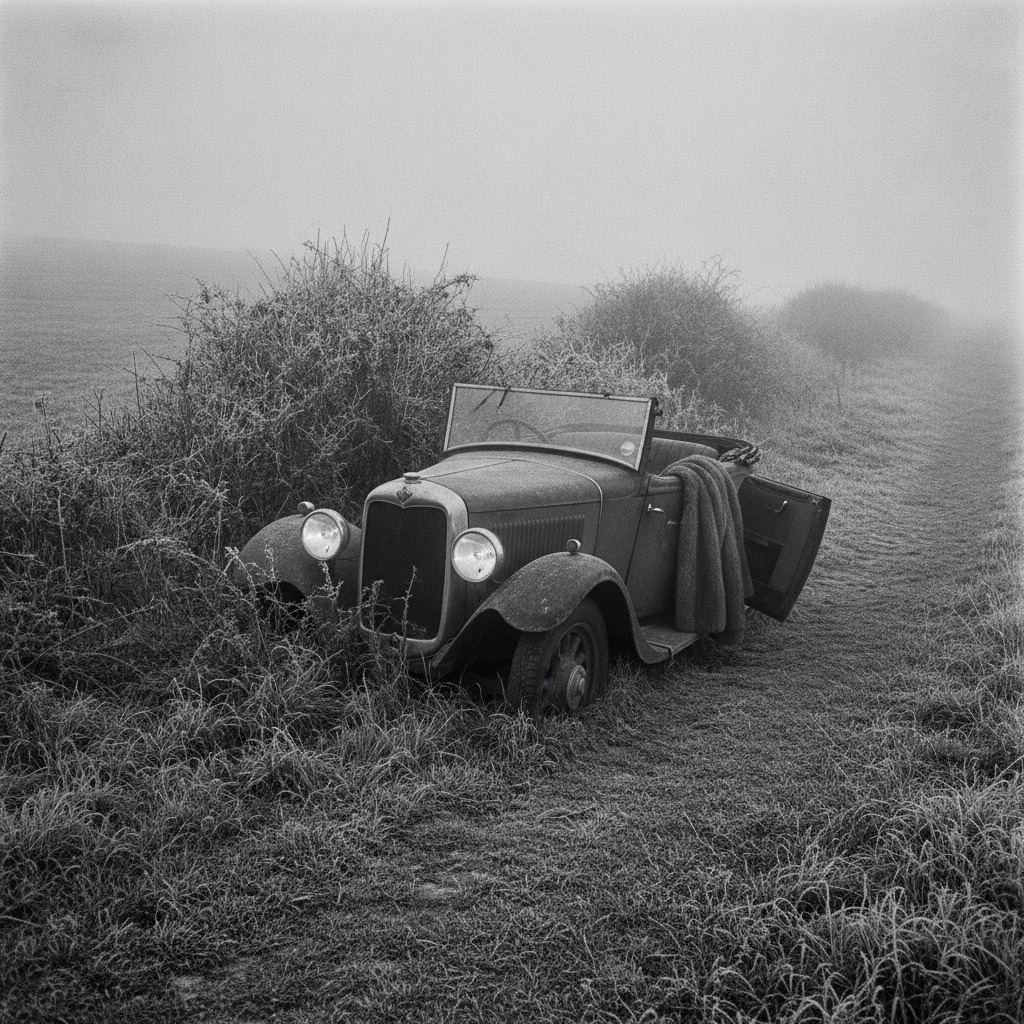
On the morning of Saturday 4 December 1926, a car was found on a hillside in the south of England.
It was a small Morris. It stood halfway down a grassy slope, well off the road, with its front pushed into the bushes. The headlights were still on.
Inside there was a fur coat. There was a small case of women's clothes. And there was a driving licence, already out of date, in the name of Mrs Agatha Christie.
The hill is called Newlands Corner. It lies in the county of Surrey, in England, about 50 km south-west of London.
Agatha Christie was 36 years old. That June her sixth novel had come out, and it had made her famous across Britain. She wrote murder mysteries. Now she herself was missing.
What the mystery is
A well-known writer left her home late on a Friday night and drove away alone. Her car was found the next morning, abandoned, about 25 km from home. For 11 days nobody knew if she was alive. Then she was found in a hotel in the north of England, healthy, registered under a false name.
She said she remembered nothing. Her family said she had lost her memory. Many people did not believe it.
What happened in those 11 days, and why, has never been settled.
A bad year
In April 1926 her mother died. The two had been very close, and those around her later described her as deeply depressed.
In August her husband told her that he had fallen in love with another woman. The woman was younger. Her surname was Neele. He wanted a divorce.
On Friday 3 December the couple argued. He told her he would spend the weekend with friends in the country. The other woman would be one of the guests. He left the house.
That evening, just after 9:30, Agatha Christie went upstairs. She kissed her sleeping daughter, who was 7. Then she came down, got into the car and drove into the dark.
Her secretary said later that she had not said a word about where she was going.
The car on the hill
The car was found on Saturday morning. Some accounts say a 15-year-old boy saw it first. The police were told by 11:00.
A man later told the police that at 6:20 that morning he had helped a woman who looked like her to start a car. He said she was dressed too lightly for the cold, and that she seemed strange.
Below the hill, not far away, was a small deep lake. The first fear was that she had drowned herself there. Police dragged it, and several other ponds nearby. They found nothing.
The police also considered that she had fallen into a chalk pit in the dark, or that she was the victim of a serious crime.
The search
What happened next became one of the largest searches for a missing person Britain had ever seen.
Officers, special constables and volunteers walked the hills on Saturday afternoon, on Sunday and on Monday. Then about 3 dozen more regular officers were brought in for a systematic sweep. Nothing.
The newspapers made it a national drama. One paper offered a reward of £100. The story went to the front page of The New York Times. The Home Secretary, the minister responsible for the police, pressed for faster results.
On Sunday 12 December a great public hunt was organised. Newspapers at the time reported that thousands of people came. More than 2,000 is the figure in one careful account. Later retellings speak of 15,000 volunteers and more than 1,000 police officers, and of aeroplanes overhead. The police report from February 1927 gives a much smaller picture. The truth is probably somewhere in between.
An aeroplane did fly over the hills. It is often called the first air search for a missing person in Britain.
Two famous crime writers joined in. The creator of Sherlock Holmes took one of her gloves to a medium, hoping the glove would "speak". The medium could not say where she was, only that he believed she was alive. Another well-known mystery novelist wrote a long newspaper article listing every possible explanation, from suicide to a planned escape, and went to the Sunday hunt herself.
Meanwhile the police had her husband followed by officers in plain clothes. The newspapers hinted at what everyone was thinking.
On 10 December word came that a woman's body had been pulled from a canal in the south of England. For a few hours it looked like the end. It was a different woman.
Where she actually was
From here the story moves to the north of England.
At some point after leaving the car, she reached London. One account says she had tea there and looked at the Christmas displays in a big department store. Then she took a train north to Harrogate, a spa town in the county of Yorkshire, about 300 km north of London.
There she checked into a large spa hotel. In the register she wrote her name as Mrs Teresa Neele, from Cape Town, in South Africa.
Neele was the surname of the woman her husband loved.
She paid 5 guineas a week for her room. She had a suitcase, suitable clothes and plenty of money. She played billiards and bridge. She danced. She did crosswords. She borrowed thrillers from the library.
She also placed a short notice in The Times of London. It asked friends and relatives of Teresa Neele, late of South Africa, to get in touch. Nobody did.
All that time, her photograph was in the national newspapers.
Found
On 14 December 1926, 2 musicians in the hotel's dance band became convinced that the guest from South Africa was the missing writer. Some accounts credit a head waiter. They told the police.
The police brought her husband north. That evening he identified her.
He told the press that she did not know him, and did not know why she was in Harrogate. He said she was suffering from a complete loss of memory. A Yorkshire newspaper reported the next day that she showed no visible sign of distress, and that her behaviour seemed natural in every way.
On 15 December she was taken to her sister's house in the north-west of England. The gates were guarded. The telephone was cut off. Visitors were turned away.
2 doctors signed a statement that she was suffering from an unquestionable, genuine loss of memory.
The anger
The public did not accept it easily. Many people felt they had been fooled. A newspaper in the north described the national mood as one of intense exasperation.
In February 1927 a Member of Parliament asked in the House of Commons who would pay for the search, and suggested that thousands of people had been misled by a cruel hoax. The police report written for the minister put the real cost at about £25. The figure given in Parliament has been reported as about £12. The sources disagree, but both are tiny next to the newspaper stories.
Her own account
She spoke publicly about it only once, in an interview published in 1928.
She said that on that night she had been in a very bad state. She said she had turned the car off the road and down the hill, towards a spot she thought was near the quarry. The car hit something with a jerk and stopped suddenly. She was thrown forward and struck her head.
After that, she said, she remembered nothing clearly until she found herself in Harrogate, believing she was a woman from South Africa.
In 1928 the divorce was finalised. A week later her husband married the other woman.
She went on to write dozens more books and became the best-selling novelist in history. Her autobiography, published in 1977, a year after her death, does not mention the 11 days at all.
**That is where the record ends. Everything known comes from the police file, the newspapers of 1926, the doctors' brief statement and her single interview. Nobody else was with her on the hill, on the train or in her mind.**
Conclusions and Open Questions
There are 4 main explanations. Each has supporters among her biographers. None has proof.
**She lost her memory.** This was the family's position and the doctors' statement. Her authorised biographer, writing in 1984, accepted it. A 2006 book argued she was in a "fugue state", a rare condition in which a person under severe stress travels away and takes on a new identity. The problem: a person who has lost her memory chose, as her new name, the surname of her husband's lover, and then advertised it in a national newspaper.
**She planned it to punish her husband.** A 1998 book argued that she staged the disappearance deliberately, to embarrass him and perhaps to make the police suspect him, and that she never expected the national uproar. The evidence: the name, the advertisement, the plentiful money and clothes, the calm life at the hotel. The problem: no document shows planning, and her own grandson has rejected the idea.
**It began as a suicide attempt.** Some writers suggest that she drove towards the edge of the quarry meaning to die, that the bushes stopped the car, and that shame and shock carried her north. The evidence: her depression, the car's position, and her own words about driving towards the quarry. The problem: it explains the hill, but not the false name.
**A breakdown with awareness.** A biography published in 2007 argued she was in a serious breakdown, aware of what she was doing but not in control of it. The problem: nothing in the record can confirm or refute a state of mind.
What remains open is simple to say. Why did a woman who had lost her memory remember the one name that hurt the most? And why, for the rest of a long life, did the most famous mystery writer in the world never solve her own?