The Charles Walton Murder: an Old Man Pinned to a Hillside with His Own Pitchfork, and the Case Scotland Yard Never Closed
On the morning of Wednesday, 14 February 1945, an old man walked out of his cottage in a small English village and up the lane toward the hill.
His name was Charles Walton. He was 74 years old.
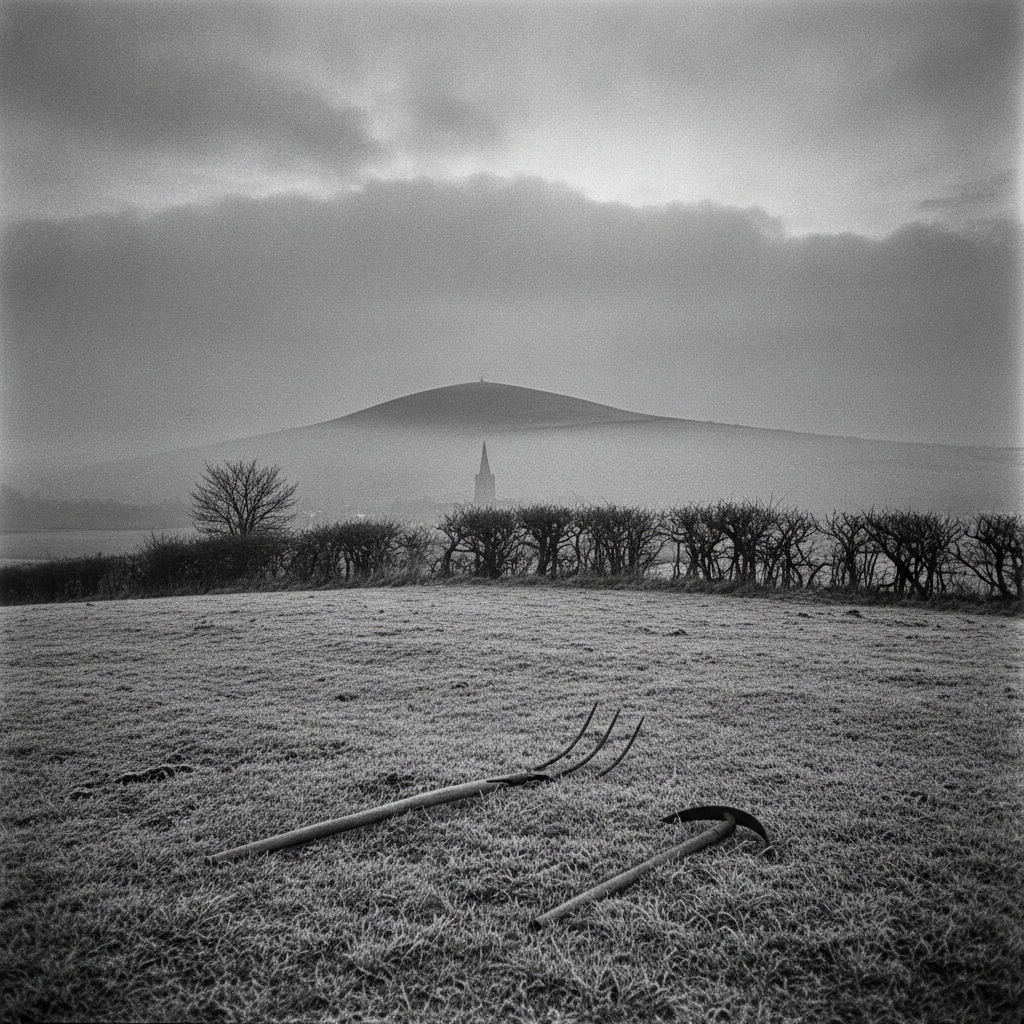
He carried 2 tools over his shoulder: a pitchfork and a slash hook. A slash hook is a heavy curved blade on a wooden handle, used to cut and trim hedges. He also carried his walking stick. His joints were stiff with rheumatism, and he did not go far without it.
Someone saw him pass through the churchyard between 9:00 and 9:30 in the morning. That was the last time anyone in the village saw him alive, as far as the records show.
The village was Lower Quinton, in the county of Warwickshire, in the middle of England, not far from Stratford-upon-Avon, the town where Shakespeare was born. Above the village rises a lone hill called Meon Hill. Walton had lived in Lower Quinton all his life.
That evening he was found dead on the slope of that hill, pinned to the ground with his own pitchfork.
Nobody was ever charged with his murder. It is the oldest unsolved killing on the records of the Warwickshire police.
This is the story of what happened that day, how one of the most famous detectives in Britain tried to solve it, and why he failed.
Who he was
Charles Walton was born on 12 May 1870. He worked the land all his life. In his younger years he had trained horses.
His wife died in December 1927. They had no children of their own. But about 30 years before his death, a young niece named Edith had lost her mother, and Walton took the 3-year-old girl into his home. Edith grew up as his daughter.
In 1945 Edith was 33. She still lived with her uncle, in a small rented cottage in the village. During the war she worked as a printer's assembler for a London organisation that had moved its work to the village to escape the bombing.
Walton was known as a quiet man who kept to himself. He lived on a state old-age pension of 10 shillings a week and on whatever casual farm work he could find.
For the 9 months before his death he had been working for a farm called The Firs, on the slopes of Meon Hill. He cut and laid hedges there. He was paid by the hour.
On 14 February he went up to a field of that farm, called Hillground, to cut a hedge. He told Edith he would be home at about 4 in the afternoon.
The evening
Edith came home from work at about 6 in the evening. The cottage was dark. Her uncle was not there.
That was not like him. He was old, he was slow, and he always came home before dark.
She went next door to a neighbour, and the 2 of them walked up to The Firs to ask the farm manager. The manager was the man Walton had been working for.
The manager told them he had seen Walton earlier that day, working on the hedge in Hillground. The 3 of them went up the hill together in the dark, with a torch, to look for him.
They found him beside the hedge he had been cutting.
Edith screamed. The neighbour held her back so she would not see more.
Another man happened to be walking on the far side of the hedge. The farm manager sent him running to call the police.
What the scene showed
The village policeman arrived at 7:05 in the evening. Detectives from Stratford-upon-Avon came later that night. A professor of forensic medicine from the regional laboratory reached the hill at 11:30 at night. The body was not taken down from the hill until 1:30 in the morning.
What they found was savage.
Walton had been beaten about the head with his own walking stick. The stick lay about 3 metres from the body, with blood and hair on it.
His throat had been cut with his own slash hook. The blade was left buried in his neck.
The 2 prongs of his own pitchfork had been driven into the ground on either side of his neck, pinning him down. The handle was wedged under a bar of the hedge, so that the fork held firm.
The post-mortem found more. Several ribs were broken. There was bruising on his chest. There were cuts on his left hand and bruises on his right hand and forearm. Those marks suggested he had raised his arms and tried to defend himself.
His shirt had been opened, and the top of his trousers unfastened.
The professor put the time of death between 1 and 2 in the afternoon. He concluded that 2 weapons had been used: one that stabbed and one that cut.
One more thing was missing. Walton always carried a plain pocket watch on a chain. It was not on the body.
Many later books say a cross had been cut into the dead man's chest. The professor's report does not mention any such cross. It appears to have been added in the retelling.
Scotland Yard is called
The next day, 15 February, the deputy chief constable of Warwickshire asked London's Scotland Yard for help.
In his message he set out the 2 ideas the local police had. The killer, he wrote, was either a madman or one of the Italian prisoners of war from a nearby camp.
There was such a camp. It stood at Long Marston, close to the village. The Italian prisoners there were allowed to move about the countryside fairly freely, and their comings and goings were not recorded.
On 16 February Scotland Yard sent its best-known detective, Chief Inspector Robert Fabian, together with a detective sergeant. The same day a third officer arrived from Special Branch. He spoke fluent Italian, and his job was to interview the prisoners.
Fabian had made his name in wartime London. He was described at the time as the foremost police detective in Britain.
The Italian prisoners
The Italian-speaking officer went through the camp.
What he found pointed away from the prisoners. On the afternoon of the murder, some of them had been at a play in Stratford-upon-Avon. Others had been at the cinema.
Some later accounts describe a prisoner who was seen in a ditch with blood on his hands and who turned out to have been killing rabbits for food. That story appears only in later, popular retellings, not in the official reports.
According to the police file, none of the prisoners was ever seriously considered a suspect. That line of inquiry closed.
The village closes its doors
Fabian and his team now turned to the village itself.
According to a later account of the case, the police took statements from more than 500 people in and around Lower Quinton, some of them children of 11.
Soldiers of the Royal Engineers were brought in with mine detectors. They swept the hillside for the missing pocket watch, and for anything else the killer might have dropped. They found nothing.
Fabian later wrote that he met a wall of silence. People were polite. They answered questions. But nobody seemed to know anything, and nobody wanted to say anything about the dead man.
The police could find no enemy. Walton had no money worth stealing. He paid 3 shillings a week in rent and gave Edith 1 pound a week for the housekeeping. His purse was later found at home; he had left it there that morning. The police could find no clear motive. Nothing about his life explained why anyone would want to kill him, and nothing explained the violence used.
The farm manager
Slowly, Fabian's attention settled on one man: the manager of The Firs, the farm where Walton died.
He was 40 years old. He ran the farm for a family company owned by his father. He was the man Walton had been working for that day, and the man who led Edith up the hill.
He was never charged with anything. Under the law he was, and remains, an innocent man. What follows is what the police files say Fabian noted, and why it was never enough.
On the night of the murder, the village policeman noticed that the manager seemed very upset. He was shivering and complaining of the cold, and he was getting ready to leave before the Stratford detectives arrived.
The manager said he had been in the village pub that morning with another farmer until about noon. That farmer confirmed it.
He then said that around midday he had seen Walton in the distance, working on the hedge in his shirtsleeves, and had not gone over to speak to him. Across his statements, the time of this sighting changed: 12:10, 12:15, 12:20. At the inquest he said only that at 12:30 he had seen "someone", standing still.
The detail of the shirtsleeves troubled Fabian. When the body was found, Walton was wearing a jacket over his shirt.
The manager first said that after lunch he had gone to see to one of his heifers, a young cow, which had fallen into a ditch and drowned. But the records showed the heifer had died the day before, on 13 February, and its carcass was taken away at 3:30 on the afternoon of the 14th. On 23 February he changed his account. Now he said he had read the newspaper after lunch and then helped a farmhand chop root vegetables for the cattle.
In his report Fabian wrote that the manager was "undoubtedly lying" about how he spent that afternoon.
On 20 February the manager told police that he had touched the weapons at the scene, because the neighbour had suggested pulling them out. That mattered, because touching them would explain any fingerprints. The neighbour denied ever saying it. In the end, no usable fingerprints were found on the weapons at all.
At first light on the morning after the murder, a constable guarding the scene reported that the manager came back up to the field alone. He chatted about the cold and gave the constable a cigarette.
The police also found that the manager had been claiming more in wages for his workers than he actually paid, and keeping the difference. He also said that Walton had lent him money. There is no proof of any such loan.
The police took the trousers the manager had worn that day. The professor found 2 marks on them that he believed were blood. But the trousers had been cleaned so thoroughly that the marks could not be tested.
**That is where the evidence stops. Fabian believed he knew who did it, but he had nothing that could prove it in court.**
In his report, Fabian himself admitted the problem. There was, he wrote, "no real evidence to connect him with the murder itself, and no reasonable motive."
A lie about a heifer does not prove a man killed someone. People lie to the police for many reasons, including fear. A missing watch, 2 untested stains, and a man who seemed nervous on a cold night on a hillside are not evidence of murder.
No charge was ever brought.
The investigation runs out
After some weeks, Fabian and his sergeant returned to London. The case stayed open.
A senior Warwickshire detective, Superintendent Alec Spooner, kept working on it. Accounts say he kept coming back to the village for years after everyone else had given up, hoping someone would finally talk.
Nobody did.
Two of the farm's workers left their jobs after the murder. The manager lived the rest of his life without ever being charged. He was 40 in 1945, and he died long ago.
In 1960, according to an account published in 1995, Walton's pocket watch turned up in an outbuilding of his old cottage. If that is true, it was never at the scene at all, and it was never a clue.
How it became a "witchcraft murder"
The way the killing was done, and the date, were enough to start talk.
About 24 km away, in another village, an old woman named Ann Tennant had been killed with a pitchfork in September 1875. The man who killed her was a local labourer. He said she was a witch. He was found not guilty by reason of insanity and died in a hospital for the criminally insane.
There was also an old book of local folklore, printed in 1929 by a vicar. It told a tale about a plough boy named Charles Walton who, in 1885, met a ghostly black dog on Meon Hill several nights running, and soon after learned that his sister had died. The superintendent drew Fabian's attention to this story.
Whether that plough boy was the same Charles Walton who died in 1945 has never been shown. Family records give no proof that they were the same man.
Rumours grew in the newspapers. Walton had the "evil eye". Walton kept toads and used them to put curses on crops and cattle, including the farm manager's drowned heifer. A dead black dog had been found hanging near the scene.
None of this appears in Fabian's reports from 1945. His official files say nothing about witchcraft, black dogs, toads or sacrifices.
It was only years later, in his popular books, that Fabian himself wrote of the killing as the climax of "a pagan rite", and placed it near an ancient stone monument. He also told of meeting a black dog on Meon Hill himself. A writer on witchcraft later pointed out that the stones Fabian named stand about 19 km from the village, and that the murder did not happen on the date Fabian gave for the old festival.
In 1954, on the eve of the anniversary, a national newspaper claimed the police had found a link between the 1875 and 1945 killings. It never said what that link was.
Where it stands
The murder of Charles Walton was never solved.
No one was charged. No weapon was missing; all 3 came from the victim himself, so there was no weapon to trace. No fingerprints were found. The only possible blood evidence was destroyed by cleaning. Forensic science in 1945 could do no more with what was left, and the evidence that might be tested today is not known to have survived.
The case file was kept by Scotland Yard and by the Warwickshire police. In 2010 and again in 2017, local and national press reported that it remained the oldest unsolved murder in the county.
The theories
**The farm manager.** This was Fabian's own belief. The changing story about the afternoon, the heifer that was already dead, the shirtsleeves, and the cleaned trousers all made him suspicious. The problem: Fabian himself wrote that there was no real evidence and no motive. The manager was never charged and must be presumed innocent.
**A passing stranger, or a madman.** This was the first idea of the local police. The violence, and the fact that nothing of value was taken, suggested someone not in their right mind. The problem: in a village where everyone knew everyone, and with soldiers searching the area, no stranger was seen and none was ever found.
**One of the Italian prisoners of war.** The deputy chief constable named this possibility on the first day. The problem: the interviews in the camp gave alibis to the prisoners, and the police file says none was ever seriously suspected.
**A ritual killing linked to witchcraft.** The pitchfork, the date, the old tale of the black dog, and the killing of 1875 made this the most famous theory. The problem: there is no sign of it in the investigation records of 1945. It grew out of later books and newspapers, including Fabian's own, and some of its details, like the cross on the chest, are not in the medical report.
What remains is a 74-year-old man who went up a hill to cut a hedge, and a killer whose name nobody has ever been able to prove.