Six Tonnes of Amber: The Room That Left Königsberg and Never Arrived
On the morning of 14 October 1941, in a looted palace eighteen miles south of Leningrad, two German specialists climbed scaffolding and began prising amber off a wall.
They worked quickly. Soldiers of Army Group North had been handed the room as a trophy, and the trophy was brittle. Within thirty-six hours the walls of the most celebrated chamber in Russia were bare plaster, and the amber was packed into crates on a westbound truck. Accounts differ on whether there were twenty-four crates or twenty-seven. They reached Königsberg, the capital of East Prussia, within days. Nobody has seen the room whole since.
What the crates held had taken eleven years to make. Work began in Prussia in 1701 to a design by the sculptor Andreas Schlüter, with the Danish amber master Gottfried Wolfram doing the carving, and was finished by two Danzig craftsmen, Gottfried Turau and Ernst Schacht. Amber is fossil resin, warm to the touch and close to impossible to work at scale: it splits along invisible faults, it clouds, it will not take a nail. Panelling an entire room in it was less a decorating scheme than proof that a kingdom could afford the impossible.
In 1716 Frederick William I of Prussia gave the panels to Peter the Great to seal an alliance against Sweden. They were crated to Russia and eventually installed at the Catherine Palace at Tsarskoye Selo, where the architect Bartolomeo Rastrelli enlarged them with mirrored pilasters and gilded carving to fill a larger hall. Finished, the room covered more than fifty-five square metres and carried over six tonnes of amber, along with gold leaf, mirrors and four Florentine mosaics of coloured stone. Visitors called it the eighth wonder of the world. Candlelight on six tonnes of resin produced a room that appeared to be lit from inside its own walls.
When the German advance reached the outskirts of Leningrad in 1941, the palace curators tried to evacuate it. The amber had been fixed to the wall for two centuries and began to crumble the moment it was touched. They gave up, glued gauze and wallpaper over the panels, and hoped the invaders would walk past. The invaders did not.
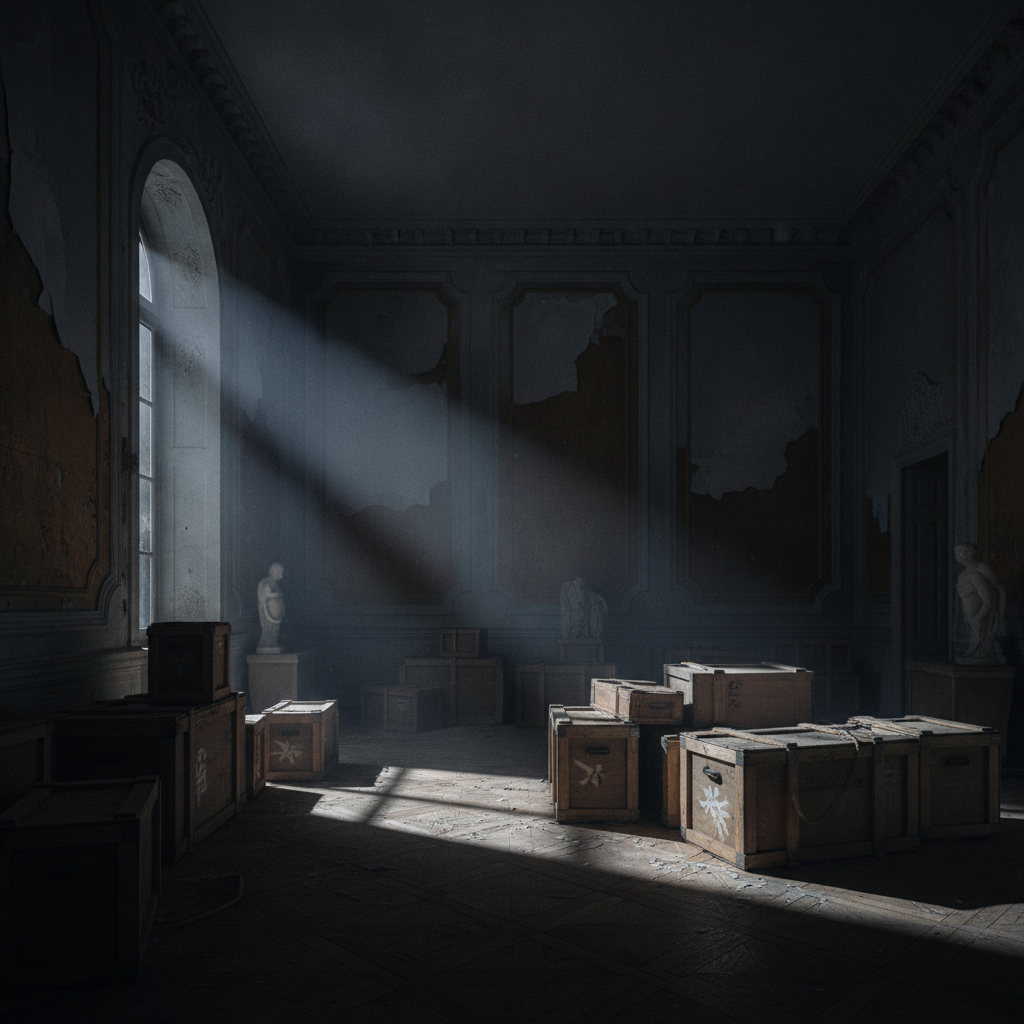
In Königsberg the crates went to Dr Alfred Rohde, director of the castle museum and one of the few people in Europe who genuinely understood amber. Rohde had the panels reassembled inside the castle and put them on public display. He published on them, and by every surviving account he treated the room as a scholarly responsibility rather than as plunder. It stayed on show until the war arrived at the city.
In late August 1944 the Royal Air Force bombed Königsberg twice in four nights. The old town burned, and the castle burned with it. Rohde reported afterwards that the amber panels had survived because they stood in a basement hall, and that he had crated them a second time. That report is the last moment at which anyone speaks about the room with real authority.
On 12 January 1945 Rohde wrote that the crates were packed and were to be sent to Wechselberg in Saxony. The same week, the Red Army opened its offensive in East Prussia. Königsberg was cut off at the end of January, shelled through the winter and stormed in April. The garrison surrendered on 9 April 1945. The castle, already a ruin, burned again.
That summer a Soviet commission entered the ruins. It was led by Alexander Brusov, an archaeologist from the State Historical Museum in Moscow. Brusov dug through the burnt basement halls and found gilded bronze fittings from the room and small charred fragments of amber. In his diary he wrote what the evidence in front of him suggested: the Amber Room had burned where it stood, in April 1945, during the storming of the city. It was an honest conclusion and a politically impossible one, because it meant conceding that Soviet shells had destroyed a Russian national treasure. Brusov's finding was set aside. The search began instead.
Rohde was interrogated. He said he did not know where the crates had gone. He was scheduled for a second interrogation in December 1945 and died before it took place, together with his wife. The recorded cause was typhus, which was killing many people in Königsberg that winter. When investigators returned later to confirm the deaths, according to the accounts that survive, they could locate neither the graves nor the doctor who had signed the certificates. Whether that indicates fraud or simply the condition of a destroyed city, where burials and paperwork alike were improvised, has never been settled.
What followed is one of the longest treasure hunts in European history. Soviet and later Russian teams searched the tunnels and cellars beneath Kaliningrad, as Königsberg became. German teams searched salt mines, bunkers, a silver mine at Deutschneudorf and the bed of a lagoon. Divers went down on the Wilhelm Gustloff, the refugee ship torpedoed off Pomerania on 30 January 1945 with some nine thousand people aboard, because witnesses said crates had been loaded onto her. Nothing from the room has ever come up.
The hunt consumed people. Georg Stein, a West German farmer, spent two decades and most of his money chasing archive references to the panels. In 1987 he was found dead in a Bavarian forest, undressed, his abdomen opened with a scalpel. The authorities ruled it suicide. His files passed to other searchers, who found in them what everyone else had found: leads that stopped.
Then, in 1997, a piece of the room surfaced. German investigators acting on a tip raided a lawyer's office in Bremen and recovered one of the four Florentine stone mosaics, which was being quietly offered for sale. It was authentic. The seller was the son of a German soldier who had served in Königsberg, and he said he had no idea what his father had left him. Around the same period an amber-decorated chest of drawers belonging to the room turned up in German private hands. Two objects, out of an entire room, after fifty-two years.
Russia stopped waiting. In 1979 craftsmen at Tsarskoye Selo began rebuilding the room from black-and-white photographs, one surviving colour image, and the pre-war records of Anatoly Kuchumov, the curator who had catalogued the panels before the invasion and spent much of his life looking for them. The work took twenty-four years and some forty Russian and German specialists, used amber from the same Kaliningrad deposits as the original, and was finished with a 3.5 million dollar donation from the German energy company E.ON Ruhrgas. The Bremen mosaic was fitted into the new room, which opened on 31 May 2003 for the three hundredth anniversary of St Petersburg.
The searching did not stop. In 2020 Polish divers examined the wreck of the German steamer Karlsruhe, sunk in the Baltic in April 1945 after leaving Königsberg loaded with cargo, and said the crates in her hold were worth opening. Nothing since has connected her to the room.
Conclusions and Open Questions
Four explanations have been argued for eighty years, and each of them fails at a different point.
The oldest is Brusov's: the room burned in the castle in April 1945. Its strength is that it is the only theory built by someone who stood in the ruins while they were still warm. Amber burns readily, the basement halls were gutted, and charred amber fragments and the room's bronze fittings were found in them. In 2004 the British journalists Catherine Scott-Clark and Adrian Levy, working through Russian archives, reached the same conclusion, and argued that the Soviet state kept the search alive for decades because the alternative was admitting its own artillery had done the destroying. The weakness of the theory is quantity. Six tonnes of amber leaves a great deal of ash and residue, and nobody has ever published a measured account of finding it. At least two authenticated pieces of the room also left Königsberg intact, which means someone opened the crates before any fire reached them.
The second theory is that the crates went west, as Rohde's note of 12 January 1945 says they were meant to, and lie in a mine, a cellar or a sealed bunker somewhere in what was eastern Germany. Its strength is documentary: the intention is on paper in Rohde's own hand, and German authorities were evacuating art westward all that winter. Its weakness is eighty years of digging. Every specific location proposed has been excavated, and none has produced a crate.
The third is the sea. Königsberg was evacuated by ship under fire, and both the Wilhelm Gustloff and the Karlsruhe have been named as carriers. Ships did take looted property out of that port, and several were sunk. But no loading manifest naming the panels has ever been produced, and the Gustloff, the more popular candidate, has been searched repeatedly without result.
The fourth explanation is the least romantic and the hardest to disprove: the crates were opened in the chaos of 1945 and the room walked away in pieces, in soldiers' kitbags, on both sides of the front. The 1997 mosaic proves this happened at least once. Its weakness as a complete answer is that dispersed loot usually resurfaces on the market across decades, and apart from those two objects, nothing has.
What remains unexplained is narrow and stubborn. Where the crates Rohde described actually went, if they went anywhere. Where the Florentine mosaic spent the fifty-two years between Königsberg and a Bremen lawyer's office, given that the seller could not say. Why the graves of Alfred Rohde and his wife could not be located, nor the doctor who certified their deaths. And the largest question, which is not archival at all: whether the object everyone is hunting still exists in any form. There is a version of this story in which the answer was found in the summer of 1945 by an archaeologist with a shovel, written in a diary and then shelved for political reasons, and every expedition since has been chasing a room that had already burned.