Ten of the Twelve Have No Name: Cleveland's Torso Murders
On the afternoon of September 23, 1935, two boys were running down the slope known as Jackass Hill, on the eastern edge of a gully called Kingsbury Run, when one of them saw something white in the weeds at the bottom. It was a man's body. It had no head. About thirty feet away lay a second body, also headless, older, the skin discoloured and leathery in a way the coroner would later attribute to a chemical preservative. The heads were found buried nearby. Both men had been decapitated, and in both cases the decapitation had been the cause of death, which meant they had been alive when it began.
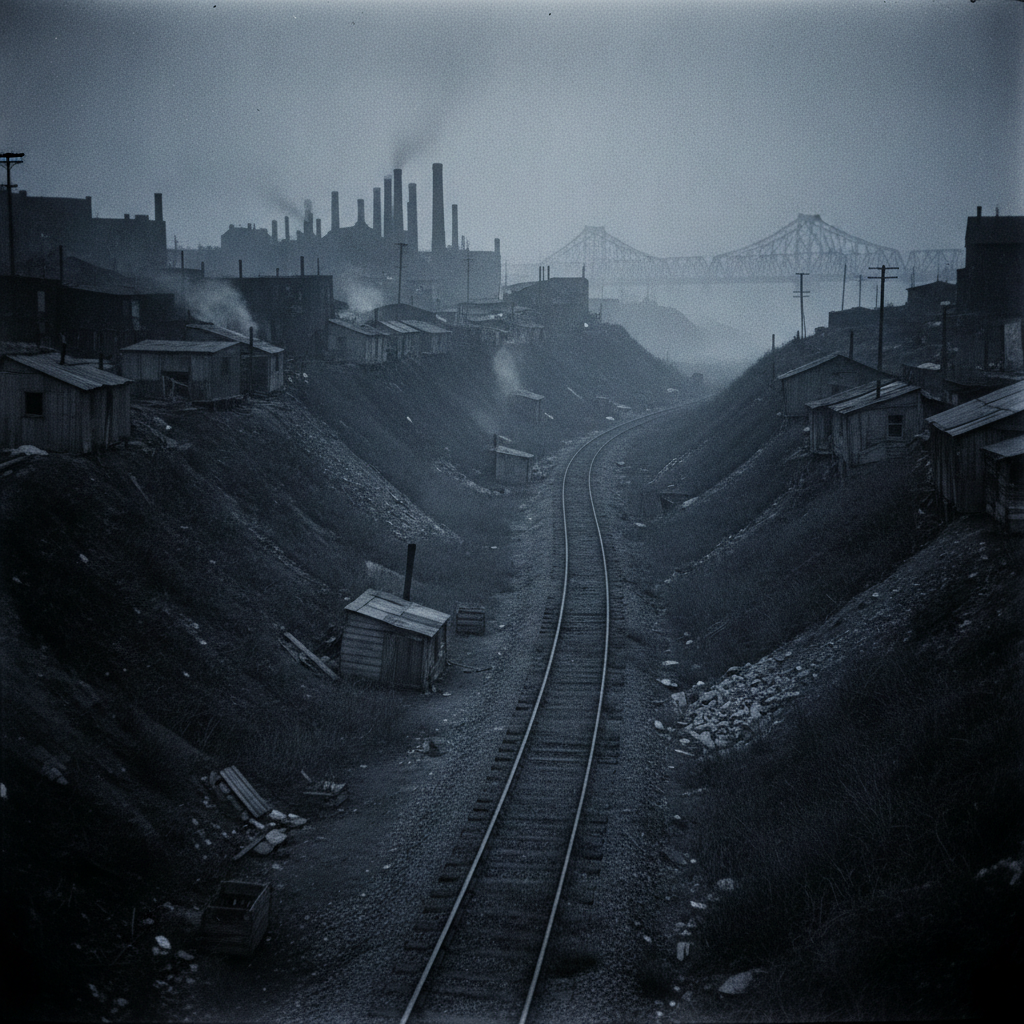
Kingsbury Run is a natural ravine that cuts through the east side of Cleveland, carrying railway lines down towards the Cuyahoga River. In 1935 it was a corridor of embankments, tracks, weeds and shanties, and the Depression had filled it with men who had nowhere else to be. It was the kind of place where a body could lie for weeks. Over the next three years the police would keep coming back to it.
Fingerprints identified one of the two men from Jackass Hill as Edward Andrassy, twenty-nine years old, known to the police and known in the neighbourhood. The other man was never identified and entered the file as John Doe I. That pattern held with brutal consistency. On January 26, 1936, parts of a woman were found in baskets behind a business on East 20th Street; fingerprints named her as Florence Polillo, and she remains one of only three victims anyone has ever been able to name. On June 5, 1936, two boys who had skipped school to go fishing found a pair of trousers rolled up under a tree on the east side. A man's severed head was tied inside them. The body turned up nearby, by the railway tracks.
That victim became the most famous of them, and the most frustrating. He was young, well nourished, and carried six tattoos, including the names Helen and Paul and the initials W.C.G. The police fingerprinted him, circulated descriptions across the country, and had a death mask made from his face. In 1936 that mask was put on public display at the Great Lakes Exposition on the Cleveland lakefront, together with drawings of the tattoos. More than a hundred thousand people are reported to have filed past it. Not one of them recognised him. Ninety years later he is still John Doe II, still the Tattooed Man.
The discoveries continued. On July 22, 1936, remains were found in the Brooklyn area of the city. Another victim was recovered from a stagnant pool near East 37th Street. On February 23, 1937, parts of a woman washed up at Euclid Beach. On June 6, 1937, a skeleton was found under the Lorain-Carnegie Bridge and tentatively identified as Rose Wallace, the third and last of the named victims, and even that identification has never been considered secure. On July 6, 1937, a man's remains came out of the Cuyahoga River. In the spring of 1938 a woman's remains came out of the same river. On August 16, 1938, two more victims were found on the same day, a woman at a dump on East 9th Street and a man on the lakefront within sight of the city's police headquarters.
The official count is twelve, seven men and five women, found between September 1935 and August 1938. Not every source agrees. Some investigators and writers put the figure at thirteen, and some add the so-called Lady of the Lake, a woman's partial remains washed ashore near Bratenahl on September 5, 1934, more than a year before Jackass Hill. Others go further and connect a headless man found in a railway boxcar at New Castle, Pennsylvania on July 1, 1936, and three headless victims found in boxcars at McKees Rocks in the same state on May 3, 1940. The disagreement is not trivial. It changes when the killing started, when it stopped, and whether it stopped at all.
What the twelve certainly shared was method. The victims were beheaded, often dismembered, in most cases with an evident and unhurried competence. The coroner, Samuel Gerber, took the view that whoever did this understood anatomy. In several cases the bodies had been drained of blood and washed. Where the killings themselves happened has never been established; no site was ever found. Most of the victims came from the drifting, transient population of the Run and the cheap rooming houses around it, people whose absence nobody was in a position to report.
The investigation ran for years. Detective Peter Merylo worked the case for six of them, following thousands of leads. The public safety director was Eliot Ness, then thirty-five and nationally famous for his work against organised crime in Chicago, and the torso murders were the one thing in Cleveland he could not solve. On August 18, 1938, two days after the double discovery, Ness led about thirty-five officers into the shantytowns of Kingsbury Run. The men living there were rounded up and fingerprinted, on the stated reasoning that the killer was drawing his victims from that population and that identifying its members would both protect them and help name the dead. Then, on Ness's order, the shacks were burned to the ground. It was the most heavily criticised act of his career. It also coincided with the end of the murders. No further victim was found in the Run.
In July 1939 the Cuyahoga County sheriff's office arrested Frank Dolezal, a bricklayer in his fifties who had known Florence Polillo. After days in custody he confessed to killing her. The confession contained errors, he retracted it, and he said he had been beaten. On August 24, 1939, he was found hanging in his cell. It was recorded as suicide. An examination afterwards found broken ribs he had not had when he was arrested. He was never tried and never convicted, and today almost no one who has studied the case believes he was the killer.
Conclusions and Open Questions
The case has one central suspect, and he was never charged with anything.
Dr. Francis E. Sweeney was a Cleveland physician with surgical training, a serious drinking problem, and a first cousin who sat in the United States Congress, Martin L. Sweeney, a political opponent of Ness. In 1938 Ness had Sweeney brought quietly to a hotel room and questioned for days. Leonarde Keeler, one of the developers of the polygraph, administered tests to him and reportedly concluded that he was the man. Sweeney did not confess. Shortly afterwards he committed himself to a veterans hospital, and from behind those walls he sent Ness taunting postcards for years, until Ness died in 1957. Sweeney himself died in Dayton, Ohio, on July 9, 1964.
The argument for Sweeney is that he had the anatomical skill the dismemberments suggest, the local knowledge, and a collapse in the timeline that fits: the killings in the Run stopped around the time he entered the hospital. The argument against him is that everything above is circumstantial. A failed polygraph in 1938 would not be admissible today and was not reliable then. Ness never brought charges, and researchers disagree about whether that was because the evidence was too thin or because prosecuting the congressman's cousin was politically impossible. Both readings are still defended, and neither has been proved.
The rival theory is that the connection to Sweeney is a story assembled after the fact, and that the killer was someone the investigation never touched. The strength of that view is the sheer number of leads Merylo pursued without result and the fact that similar killings appeared in Pennsylvania along the same rail lines, which suggests a mobile offender rather than a doctor confined to Cleveland. Its weakness is that it explains nothing about why the Cleveland killings ended when they did. A third possibility, argued by some, is that there was never one killer at all, and that the official twelve include the work of more than one person, which would explain the variations in method that have troubled every writer who has gone through the autopsy records.
What is not in dispute is the arithmetic of the naming. Three victims out of twelve were identified, and one of those three only tentatively. The other nine, six men and four women, were buried in unmarked graves in a potter's field at Memorial Park Cemetery in Highland Hills, and there they stayed for the better part of a century.
That is the part of the case that is now moving. In 2024 the Cuyahoga County Medical Examiner's Office began working with the DNA Doe Project to exhume the unidentified victims and attempt investigative genetic genealogy, the technique that builds family trees out of DNA matches until it arrives at a name. Two sets of remains were recovered in the first phase. The work is slow, the remains are old, and there is no guarantee of a result.
The killer is beyond any court now. The victims are not beyond identification. After eighty-eight years the open question about the torso murders is no longer only who did it, but whether the men and women who were found in the Run will get their names back before the evidence disappears altogether.