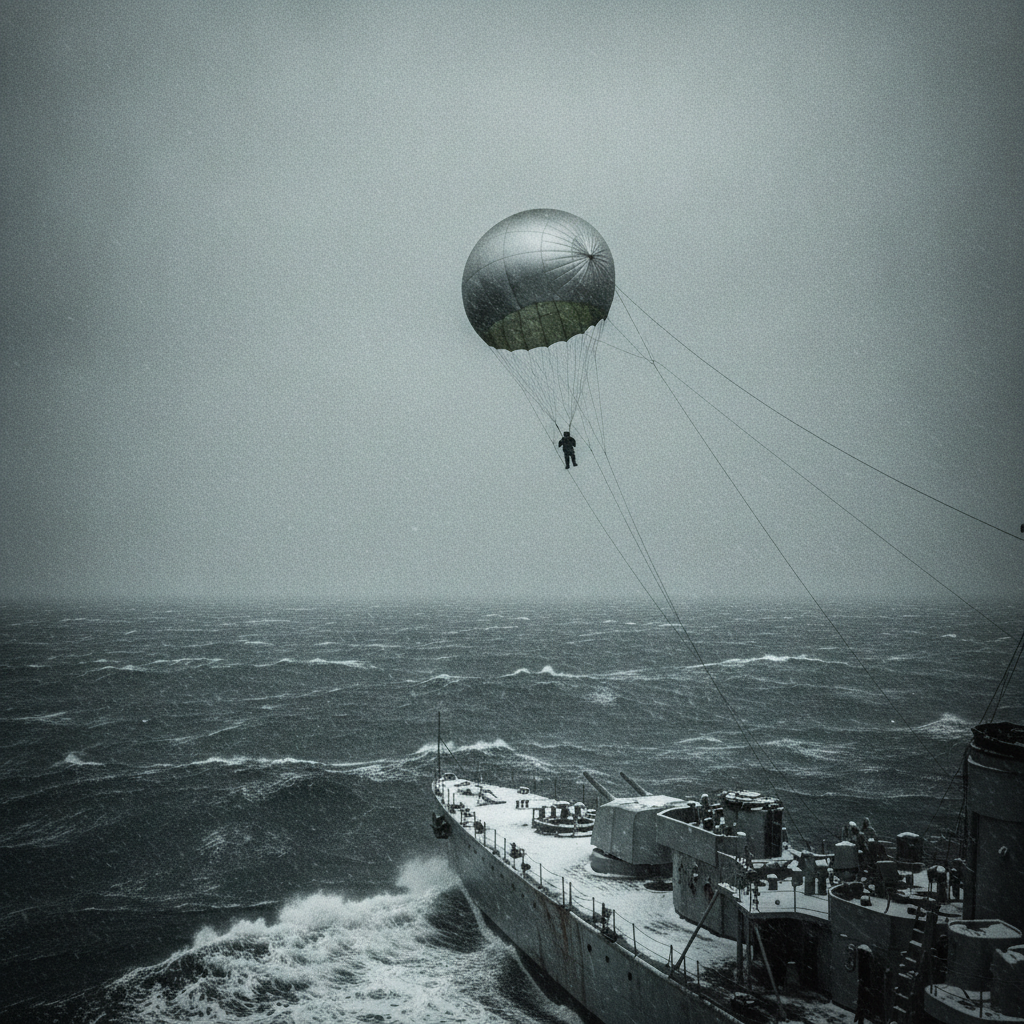
A Parachute in the Snow: the Last Flight of Amy Johnson
It was Sunday 5 January 1941, and it was snowing over the sea.
A line of wartime ships was moving slowly through the Thames Estuary, the wide mouth of the river that runs through London, about 85 km east of the city. The water was rough. The tide was strong. The cold was the kind that kills a person in the water within minutes.
Then the sailors on deck saw something coming down out of the cloud. A parachute.
It landed in the sea. Someone was in the water, alive, calling for help. Several men who heard the voice said afterwards that it was a woman's voice.
The nearest ship turned towards her.
Who she was
The woman was Amy Johnson. In 1941 almost everyone in Britain knew her name.
She was born in 1903, the daughter of a fish merchant in the north of England. She learned to fly in her twenties, at a time when very few women did.
In May 1930 she did something nobody had done before. She flew alone from England to Australia, in a small, open, single-engine biplane. The trip was about 18,000 km and took her 19 days. She was the first woman ever to make that flight.
She became a national celebrity. Crowds met her. Songs were written about her. Over the following years she set more long-distance records, including flights from London to the southern tip of Africa.
She married another well-known pilot. The marriage was unhappy, and they divorced in 1938.
When the Second World War began, she joined a civilian service that ferried military aircraft around Britain. Its pilots did not fight. Their job was to take new or repaired aircraft from factories and workshops and deliver them to air force bases. It was hard, often dangerous work, flown in all weather.
The last flight
In early January 1941 she was given a delivery job. She had to fly a twin-engine training aircraft from Scotland to an air base near Oxford, in the south of England.
The weather was bad. She broke the journey and spent the night in Blackpool, a seaside town on the north-west coast of England.
On the morning of 5 January she took off again from Blackpool. The base near Oxford was about 250 km away, to the south-east. For an aircraft of that type, it was a short trip.
The cloud was thick. According to the accounts of her last day, she was flying with a compass she did not trust, and the weather was getting worse.
Somewhere along the way she climbed above the cloud. Above it, there was nothing to see but a white floor stretching in every direction. No towns, no rivers, no coast.
What happened in the next hours is not recorded anywhere. No witness has ever described seeing her aircraft along the way.
About 5 hours after she took off, the convoy in the Thames Estuary saw her parachute.
By then she was not near Oxford at all. She was over the sea, roughly 170 km east of the base she was meant to reach.
The most widely accepted explanation is simple. She was lost above the cloud, flew on until the fuel ran low, and jumped.
The rescue
The ship that turned towards her was an old passenger ferry, taken over by the navy for the war. It was serving in the convoy as a balloon ship, flying a large barrage balloon to keep enemy aircraft from diving low.
The crew came as close as they could in the heavy sea. They threw ropes towards the figure in the water. The ropes landed near her, but she could not hold on to them. She seemed too cold or too weak.
Then the ship's stern rose on a wave, and she disappeared beneath it.
The ship's captain did something remarkable. He dived into the freezing sea himself.
He swam to something floating in the water. Some of the men watching thought it was a body wearing a flying helmet. He held on to it for a few minutes. Then he let go.
A lifeboat was lowered. When it reached him, he was unconscious.
He was taken to hospital. A few days later he died from the effects of the cold. In May 1941 he was awarded, after his death, one of the highest British medals for bravery in saving life.
What was found, and what was not
**Amy Johnson's body was never found. From this point on, everything about how she died is uncertain.**
Some things did come back out of the sea. Her waterproof flying bag washed up near the place where she had come down. So did her logbook and her chequebook.
Several witnesses on the ships believed they had seen a second body in the water, not just one. This has never been explained.
The aircraft itself was never officially recovered.
Her name was later carved on the memorial at Runnymede, west of London. It honours more than 20,000 airmen and airwomen of the Second World War who have no known grave.
For decades, that was where the story stopped.
A voice from 1999
In 1999, 58 years after the crash, an elderly man told a Scottish newspaper something he said he had kept to himself all his life.
In 1941, he said, he had served in an anti-aircraft gun crew on the coast. An aircraft had appeared and was asked for the correct identification code, the signal that told the guns it was a friendly plane.
According to his account, the pilot gave the wrong code twice. The guns opened fire. 16 shells were fired, and the plane dived into the estuary.
He said the crew believed they had shot down an enemy aircraft. The next day, they read in the papers that Amy Johnson had been lost. Their officers, he said, told them never to speak about it.
His story has never been confirmed by any official record. No document has been produced to support it.
The propellers, and a piece of the plane
In 2016 a British historian reported another account. The son of a man who had served on the rescue ship said that his father believed Amy Johnson had been drawn into the ship's propellers as the stern rose and fell.
His father did not see this happen himself. It was what he believed, and what he told his family.
Then, in 2024, a piece of the aircraft surfaced in a family home.
A man in North London put up for auction a fragment of a door. It had belonged to his uncle, who in 1941 was a sailor on a small navy escort ship in the same waters. The uncle had always said that during the rescue attempt he scooped the piece out of the sea and put it in his pocket.
The uncle's navy service records confirm that his ship was at the crash site.
The piece is believed to be part of the parachute exit door, the door Amy Johnson would have used to jump. It sold in February 2024 for GBP 2,800 before fees, to a museum of Second World War aviation in Kent.
It is thought to be the only piece of her aircraft that still exists.
Where the story ends
So this is what is known. On 5 January 1941 Amy Johnson took off from Blackpool for a short delivery flight. About 5 hours later she came down by parachute into the sea, far to the east of where she should have been. A convoy saw her, a ship tried to save her, and its captain died trying. Her bag and papers washed ashore. She was never seen again.
What is not known is why she flew so far off course, whether she was alone in the water, and exactly how she died.
Conclusions and Open Questions
There are 4 main explanations. Each answers part of the mystery. None answers all of it.
**She was lost above the cloud and ran out of fuel.** This is the view of the Royal Air Force Museum, and the most widely accepted one. The weather was bad, the compass was suspect, and she was flying above a solid layer of cloud with no way to see the ground. 5 hours is far longer than the flight should have taken. The problem: it explains why she came down, but not the second body some sailors were sure they saw.
**She was shot down by British guns.** This rests on the account of one veteran, published in 1999. The problem: it was told 58 years after the event, by one man, with no document behind it. It also does not explain how she managed to come down by parachute, in one piece, if her plane had been hit.
**She was drawn into the propellers of the rescue ship.** This would explain why her body was never found. The problem: it is a second-hand account, passed from a father to his son. No one has said they saw it happen.
**There was someone else in the water.** Several witnesses said so, and the captain swam to something that looked like a body in a flying helmet. The problem: no record of any passenger on her flight has ever been produced. The "second body" may have been her bag, wreckage, or Amy Johnson herself seen twice in heavy waves.
Some questions remain open, and may stay open for ever.
Why did a pilot with her experience end up about 170 km past her destination, over the sea?
What did the sailors really see in the water that day?
And where did the woman who once flew alone across half the world finally come to rest?
In 2016 a statue of her was unveiled on the Kent coast, facing the sea, close to the place where she was last seen alive.