The Family in the House on Edgemoor: Thirty-One Years, and the Killer Mailed the Answer Himself
Julie Otero drove her children to school on the morning of 15 January 1974, the same as every other morning.
She was thirty-three. Her husband Joseph was thirty-eight, a retired Air Force man who had moved the family to Wichita from Panama a few months earlier and taken work as a flight instructor. There were five children. That morning the three eldest went to school and the two youngest stayed home: Joey, who was nine, and Josephine, who was eleven and went by Josie.
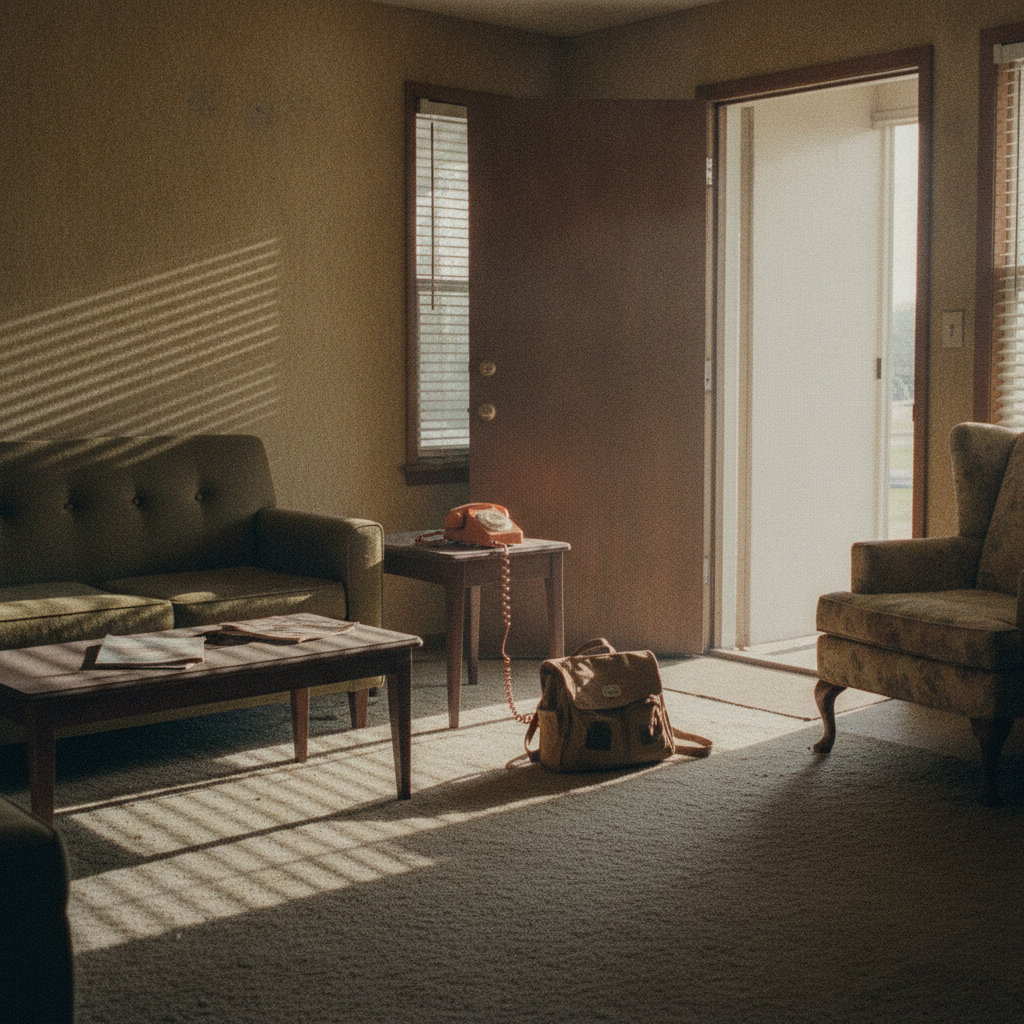
At around a quarter to four in the afternoon, the older children came home. The house on North Edgemoor Street was quiet. Their father was on the bedroom floor. Their mother was on the bed. Joey was in his own room. Josie was in the basement.
The family dog had been put outside. The telephone line had been cut. Nothing of value had been taken.
What none of them could have known, and what would only be established thirty-one years later from the killer's own mouth, is that the man responsible had chosen them two months earlier. He had watched Julie taking the children to school. He had decided on the house, learned the routine, and waited for a morning when the ratio of adults to children in it suited him.
A name he gave himself
The Wichita police had no fingerprints they could use, no witness who had seen a face, and no obvious motive. Robbery had not happened. There was no connection between the Oteros and anyone known to police.
In October of that year, a caller directed a newspaper employee to a specific engineering textbook in the Wichita Public Library. Tucked inside was a letter. It described the Otero scene in detail that had never been released to the public, which is what made it credible, and it complained that the police were looking in the wrong direction. Near the end, the writer proposed a name for himself, based on what he said was his method: bind them, torture them, kill them.
BTK.
He wrote again in 1978, after two more murders, and complained that he was not getting the attention he deserved. He asked how many people he had to kill before he got a name in the papers.
That letter told investigators something they should have weighted more heavily than they did. This was a man for whom being known was part of the point. It was also, in the end, the only thing about him that could be used.
What the scenes had in common
By the time the letters started, detectives could see a method, and the method was the most useful thing they had.
He did not break in violently. He came in through a door or a window he had already inspected, often after cutting the telephone line first, so that the house was severed from the outside before anyone inside knew there was a reason to call. He brought his own materials with him - cord, tape, plastic bags - which meant every visit had been planned in advance rather than improvised. He controlled his victims by talking to them, telling them he only wanted a car or money, keeping them cooperative for as long as that was useful to him.
And he took small objects afterwards. Not valuables. Personal items - a driver's licence, jewellery of no worth, photographs. Investigators understood these were kept, which meant that somewhere in Wichita there was a container of them in a house nobody had searched.
The other thing the scenes shared was daylight discipline. Several of the attacks happened in the middle of the day, in ordinary residential streets, in houses with neighbours on both sides. A man who does that either takes enormous risks or has a reason to be seen on a street in the middle of a working day without anyone thinking about it.
That second possibility was in the file the entire time. Nobody built a case around it.
The years of nothing
Then the killings appeared to stop, and the file went cold in the most complete way a file can.
The problem was not effort. In the mid-1980s a dedicated unit was formed, known inside the department as the Ghostbusters, and it worked the case for roughly three years using everything that existed at the time: early DNA work, computerised database searches, psychological profiling from the FBI's behavioural unit. They compiled lists of men who fit the profile. They ran down tips. They found nothing, and the unit was wound down.
Read the reasons together and the shape of the trap becomes clear.
There was no physical evidence that pointed anywhere. Fingerprints existed at some scenes but matched no one on file, and the man had never been arrested for anything, so his prints were not on file and never would be.
There was no eyewitness. Nobody who saw him survived.
And his rhythm broke the model. Serial offenders are profiled partly on frequency, and the assumption in the 1970s and 1980s was that a man like this kills often and escalates until he is caught or stopped. This one went years between crimes. He killed in 1974, and again in 1977, and again in 1985 and 1986 and 1991. The gaps were long enough that investigators repeatedly concluded he must be dead, imprisoned for something else, or moved away. All three assumptions were wrong. He was at home in Wichita the entire time.
He had a wife and two children. He worked as an installer of home security alarms, which put him inside strangers' houses legitimately and taught him how their locks failed. Later he became a compliance officer for the city, the man who measured the height of your grass and cited you if your dog was loose. Neighbours found him officious and unpleasant. He was president of the council at his Lutheran church and a Cub Scout leader.
He was, in other words, exactly the kind of man nobody looks at.
The letter that started the countdown
In March 2004, the Wichita Eagle received an envelope containing photocopies of photographs taken at a 1986 murder scene, along with a photocopy of the victim's driver's licence.
The case had been cold for thirteen years. After twenty-five years of silence, BTK had started writing again.
Nobody knows for certain why. He was fifty-nine years old, and a local reporter had recently published a piece on the thirtieth anniversary of the Otero murders which described the case as unsolved and, by implication, the killer as forgotten. It is a reasonable inference that this stung. It is not a proven one, and it is worth saying so.
What followed over eleven months was a correspondence: packages left in parks, taped to signs, dropped in a Home Depot parking lot, addressed to newspapers and television stations. They contained trophies from the crimes, puzzles, drawings, chapters of an autobiography written in the third person.
Lieutenant Ken Landwehr, who ran the investigation, made a decision that decided the case. Instead of treating the letters as taunts to be endured, he treated the writer as a man with a need, and set out to meet it. He held press conferences addressed, in effect, to one viewer. He used the name BTK respectfully. He answered questions the letters had asked. He built, deliberately, the appearance of a dialogue between equals.
It should be said plainly that this was a gamble, and that it was criticised at the time. Every package was a message from a man describing what he had done to people whose families were still in that city, and the police were on television being courteous to him. There were officers who thought it was grotesque. There were relatives who found it unbearable to watch.
Landwehr's calculation was that the alternative was worse. Twenty-five years of correct, distant police work had produced nothing at all. The man had come back on his own, and the only question that mattered was whether he could be kept talking long enough to make a mistake. Silence from the police would end the correspondence, and the correspondence was the entire case.
There was a second risk, and it was heavier. A man in that state, receiving that much attention, might not be content with letters. Investigators knew that engaging him could escalate him. They went ahead anyway, and they were fortunate that nobody died while they were doing it.
In one of his packages, the writer asked whether a floppy disk could be traced back to him. He wanted an assurance.
Landwehr went on television and gave him one. He said it could not be traced.
That statement was false.
Sixteen days
On 16 February 2005, a padded envelope arrived at television station KSAS. Inside was a purple floppy disk.
Forensic examiners opened the deleted document it contained and read the file's metadata - the invisible record a word processor keeps of who created a document and where. Two things were in it. The document had last been modified by a user named Dennis. And it had been saved on a computer registered to Christ Lutheran Church.
An investigator searched the church's website. The president of its congregation council was named Dennis Rader.
They still needed proof. A judge granted a warrant for a tissue sample his daughter had left at a university medical clinic years earlier. Her DNA was compared with the DNA recovered from the crime scenes. It was not a match to her - it was a familial match, the profile of a close relative. A father.
Dennis Rader was arrested on 25 February 2005, nine days after he mailed the disk, while driving near his home. He was sixty years old.
The city learned who he was from the television, the same as everyone else. People who had sat in pews behind him for years, whose children he had led on camping trips, whose grass he had measured, watched the name come up on the screen. Several of the surviving Otero children were adults by then with children of their own; they had waited thirty-one years to be told, and were told by a news broadcast.
He confessed comprehensively, in a courtroom monologue that lasted most of a day, and described each of the ten killings in a flat administrative voice that disturbed everyone who heard it. He corrected the prosecutor on dates. He used the word "projects" for the murders and appeared, at moments, to be enjoying the precision of his own account. In August 2005 he was sentenced to ten consecutive life terms. Kansas had no death penalty in force for crimes committed in those years.
Conclusions and Open Questions
The case is often told as a story about technology - the metadata on a floppy disk that a man did not know existed. That reading is true and incomplete.
The disk mattered because he sent it, and he sent it because a detective spent eleven months persuading him it was safe. The investigative work was not forensic. It was the decision to stop treating a killer's vanity as an insult and start treating it as the only weakness he had. That decision is the reason there is a conviction, and it is not a technique that can be reduced to a procedure.
**Why did nobody look at him?** This is the question the case leaves hardest. He lived in Wichita for the entire thirty-one years. He had been inside houses professionally as a security installer, precisely the trade a competent investigator would think to check. He had a documented history of cruelty to animals as a young man. He drove city streets in a uniform with a clipboard. And he wrote letters full of specific local detail. Yet the profile the FBI produced pointed at a loner, and Rader was a married father, a church officer, a Scout leader. He did not fail to match the profile in every respect - but he matched it badly enough, in the respects most visible to a neighbour, to stay invisible.
**Would he have been caught if he had stayed silent?** Almost certainly not. His DNA was not in any database and would not have been - he had never been arrested. There were no witnesses. The evidence sat in boxes for a quarter of a century without producing a single viable suspect. The honest conclusion is that the police did not find him. He walked out to them, over eleven months, and even then it took a specific technical detail he did not understand to close the distance.
**And why after twenty-five years?** He has given answers, and they should be treated cautiously, because he is a man who has spent his life constructing a version of himself for an audience. He has said he wanted recognition. He has said he was bored. Investigators who dealt with him believe he could not tolerate being forgotten while he was still alive to notice. That is plausible and unprovable, and it belongs in the category of things we understand about him only through what he chose to tell us.
What is not in doubt is the arithmetic. Ten people died. Thirty-one years passed. And the thing that ended it was not a fingerprint, or a witness, or a database - it was that the man could not bear for the story to be over while he was still in it.