The Poisoning of Charles Bravo: 3 Days Dying, and Never a Word About Who Did It
On the evening of Tuesday, 18 April 1876, Charles Bravo came home shaken.
He was 30 years old, a barrister in London, England: a lawyer who argues cases in court. That day, on his way back from work in the city, the horse under him had bolted. He got it under control, but he reached home pale and stiff, sometime between 6 and 7 in the evening. He went straight into a long hot bath.
Home was a large house called the Priory, in Balham. Balham was then a quiet and wealthy suburb on the southern edge of London, beside an open common.
He had been married for 4 months.
His wife, Florence, was not well. A few days earlier she had lost a pregnancy. It was the second time since the wedding.
That morning the couple had quarrelled in their carriage. At one point Florence told the driver to turn back home. Her husband talked her into going on.
After his bath the household sat down to dinner: Charles, Florence, and Florence's paid companion, a widow who also ran the house.
The cook served roast lamb and poached eggs on toast, among other dishes. Charles drank 3 or 4 glasses of burgundy, a red wine. The two women did not touch it.
During the meal a letter arrived from his stepfather, with a report from a stockbroker. It showed money lost on the market. According to one account, it made him furious.
After dinner they sat for about 30 minutes in the morning room. Florence was still weak, and Charles told her to go up to bed. The companion went up with her.
Charles stayed downstairs alone until about 21:15.
The last minutes
On the stairs he passed a young housemaid. She was carrying a glass of wine up to Florence.
She later told the police that he looked pale. He looked at her twice, and said nothing.
He went into his wife's bedroom. In French, so the servant would not understand, he accused her of drinking wine all day. She did not answer. He went to his own room.
Since Florence's illness the couple had been sleeping apart. That night the companion slept in Florence's room.
In his bedroom, by his own later account, Charles rubbed a little laudanum into his gums. Laudanum was a common medicine of the time, opium dissolved in alcohol. He used it against pain in his jaw.
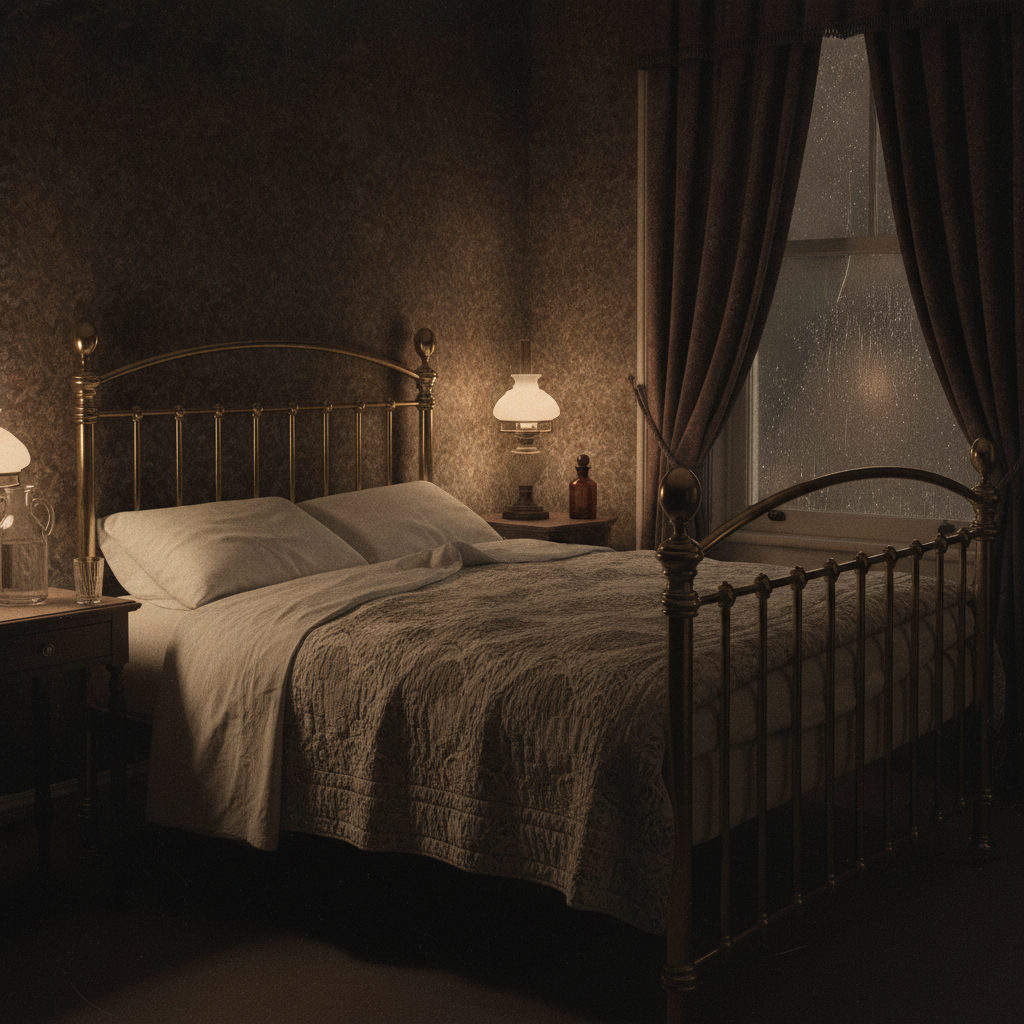
Then he drank water from the jug that stood by his bed.
Within minutes he was at his door, shouting for hot water.
The night of the doctors
The housemaid heard him and ran to the companion.
Charles was vomiting. He vomited out of the window onto the roof below, and then into a basin. The companion had the basin taken away and washed.
She mixed mustard into water and gave it to him to drink, to make him vomit more. She put his feet and hands into hot mustard water. Then she sent a servant for Florence's own doctor, who lived in a neighbouring district.
Florence woke up. When she understood how ill her husband was, she sent for the nearest doctor as well, from Balham itself.
That doctor arrived at about 22:30. By then Charles was unconscious. Florence's doctor arrived soon after.
Both suspected poison from the start. At their request Florence sent to central London for a relative of Charles, a surgeon from Harley Street, the street of the city's leading doctors. He arrived at 02:30 in the morning, together with a senior physician.
It was then that the companion told the doctors something new. She said that when she first reached him, Charles had told her: "I have taken poison. Don't tell Florence."
3 days
About 2 hours after the doctors began treating him, Charles woke up.
He stayed conscious, and mostly clear in his mind, for the next 2 days.
The doctors asked him again and again what he had taken. Every time he gave the same answer: only the laudanum, rubbed into his gums. Laudanum could not explain what they were seeing.
He was in great pain. On Wednesday, 19 April, he dictated a will to his relative, the surgeon. He left everything to his wife. He also asked her to be kind to a little girl he had fathered before the marriage.
On the afternoon of Thursday, 20 April, the most famous doctor in England came to the house: one of the queen's personal physicians. He stayed at the bedside for 2 hours.
He told Charles plainly that he was dying, and that he must say what he had taken. Charles gave the same answer: laudanum, and nothing else.
Later the royal physician gave his impression under oath. The man in the bed, he said, did not behave like someone who thought he was being murdered.
Florence suggested calling a priest. Charles refused. His family said the Lord's Prayer at his bedside.
Charles Bravo died at 5:30 in the morning on Friday, 21 April 1876. He had suffered for about 54 hours.
In all that time he never said how the poison had reached him.
What the body showed
A doctor carried out the post-mortem. A professor of chemistry analysed the stomach and the vomit that had been collected from the roof.
The result was clear. Charles had swallowed between 1.3 and 2.6 grams of antimony, in the form of a salt called tartar emetic. A London weekly reported at the time that the dose found was enough to kill 10 people.
Tartar emetic was a white powder that dissolves in water and has almost no taste. Doctors gave tiny amounts of it to make patients vomit. Grooms used it on horses.
According to one account, no antimony was kept anywhere in the house.
Most accounts of the case conclude that the poison was in the water he drank in his room.
**This is the point on which the whole case turns: a large dose of poison got into the water by his bed, and from here on no one has ever been able to prove who put it there, or whether he did it himself.**
Who was in the house
To understand the suspicion, you have to know the people who lived at the Priory.
Florence came from a very wealthy family. Her father had made his fortune in Australia.
At 19 she married a young army officer. He drank heavily and beat her. She left him, and in 1871 he died, in a hotel in Germany. She inherited a large fortune from him.
Then she began a love affair with a famous doctor. He ran a fashionable water-cure clinic, and he was nearly 40 years older than her. He was married, though he had lived apart from his wife for decades. The affair was a scandal, and her own family cut her off over it.
The affair ended when she agreed to marry Charles, in December 1875. But the elderly doctor still lived nearby.
A law passed in 1870 let a married woman keep her own money. Florence kept hers. For Charles, a lawyer with debts and a modest income, this was a constant source of anger. He pressed her to cut costs: fewer servants, fewer horses.
One of the people he wanted to cut was the companion. She was a widow with 3 young sons, and she lived on the money Florence paid her. In the weeks before his death Charles had wondered aloud whether they could still afford to keep her.
And there was one more person: the coachman. Soon after the wedding Charles dismissed him, for careless driving according to one account. The coachman used tartar emetic in his work, on the horses. In December 1875, in a London pub, he was heard to say of his new master that he would not live 4 months.
Charles died 4 months later.
The first hours were lost
Now the investigation. It started badly, and much of what could have answered the question was gone before anyone looked for it.
The basin he had vomited into was washed that same night. The glass by his bed was emptied. The wine bottles from the last dinner were washed.
A senior detective from Scotland Yard, the headquarters of the London police, took charge. He searched the house. He found no antimony anywhere. He found laudanum, and he found chloroform, another drug Charles used against pain in his face.
He collected 13 empty wine bottles. 4 more had already been sent back to the wine merchant.
According to one account, the police did not question Florence or her companion until 8 days after the death.
The detective spent weeks interviewing the household and everyone around it. He built a timeline of the evening, minute by minute. In the end he wrote that nothing had been found to show by what means the dead man had met his death.
The first inquest
In England, a sudden and unexplained death went to an inquest: a hearing before a coroner and a jury, to decide how the person died.
The first inquest opened on 25 April 1876, 4 days after the death. It was held at the Priory itself, in the dining room, at Florence's request. Refreshments were served to the jury.
Florence was not called to give evidence.
The jury agreed that Charles had been poisoned, but could not say how. Most sources call this an open verdict. One source calls it a verdict of misadventure, meaning an accident.
The case could have ended there. It did not.
The pressure grows
Charles's family did not accept that he had killed himself. His stepfather and his friends insisted he was not that kind of man.
One of the doctors who had sat by his bed spoke to the press. He said that in his opinion Charles had not knowingly taken poison.
The newspapers seized on the story. Every week brought new rumours about the rich young widow, her companion and the old doctor.
On 2 June both women gave new written statements to their lawyers. In hers, the companion changed her account. She now said that Charles had told her he had taken the poison "for" the elderly doctor, meaning because of Florence's affair with him.
This turned a quiet family tragedy into a national scandal.
The government's chief law officer, the Attorney General, went to the High Court. On 19 June the court cancelled the first inquest and ordered a new one.
The second inquest
The second inquest opened on 11 July 1876. The Priory was not big enough this time. It was held in the billiard room of the Bedford Hotel, a large pub in Balham.
It ran until 11 August, a full month. Sources differ on how many days it actually sat; most say 23. More than 40 witnesses gave evidence.
The companion was questioned for 5 days. Her story kept shifting. At one stage she said Charles had confessed to taking the poison himself. Later she said he had denied it.
When Florence's turn came, women and children were ordered out of the room.
A lawyer for the Bravo family questioned her closely about the affair with the elderly doctor. She admitted it. She broke down in tears 3 times, and appealed to the coroner to protect her from the questions.
She said she did not believe her husband had taken his own life. She also admitted that by the end she no longer loved him.
The elderly doctor gave evidence too. He did not deny the affair. He denied having anything to do with the poison.
The former coachman was called as well. Asked about his prediction in the pub, he said it had been based on a rumour that Charles had been bitten by a dog.
The newspapers printed every word. One leading paper called Florence an adulteress and a drunk.
What the jury decided
On Friday, 11 August 1876, the jury gave its verdict.
Charles Bravo had not killed himself. He had not died by accident. He had been wilfully murdered, with tartar emetic.
But, the jury said, there was not enough evidence to fix the guilt on any person or persons.
No one was ever arrested. No one was ever charged. In law, every person connected to the case died innocent.
Where it stands
The case was never solved, and it never will be in a court. Everyone involved has been dead for more than 100 years.
The reasons were plain even then. The basin, the glass and the bottles were washed before the police arrived. No one ever found where the poison came from, or saw anyone buy it. The only words Charles spoke about it, "I have taken poison", reach us through a single witness, the companion, who changed her account more than once.
And the victim himself, conscious for 2 days and questioned by 6 doctors, never explained.
What happened afterwards to the people in the house is known.
Florence had the furniture sold at auction and left the Priory. In April 1877 she moved to Southsea, a seaside town on the south coast of England, under her husband's birth surname, Turner. She drank heavily, and died there in September 1878, at 33. Sources give the date as either 17 or 24 September.
The elderly doctor lost his standing in society and in medicine. He died in 1883.
The companion went back to Jamaica, where she had family property, and later returned to England. She died in 1913.
The suspects and the theories
These are theories, taken from the documented record. None was ever proven. None of these people was ever charged with anything, and each of them is presumed innocent.
**Florence did it.** She had a motive: a husband who was harsh with her, who wanted control of her money, and with whom she had lost 2 pregnancies in 4 months. A British writer argued this in a 2001 book, "Death at the Priory", and suggested she feared yet another pregnancy. The problem: nothing ever linked her to the poison, and the jug was in his room, not hers.
**The companion did it.** She was about to lose her home and her income. She had the run of the house. She had the basin washed, and her story changed in ways that pushed suspicion toward Florence. The problem: no one ever found antimony in her hands. The case against her rests on her behaviour, not on evidence.
**The elderly doctor did it.** He was still in love with Florence, and as a doctor he knew poisons. By one account, the crime novelist Agatha Christie suspected him. The problem: he was not in the house that night. And a doctor would hardly choose a poison so easy to detect.
**The dismissed coachman did it.** He had a grudge, he used tartar emetic on horses, and he predicted the death. The problem: nothing placed him in the house, and the police soon dropped the idea.
**Charles killed himself.** The police and the first coroner leaned this way at first. The problem: he showed no sign of planning to die, and no one who wanted to die would choose such a slow and painful poison.
**It was an accident.** One version, offered in the BBC documentary-drama series "A Most Mysterious Murder", holds that the bottles of laudanum and of antimony could have looked alike. A darker version, raised by some later researchers: Charles himself had been secretly giving Florence small doses of tartar emetic, and that night he swallowed a large dose by mistake, or took it believing it was a harmless remedy to make himself vomit. The problem: there is no direct evidence that he ever bought the poison or gave it to anyone.
150 years later, the question is the same one the jury faced in 1876. The poison was in the water by his bed. No one has ever shown who put it there.