The Kaikoura Lights: A TV Crew Went to Film an Empty Sky, and the Lights Came Back
It was a few minutes before midnight on 30 December 1978, and a cargo plane was climbing out of Wellington, the capital of New Zealand.
It was an old four-engine freighter. Every night it carried the next morning's newspapers south along the coast. Tonight it carried something else as well: a television crew.
The crew had come from Melbourne, in Australia. They were there to film background shots for a news report. The report was about something that other pilots had seen from this same route 10 days earlier.
Nobody on board expected to see anything.
Within an hour, the captain was calling air traffic control about lights outside his window. And the cameraman was filming them.
This is the case the New Zealand press named the Kaikoura Lights. Kaikoura is a small coastal town on the east side of New Zealand's South Island, roughly halfway between Wellington and Christchurch. On 2 nights in December 1978, pilots flying past it reported bright lights that seemed to follow their aircraft. Radar controllers on the ground said they saw targets too. On the second night, the lights were filmed.
The film still exists. The radar reports still exist. What nobody has ever been able to prove is what the lights actually were.
The first night
To understand that flight, we have to go back 10 days, to the early hours of 21 December 1978.
A cargo plane from the same company was flying the same night route down the coast. It was an Argosy, a large and slow propeller freighter built in Britain.
Off the Kaikoura coast, the 2 pilots saw lights they could not explain. The captain described a bright red glowing light out to the left of the plane.
He radioed Wellington. In the control centre there, a radar controller was watching his screen. He told the pilots he could see targets near their plane. According to what he said later, one of them was as strong on his screen as the aircraft itself.
The lights came and went over a long stretch of the flight. People living along the coast below also reported strange lights that night.
The pilots reported what they had seen. Within days the story had reached the newspapers in Australia.
A camera crew goes to film the sky
A television station in Melbourne decided to make a report about it. Its reporter happened to be in New Zealand. The station sent a cameraman and a sound recordist to join him. A journalist from New Zealand's own television network came along too.
The plan was simple. They would ride the newspaper run, on the same route as the sighting, and film the view from the cockpit.
The plane took off from Wellington late on 30 December, with a new captain and co-pilot at the controls.
The lights come back
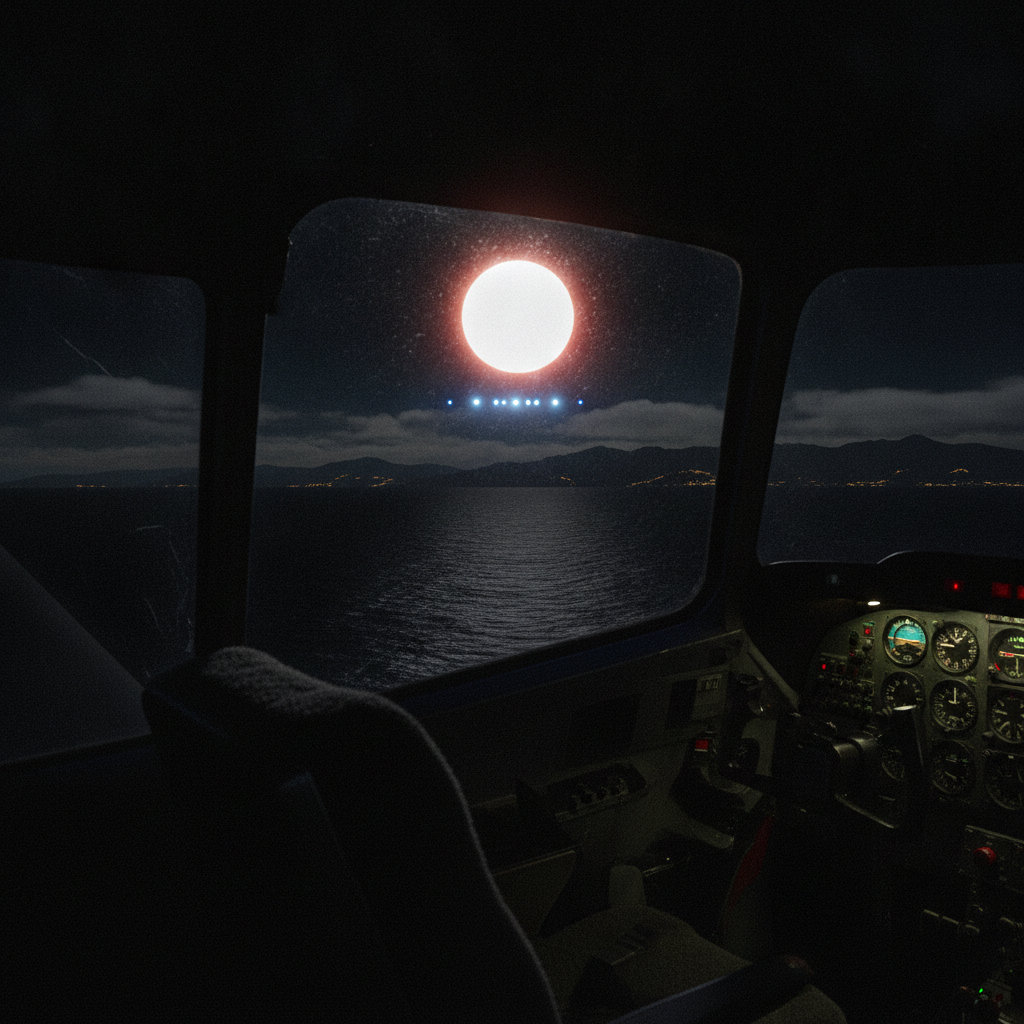
As the plane came level with the Kaikoura coast, the crew saw lights.
The captain later described a huge, bright white light with a red tinge that seemed to keep pace with the plane. Other, smaller lights appeared and disappeared.
The cameraman started filming. He was using a 16 mm film camera, the standard kind for television news at the time. He had to film through the cockpit windows, which were thick and curved.
The captain called Wellington. Once again, the radar controller there said he could see targets in the area of the plane. For many minutes the pilots and the controller talked back and forth.
The plane landed in Christchurch as planned.
The second leg
At 2:16 in the morning of 31 December, the Argosy took off from Christchurch again, this time heading back north.
Soon after take-off they saw it again. This time it was a line of 5 small bright lights and, near them, what looked like a large glowing ball.
The plane had its own radar in the nose. According to the crew, it showed a strong return in the same direction as the big light.
The light stayed beside the plane for almost a quarter of an hour. On the sound track, the reporter can be heard trying to describe what he sees. At one point he says: "Let's hope they're friendly."
Then the light fell behind, and the plane landed safely before dawn.
The film goes around the world
Within days, the film was on television in Australia and New Zealand. Soon it was shown in other countries as well.
According to reports from the time, New Zealand's prime minister asked to be briefed on the investigation personally.
What the investigators did
The government handed the case to its science agency, the Department of Scientific and Industrial Research. The air force, the police and the national observatory in Wellington also looked into it.
The scientists had 3 things to work with: what the witnesses said, what the radar showed, and the film.
They started with the film. Much of it was blurred and distorted. The scientists showed that part of this came from filming through the thick cockpit glass. They reproduced some of the same strange shapes simply by shining a torch through an aircraft window.
A second film, from New Zealand's own television network, was clearer, because it had not been shot through glass. The scientists converted it into computer data to remove the distortions.
Then the radar. According to the documents released later, both Wellington and Christchurch recorded radar signals during the period of the sightings. The scientists said these signals did not line up with what the pilots, or the people on the ground, said they saw. They pointed out that the weather that month could bend radar beams and create false echoes.
The sources disagree on one detail: some accounts say the Christchurch radar saw nothing while the lights were being filmed.
In January 1979, New Zealand sent a briefing on the case to the United Nations. It was declassified decades later. It said the lights should be treated as "UFOs until identified", and that the chance of anything from outside Earth being involved was "extremely remote". It suggested the lights might be no more than a general glow on the horizon, perhaps from Jupiter or Venus.
When the official summary was released to the press later in 1979, it said the lights were most likely natural but unusual effects. It named 2 likely candidates: a fleet of Japanese squid-fishing boats working off the coast near Christchurch, and the planet Venus, which was unusually bright that month.
**This is where the documented record stops. The film, the radar signals and the witnesses' words are real. What the lights were has never been proven.**
Conclusions and Open Questions
Several explanations were offered. Each one explains part of what happened. None explains all of it.
**The lights were squid-fishing boats.** Squid boats hang rows of very bright lamps over the water at night to draw the squid to the surface. In 2000, a scientist from the same government agency went back to the film frame by frame. He said the big "ball" was really several parallel rows of separate lights. He estimated they were about 6 km from the plane, on boats 20 to 25 m long, with lamps 2 to 3 m apart, exactly like the lamp rigs of squid boats. The strange movement, he said, came from the zoom lens and the plane's own motion. The problem: the crews always rejected this. The pilots said they were flying at around 4,000 m for much of the trip, and they knew what boats look like from the air. An American physicist who studied the film said there was no evidence that squid boats were in that exact place at that time. That question has never been settled.
**It was Venus, or Jupiter.** Bright planets low on the horizon are among the most common causes of UFO reports, even among experienced pilots. Venus was unusually bright that month. The problem: a planet does not stay on one side of a plane for 15 minutes, and it does not show up on radar. The cameraman later tried filming Venus with the same equipment. He said it came out as a very small dot, nothing like what he had filmed that night.
**The radar signals were false echoes.** The weather that December could bend radar beams, and people who worked with the radar noted that odd echoes over that coast were fairly common. The air force leaned towards faulty or misread equipment. The problem: this explains the radar, but not the lights that the pilots saw with their own eyes, at the same time and in roughly the same directions.
**It was something nobody has identified.** The American physicist, who worked at a US Navy research centre, analysed the film in detail. At first he calculated that the main light was extremely bright and at least 20 m across. He concluded that the crew had seen something that fits the definition of a UFO: an object in the sky that nobody identified. The problem: he later admitted he may have used the wrong lens setting in his calculations. If so, his figures for size and brightness are wrong too.
Almost 50 years later, the pieces still do not fit together. The film was shot through distorting glass, with a zoom lens, from a moving plane, at night. The squid boats have never been definitely placed in the right spot, and never definitely ruled out.
The captain of the second flight and the Australian reporter both wrote books about that night. The co-pilot said he still did not know what they had seen, but that he did not believe in UFOs.
The most honest answer may still be the one New Zealand gave the United Nations in 1979. Something was out there. It was seen, it was filmed, and nobody has proven what it was.