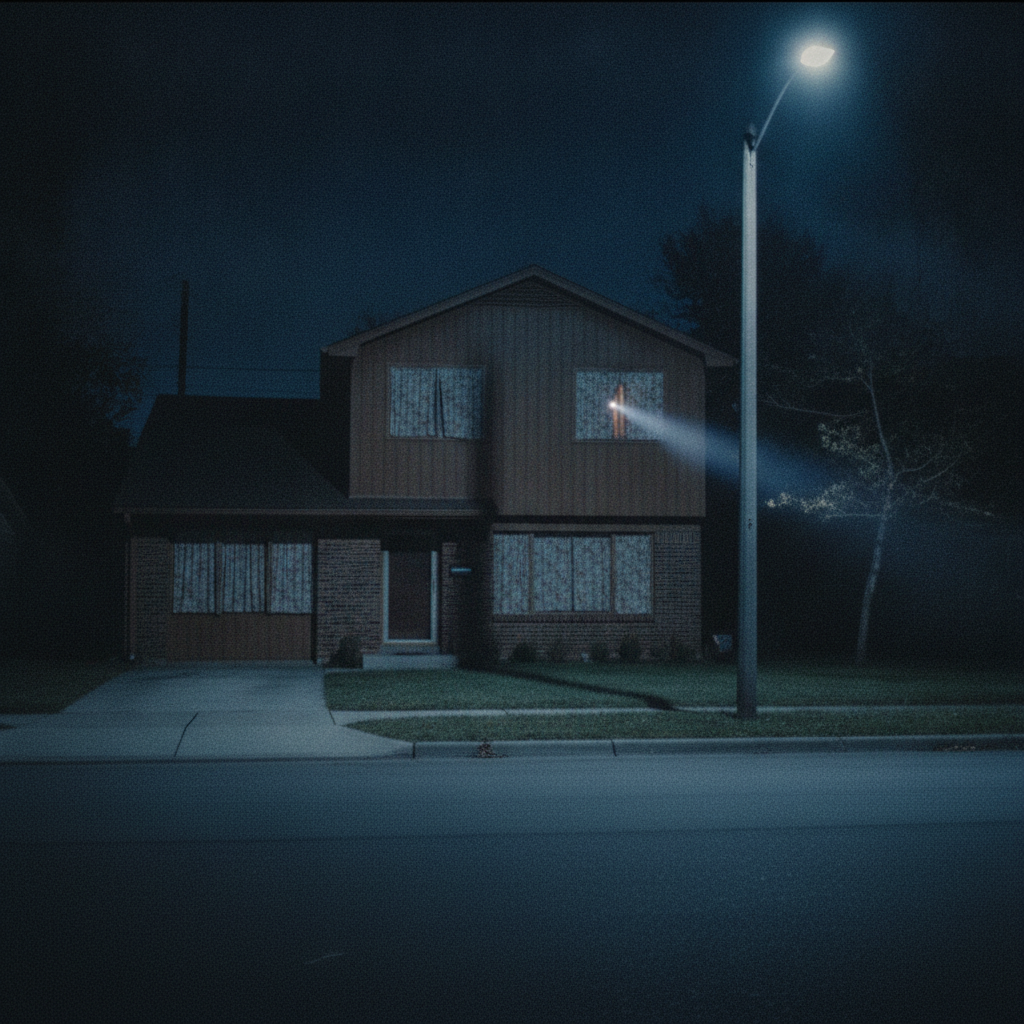
Forty-Four Years, Six Names, One Family Tree: How the Golden State Killer Was Finally Caught
The call came into the Sacramento County Sheriff's Department in December 1977, and the voice on the line was calm.
"I am going to hit tonight. Watt Avenue."
Deputies flooded the district. They were still there when a man in a ski mask rode a bicycle over the Watt Avenue bridge, directly past them, and vanished into the dark. They had been told where he would be. They had been told when. He went anyway, and he got away, and the message was not lost on anyone in the room the next morning: he was not afraid of them.
That was the fifteenth month of a manhunt that would run for another forty years.
The summer everything started
In June 1976, burglaries and rapes began in the eastern suburbs of Sacramento County. The press named the man responsible for the geography — the East Area Rapist — and the name stuck for a decade because nothing better ever emerged. No face, no name, no fingerprint that led anywhere.
The pattern was cold and repeatable. He entered homes days or weeks before an attack, walking through rooms while the family slept, learning the layout. He took small things nobody reported missing. He unlocked a window and left it that way. He made phone calls — hang-ups, mostly, sometimes whispered threats — and investigators later worked out how he got the numbers: rotary telephones in the 1970s carried the subscriber's own number printed on the dial face. He had been standing in the house, reading it.
When he came back, he came in the middle of the night with a flashlight and a gun. He bound his victims with shoelaces he had brought with him. Where there was a couple in the house, he stacked dishes on the man's back and told him that if he heard them fall, everyone in the house would die. Then he took his time, and often he ate their food before he left.
Between 1976 and 1986 the same man committed at least thirteen murders, more than fifty rapes, and over a hundred and twenty residential burglaries across the state of California.
What the survivors described afterwards was almost always the same, and the sameness is part of why the case is so hard to read. He did not rush. He moved through the house as though he had been there before, because he had. He knew which floorboards were loud. In several homes he had already loosened the screws on a gate or moved a ladder into position days earlier, and nobody had noticed, because nothing had been taken and nothing had been broken.
He spoke in a forced whisper, through clenched teeth, and several victims said the voice sounded put on — an accent that slipped. He asked for specific things by name and knew where they were kept. And afterwards, sometimes weeks afterwards, the telephone would ring in the middle of the night and there would be breathing on the line, and the survivors understood that he had not moved on and had not forgotten them.
Sacramento in 1977 was a city with a curfew nobody had imposed. Gun shops sold out. Men slept in shifts. Neighbourhood patrols drove the streets with flashlights, and at a public meeting that autumn a resident stood up and said that no man would let this happen in his own home. Six weeks later that man's house was one of the ones entered.
For most of those years, the men investigating him did not know they were investigating one man.
Three killers who were the same person
This is the failure at the centre of the case, and it deserves to be stated plainly, because it cost lives.
When the attacks in Sacramento stopped, the task force was wound down. Detectives were reassigned. In Contra Costa County, Lieutenant Larry Crompton was ordered to stand down when the local assaults ended. The reasoning was ordinary and, on its own terms, reasonable: the crimes had stopped, and there were other cases waiting.
But the crimes had not stopped. They had moved.
Four hundred miles south, in Santa Barbara County and Orange County, couples were being murdered in their homes at night by an intruder who bound them and beat them to death. The press called that man the Original Night Stalker. To the detectives working those scenes, he was a killer. To the detectives in Sacramento, their man was a rapist who had never killed in the north — except, in fact, he had, twice, in 1978.
One southern detective read the northern files and became convinced they were hunting the same person. He took it to Sacramento. Lieutenant Ray Root, running the investigation there, disagreed. Root's reasoning, as he later described it, was that the Goleta killer was sloppy, while the East Area Rapist had been meticulous and always kept control of his victims. It was a judgement about craft, made by an experienced man, and it was wrong.
There was a third thread nobody connected either. Between 1974 and 1975, in the farming town of Visalia, someone ransacked more than a hundred homes in a manner that made no sense to anyone — drawers emptied, single earrings taken, women's underwear arranged on beds, cash left untouched. The Visalia Ransacker also shot and killed a journalism professor who tried to stop him from abducting his daughter. Visalia detectives believed they were dealing with one man. Detectives elsewhere disagreed. The ransackings stopped in late 1975. In the summer of 1976, the East Area Rapist began.
Three jurisdictions, three names, three files that did not talk to each other. The technology to compare DNA across county lines did not exist yet, and the culture that would have compared notes anyway did not exist either.
The man they were looking for was one of them
There is a detail in this case that investigators have had to sit with for years, and it explains a great deal about why the composite sketches never worked.
Joseph James DeAngelo was a police officer.
He served in Exeter, in Tulare County, from 1973 to 1976 — the years of the Visalia ransackings, in the same small county. He left Exeter at roughly the moment those crimes ended, and joined the police force in Auburn, north of Sacramento. The East Area Rapist attacks began in Sacramento's eastern suburbs that same summer.
He was fired from the Auburn force in 1979 for shoplifting a hammer and a can of dog repellent from a drugstore.
A man with police training knows how a scene is processed. He knows what patrol coverage looks like at three in the morning, and how long it takes a unit to respond, and which streets have no lights. He knows what detectives will look for and therefore what not to leave. The reason he could telephone the sheriff's department, announce his target, and still walk through the net is that he understood exactly how the net was built.
The decades in between
The attacks stopped in 1986. Nobody knew why. The file went cold in the way these files do — not closed, but shelved, worked in the evenings by a shrinking number of people who could not let it go.
Paul Holes was one of them. A criminalist and later an investigator with the Contra Costa County District Attorney's Office, he first opened the boxes in the 1990s and kept coming back for more than two decades. He re-read statements. He drove the routes. He built theories and dismantled them. In 2001, DNA testing finally proved what one detective had argued in 1979 and been overruled on: the East Area Rapist and the Original Night Stalker were the same man. It was a vindication that arrived twenty-two years late, and it changed nothing, because the DNA matched no one in any law-enforcement database.
That is the trap in a case like this. A DNA profile is only useful if the person it belongs to has already been arrested for something. DeAngelo had been fired from a police force for stealing a hammer. He had never been convicted of a felony. His DNA was not in the system and never would be. By conventional means, the case was unsolvable, and it would have stayed unsolvable indefinitely.
The idea that broke it
In 2017, Holes went to see a woman named Barbara Rae-Venter.
Rae-Venter was not a police officer. She was a retired patent attorney with a doctorate in biology who had taken up genetic genealogy as a hobby in retirement, helping adoptees find their birth families by tracing DNA matches through public databases. She had already used the technique to identify a woman who had been abducted as a child.
The proposition Holes brought her was this: take the DNA profile from a Golden State Killer crime scene, upload it to GEDmatch — a free public site where people share their consumer DNA results to find relatives — and see who it matches. Not the killer, who obviously had never uploaded anything. His cousins. Distant ones. People who had spat into a tube out of curiosity about their ancestry and had no idea their genome would be used this way.
The search returned more than a thousand genetic cousins.
What followed was months of unglamorous genealogical work: building family trees backwards from those matches, looking for the point where separate branches converged on a common ancestor, then working forward again through birth, marriage, census and death records to find the descendants who could have been in the right places at the right times. Along the way the DNA yielded physical clues — indications the man was likely of Italian descent and prematurely bald.
The tree narrowed to six candidate men.
Then came the smallest step in the entire forty-four-year investigation. Someone requested the six driver's licence records from the California DMV. One of the six had blue eyes, which matched the descriptions given by surviving victims decades earlier.
His name was Joseph James DeAngelo, and he was seventy-two years old, living in a suburban house in Citrus Heights, ten miles from where the East Area Rapist attacks began.
Investigators put him under surveillance and collected what he discarded — a tissue, and later the handle of his car door. The DNA matched the crime scenes.
He was arrested on 24 April 2018, in his own driveway. From the day Holes first walked into Rae-Venter's office to the day of the arrest, the case took roughly four and a half months.
The plea
On 29 June 2020, in a converted university ballroom large enough to hold the survivors, DeAngelo pleaded guilty to thirteen counts of first-degree murder. As part of the agreement that removed the death penalty from the table, he also admitted in open court to dozens of rapes that could no longer be charged because the statute of limitations had run out — a condition the survivors had insisted on, so that the record would say what he had done to them.
He was sentenced to life without the possibility of parole. He was seventy-four.
Conclusions and Open Questions
The technical achievement is easy to describe and hard to overstate. Investigative genetic genealogy did not find the killer's DNA in a database. It found his relatives' DNA, and reasoned its way from them to him. In the years since, the same method has identified more than a hundred and fifty suspects in cases that were considered permanently closed.
But the technical story is the smaller one. The harder question is the one that hangs over the four decades before 2018.
**Why did it take so long, when so much was known?** The evidence is uncomfortable. By 1979, at least one detective had read both files and concluded, correctly, that the northern rapist and the southern killer were the same man. He was overruled by a more senior officer whose objection was essentially aesthetic — that the southern crimes felt sloppier. Everything needed to link the cases existed, on paper, in 1979. What did not exist was a mechanism that could override a lieutenant's judgement, and a culture in which three counties would pool files that each considered its own.
**Would a joint investigation have caught him?** This is where honesty requires caution. It is tempting to say yes, and impossible to prove. DeAngelo's DNA was not in any database and would not have been. No witness ever saw his face. A unified task force might have narrowed the geography, or noticed that a police officer had moved from Exeter to Auburn at precisely the two moments the crimes shifted. Or it might have produced a bigger version of the same dead end. The claim that better coordination would have stopped him is a reasonable inference, not an established fact, and the difference matters.
**Why did the attacks stop in 1986?** Nobody has answered this. He was forty years old and not caught. He was not in prison. He lived another thirty-two years as a free man, worked as a mechanic, raised a family, and by all outward accounts did nothing to draw attention. Serial offenders of this type do not usually stop, and when they do, there is usually a reason — incarceration, illness, relocation, a change in circumstance. Here there is no reason on record, only a silence that lasted longer than the crimes.
**And the question the case leaves for everyone else:** the men who caught him used the DNA of a thousand people who never consented to this. They had uploaded their results to find a great-grandparent's village. That data convicted a man of thirteen murders, and almost nobody objects to the outcome. But the precedent was set by that outcome, and the debate about where its limits lie has not been settled — it has mostly been postponed, because the first case was one where the answer felt obvious.
What remains, past the DNA and the genealogy and the four and a half months at the end, is the shape of the thing: a man who spent ten years walking through other people's houses while they slept, who was never seen clearly by anyone who survived, and who was found in the end not by anything he did, but by an accident of who he was related to.