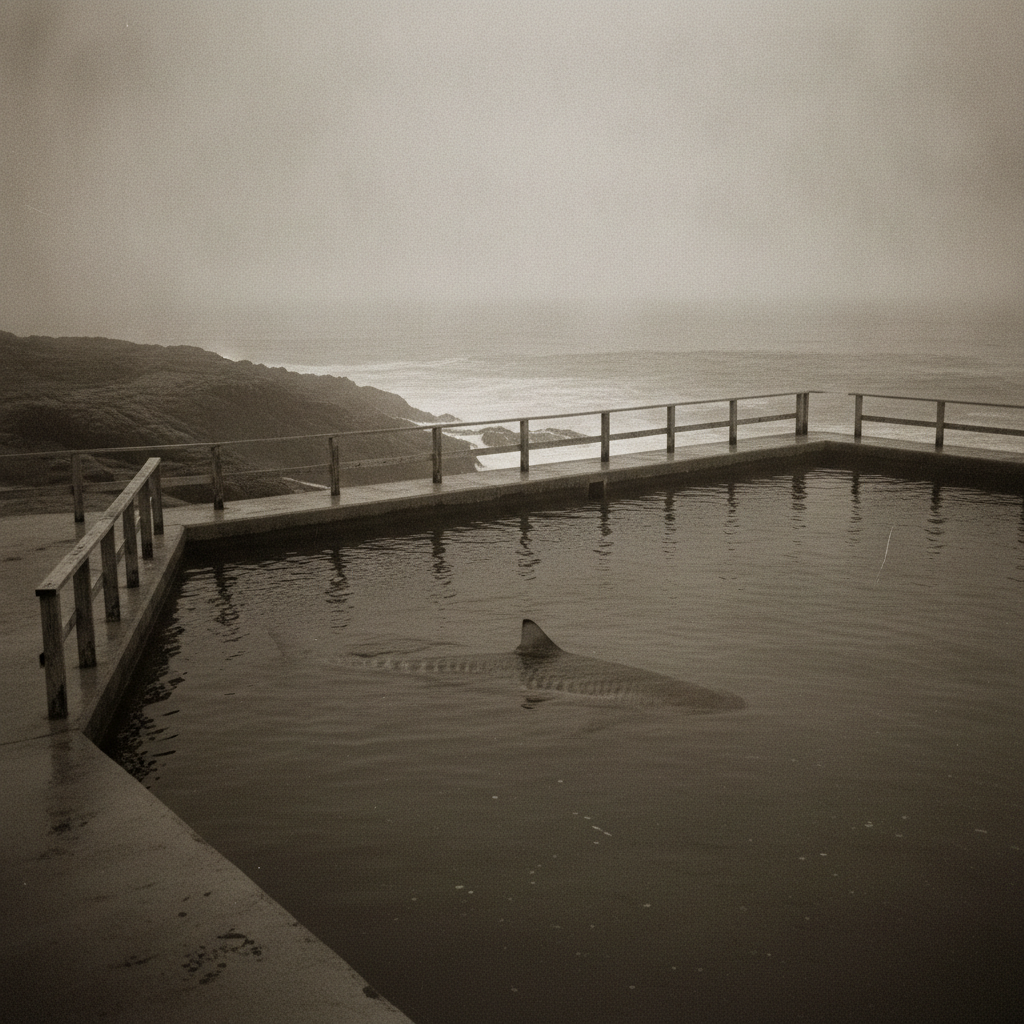
The Shark Arm Case: A Tattooed Arm in an Aquarium, a Witness Shot Dead, and 2 Murders Sydney Never Solved
On the morning of Monday 8 April 1935, Jim Smith left his home in Sydney, Australia, at about 9:30.
He told his wife he was going fishing.
He was 45 years old. Some newspapers of the time gave his age as 40. He had been a boxer in his youth, then a builder, and his building business had gone bankrupt. He had run a billiard room and taken illegal bets. He had a few small convictions.
He also had one secret that very few people knew. He passed information to the police. In the language of the Sydney underworld, he was a "fizgig", an informer.
That afternoon he did not go fishing. At about 2:30 he walked into the Cecil Hotel in Cronulla, a beach suburb on the southern edge of Sydney, about 25 km from the city centre.
He met an old friend there, a man who made his living forging cheques. The two of them drank and played cards.
The last sure sighting of Jim Smith is at about 6 pm that evening, with that friend. Some later accounts put that day as 7 April, not 8. The newspapers of 1935 are not consistent on this.
On Saturday 13 April someone telephoned the Smith family. The caller said Jim would be home on Monday.
He never came home.
A shark at the swimming baths
On Wednesday 17 April 1935, about 2 km off Coogee Beach in the east of Sydney, a fisherman and his son set baited lines in the sea.
The fisherman owned the Coogee Aquarium, a seaside building with a public swimming pool and tanks for sea animals.
When they pulled up the lines the next morning, a small shark was hooked. A much larger tiger shark had swallowed it and become tangled in the line.
The sources give the tiger shark's length as between 3.5 and 4.4 metres. Several put its weight at close to 1 tonne.
Sydney was afraid of sharks that year. In February and March, sharks had killed 3 young men at beaches in New South Wales. A live tiger shark was a crowd-pleaser.
So the fisherman did not kill it. He put it on show in the aquarium pool, ready for the Anzac Day holiday on 25 April.
For a week the shark swam slowly. It barely ate. It seemed sick.
In front of the crowd
On Thursday 25 April, Anzac Day, at about 4:30 in the afternoon, the shark began to thrash in its pool.
It threw up a cloud of brown, foul-smelling froth. A bird came out, and a rat, and other waste.
Then something else floated to the surface. It was a human arm.
It was a left arm, from the hand up past the elbow. On the forearm was a tattoo of 2 boxers facing each other, fists raised. Around the wrist, tied in a knot, was a piece of cheap rope about 2 cm thick.
This is the start of what Sydney soon called the Shark Arm case.
In plain words: a shark in a Sydney aquarium threw up the arm of a missing man. Doctors soon proved that the arm had been cut off his body with a blade. The question was, and still is, who killed him, and where the rest of him went.
The shark did not do it
The police took the arm away. The first guess was that the shark had attacked a swimmer. Some people suspected a prank by medical students.
The next day, the government's medical officer examined the arm, together with a doctor who was the country's leading expert on shark attacks.
Their finding changed everything.
The arm had not been bitten off. It had been cut off, at the shoulder, with a sharp tool such as a knife, and by someone who was not a surgeon. There were marks of a blade on the bone.
The doctors estimated that the arm had been inside the shark for 8 to 18 days. It was surprisingly well preserved. One explanation was that the arm had first been swallowed by the small shark, and the tiger shark had then swallowed the small shark.
The aquarium owners killed and opened the tiger shark a few days later. Inside its stomach they found only fish bones.
There was no other part of a human body. The shark itself, the only possible witness, was gone. The police later complained that killing it had made their work harder.
The brother who read the newspaper
A Sydney weekly newspaper printed a description of the tattoo.
Jim Smith's brother read it. He went to the police and said the arm might belong to his brother, who had been missing for weeks.
On 29 April, the brother and Jim Smith's wife both identified the tattoo.
That was not enough for a court. The police needed proof.
The skin of the fingers was damaged, but the police experts managed to take prints from the thumb and one finger. Jim Smith had been fingerprinted in 1932, after a police raid on a gambling den.
The prints matched.
The arm belonged to Jim Smith. And since the doctors had ruled out the shark, the police were now looking for a murderer.
The cottage and the taxi
The detectives started where the trail stopped: the Cecil Hotel in Cronulla, and the friend Jim Smith had been drinking with.
The forger had rented a small cottage in Cronulla, right on the shore of a quiet bay. After the hotel, the police alleged, the two men had gone back to that cottage.
The detectives searched it. They found no blood and no weapon.
But witnesses said 2 things were missing: a mattress, and a tin trunk large enough to hold a body. Other accounts say the forger bought a new trunk and a new mattress a few days after Jim Smith vanished. The sources describe this point differently.
Then a taxi driver came forward.
On the day after Jim Smith was last seen, he said, he had picked up the forger in Cronulla and driven him all the way across Sydney to a house on the north shore of the harbour.
The driver remembered his passenger well. The man looked dishevelled. He kept one hand in his pocket the whole time. He seemed afraid that someone was following them.
The house belonged to Reginald Holmes.
The boatbuilder
Reginald Holmes was a respected businessman. He ran his family's boatbuilding firm on Sydney Harbour. He was well off.
He also had another life. The police believed that he used his fast motorboats to pick up smuggled goods thrown overboard from ships outside the harbour mouth. He was involved in fraud and in insurance scams.
Jim Smith had worked for him.
In April 1934, a year before Smith vanished, a yacht called Pathfinder sank off the coast north of Sydney. Holmes owned it. It was insured for about £8,500, roughly 3 times what it was worth.
The insurance company became suspicious and refused to pay. Holmes lost his money. According to the police, Jim Smith had been involved in the sinking, and after it went wrong he was squeezing Holmes for money.
So now the police had a link. A man who might have had a reason to want Jim Smith silent. A friend who was the last to see Smith alive. And a taxi ride between them.
When the detectives asked, Holmes said he did not know the forger at all.
The arrest
On 16 May 1935 the police arrested the forger in Sydney. He tried to get out through a bathroom window.
The detectives did not yet have enough to prove a murder. At first they held him on old charges of forged cheques worth thousands of pounds, from 2 Australian states.
He was questioned for about 6 hours. His statements contradicted each other. He said he had not been in Cronulla on the day in question. Then he said he had last seen Smith 2 days later.
In the end, according to the accounts of the investigation, he gave a new version, and in it he pointed to Reginald Holmes.
The police charged him with the murder of Jim Smith.
The chase on the harbour
3 or 4 days later - the sources give 19 May and 20 May - Reginald Holmes did something nobody expected.
He took one of his speedboats out onto Sydney Harbour, alone, with a bottle of liquor.
Near a small island in the harbour he put a pistol to his own head and fired.
The bullet did not go through his skull. He fell into the water, bleeding, climbed back into the boat, and started the engine.
The water police went after him. For about 4 hours they chased him around the harbour, while crowds watched from the shore. In the end his own brother reached him, took the keys of the boat, and Holmes gave himself up.
He was taken to hospital and the bullet was removed from his forehead.
What Holmes told the police
At first Holmes said that unknown men had tried to kill him. The police believed he had tried to kill himself.
Then he began to talk.
He told the detectives that the forger had killed Jim Smith in the Cronulla cottage. He said the forger had cut up the body and thrown it into the sea in a trunk.
He said the forger had come to his house carrying the arm, and had used it to threaten him and demand money. He said he, Holmes, had then thrown the arm into the surf at a beach in the east of Sydney.
Holmes had now admitted that he knew the forger after all. The police warned him that he could be charged as an accessory to murder.
He agreed to be the main witness for the prosecution.
The coroner's inquest into the death of Jim Smith was set to open on 12 June 1935. Holmes would give his evidence there.
The night before the inquest
On 11 June 1935, Holmes withdrew £500 in cash from the bank. In the evening he left his home.
At about 1:10 in the morning of 12 June, a police patrol found his car parked on the waterfront right beside the southern end of the Sydney Harbour Bridge.
Reginald Holmes was slumped over the steering wheel. He had been shot 3 times at close range, with a pistol of .32 calibre. Some sources say the wounds were in his chest, others say his head. He was dead.
The scene had been arranged to look as though he had shot himself. The police did not believe it. 3 shots, they said, is not a suicide. They opened a murder investigation.
A few hours later, that same morning, the inquest into Jim Smith's death opened as planned. Its main witness was lying in the morgue.
Holmes was cremated the next day.
An arm is not a body
The inquest went on without him. Witnesses gave evidence under police protection.
The forger's lawyer then made a legal argument that became famous in Australian law.
The law, he said, required the coroner to view the body of the dead person. The coroner had not viewed a body. He had viewed an arm. An arm, he argued, is not a body. And a man can live without an arm. So nobody could be sure that Jim Smith was even dead.
The lawyer went to the Supreme Court of New South Wales. On 24 June 1935, a judge of that court agreed with him. He said that a limb could not be called a body, and he ordered the coroner to stop.
The inquest was closed.
The prosecution did not give up. In a separate hearing before a magistrate, which ended on 16 July 1935, the forger was sent to stand trial for murder all the same.
The trial
The trial opened in the Supreme Court in September 1935.
Without Reginald Holmes there was very little left. The prosecution had the taxi driver, the missing mattress and trunk, and the forger's changing statements. It had no body, no weapon, no blood and no witness who had seen a killing.
The defence also pointed out that the accused was a small man with no record of violence.
On 10 September, after less than 2 days, the Chief Justice of New South Wales ruled that the evidence could not support a conviction. He directed the jury to find the accused not guilty. The jury did so.
The acquitted man walked out of the back door of the court. About 50 metres further on, detectives arrested him again, on the old forgery charges.
The trial for Holmes
The police did not drop the second murder either.
2 men were charged with killing Reginald Holmes. One of them was a business associate of Holmes, a man Holmes himself had named to the police in his confession about building and insurance frauds.
That man was tried twice. The first jury could not agree on a verdict. At the second trial, in December 1935, he was found not guilty.
Nobody was ever convicted of the murder of Reginald Holmes.
Where it stands
**From here on, the record is empty. No court ever decided who killed Jim Smith, or who killed Reginald Holmes.**
Here is what was never found.
The rest of Jim Smith's body was never found. Navy and air force searches of the waters around the city found nothing. The trunk was never found.
The place where he died was never proved. The cottage showed no trace of a killing.
The tiger shark, which held the only physical evidence, was killed and cut open by its owners within days.
The man who drove the case, the witness who claimed to know what happened, was shot dead a few hours before he was due to speak in court.
And no gun from the Holmes killing was ever linked to anyone.
The forger who was acquitted lived another 30 years. He spent much of that time in and out of prison for fraud. He died in a Sydney hospital in April 1965, aged 76. Until the end, he said he had not killed Jim Smith.
The theories
These are the explanations on the record. None of them was ever proved in court.
**Theory 1: The forger killed Smith, as Holmes said.** This was the police case, and it rests on Holmes's own statement, the taxi ride and the missing trunk. The problem: Holmes was deeply involved himself, he changed his story more than once, and he died before anyone could test his words in court.
**Theory 2: Holmes ordered the killing, and then had himself killed.** The police at the time suggested that Holmes, facing disgrace and prison, paid someone to shoot him, because an insurance policy would not pay out on a suicide. A legal historian supported this idea in a book on the case published in 1995. The problem: it explains the 3 shots, but there is no direct evidence of such a deal.
**Theory 3: The forger came home and found Smith already dead.** The same legal historian suggested that the forger may have gone out fishing, returned to find Smith killed in the cottage by others, and then stayed silent out of fear. The forger's wife spoke of hearing a group of men drinking and playing cards in the cottage. The problem: her account was never confirmed by anyone else.
**Theory 4: Revenge from the underworld.** Jim Smith had informed on a bank robber, who was caught in the act because of him. The same historian named that criminal as a possible suspect in the death of Holmes, and as a figure behind the whole affair. The problem: the 2 deaths were never formally linked to him, and the police never charged him.
In 2020, 2 Australian writers returned to the case in the book "Shark Arm: A Shark, A Tattooed Arm and Two Unsolved Murders". It is still unsolved.
Everyone involved has been dead for decades. The only thing that ever came out of the sea was one arm, with 2 boxers tattooed on it and a rope tied around the wrist.