200,000 Dead in 3 Weeks: What Killed the Saiga of Kazakhstan
In May 2015, a team of scientists was camped on the open steppe of central Kazakhstan, the huge country in Central Asia south of Russia. They were there to watch one of the strangest-looking animals on Earth give birth.
The animal is the saiga antelope. It is about the size of a goat, sandy brown, with a large, soft nose that hangs over its mouth like a short trunk. The nose filters dust in the summer and warms the freezing air in the winter. Saiga have lived on the grasslands of Central Asia since the Ice Age, when they grazed alongside mammoths.
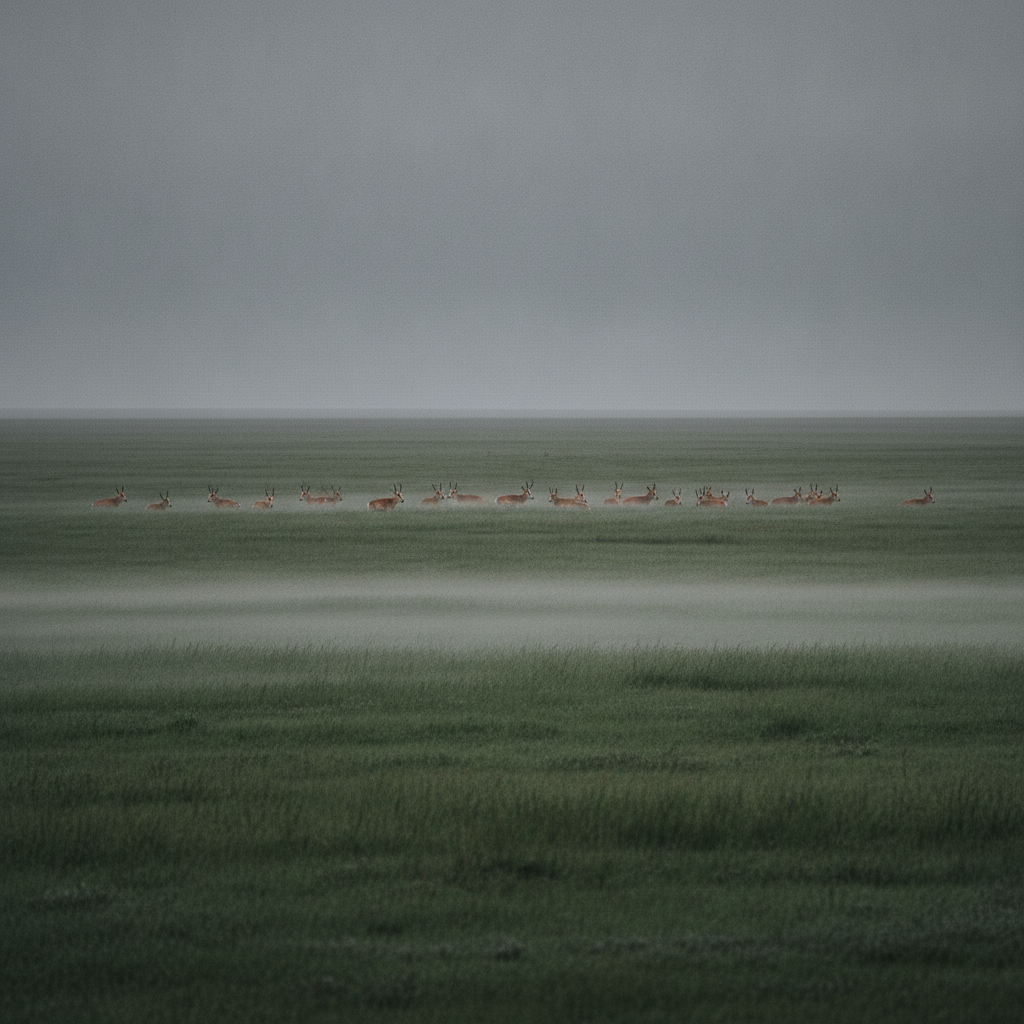
Each spring the females gather in huge groups to give birth, all within a few days of each other. Tens of thousands of mothers and newborn calves crowd onto the same stretch of grass. The scientists came to count them, weigh the calves and take routine samples. They had done this work many times before.
Then, around 10 May, the animals began to die.
Within 3 weeks, about 200,000 saiga were dead. That was more than 2/3 of all the saiga in the world. In one population, 88% of the animals died. Not one sick animal recovered.
This is the story of how scientists found what killed them, and why part of the answer is still missing.
A death that came in hours
The first deaths were reported in one calving area in the north of the country. Soon there were more, in other calving groups, some of them hundreds of kilometres away.
The researchers on the ground described a pattern none of them had seen before. An animal looked normal one day. Then it became dull and weak, stopped eating, lay down, and died within hours. Some had diarrhoea and foam at the mouth.
The mothers died first. Their calves, only days old, stayed beside them and tried to feed from mothers that were already dead. Then the calves died too.
One of the vets on the team later said: "It was like a switch was turned on in each animal."
A calving group of thousands could be wiped out in a few days. Then the dying stopped as suddenly as it had started. By early June it was over.
The size of the disaster
The numbers are hard to picture.
Kazakhstan has 3 separate saiga populations, in different parts of the country. The worst hit was the largest. It lives on a dry plain called Betpak-Dala, in the centre of the country. It lost 88% of its animals in less than a month.
Across the country, about 200,000 bodies were counted. The authorities brought in machines to dig pits and bury the carcasses, so that no disease would spread to farm animals.
For a species that had already been close to extinction, it looked like the end. In 2003, after years of poaching for their horns, only about 21,000 saiga had been left in Kazakhstan. Since then they had slowly climbed back. Now, in 3 weeks, most of that recovery was gone.
The question was simple. What could kill 200,000 wild animals that fast, and then stop?
Searching for the killer
The first suspects were the obvious ones.
Anthrax kills grazing animals quickly, and it survives in the soil of the steppe for decades. Foot-and-mouth disease and other viral plagues of sheep and goats can sweep through herds. Some people suggested poison, or a leak of rocket fuel from the space launch site in the south of the country.
The researchers had one advantage: they were already there when it started. In the last days of the outbreak they took blood, tissue and organ samples from fresh carcasses in the field. Laboratories in Kazakhstan and in Europe went to work on them.
The tests ruled out anthrax. They ruled out foot-and-mouth disease, bluetongue, and the plague of sheep and goats known as PPR. They found no poison.
What they did find was a bacterium, in almost every sample. It is called Pasteurella multocida, type B. It causes a disease called haemorrhagic septicaemia: blood poisoning, with bleeding into the organs. That matched exactly what the vets had seen inside the bodies.
Later studies used 3 different modern methods to read all the genetic material in the samples, searching for any hidden virus or second germ that might have helped. They found none. The bacterium alone was the killer.
A killer that was already inside
That should have closed the case. Instead it opened a bigger puzzle.
This bacterium is not new to saiga. It is commonly carried, quietly and harmlessly, in the tonsils and noses of healthy animals, saiga among them.
And the way the deaths spread did not look like an infection passing from animal to animal. Groups hundreds of kilometres apart began dying at almost the same time. If a germ had been jumping from one herd to the next, the deaths would have moved across the map like a wave. They did not.
So the scientists faced something strange. The killer had not come in from outside. It had been inside the animals all along. Something had turned it, suddenly, from a harmless passenger into a killer, in tens of thousands of animals at once.
This is where the certain answer ends. The cause of death is known. What flipped the switch is not fully known.
The weather in the 10 days before
In January 2018, an international team published the most detailed study of the event in the scientific journal Science Advances.
They had gathered everything they could: the weather, the plants, the soil, the numbers of animals, and the history of earlier die-offs. Then they looked for what made the places and days of the deaths different.
One thing stood out. In the 10 days before the deaths, the air in the calving areas had been unusually warm and unusually humid. It was much wetter and warmer than a normal May on the steppe.
The researchers' explanation is that this heat and moisture let the bacteria multiply in the animals' throats until they broke through into the blood. Females who had just given birth, tired and drained, were the most exposed. Their calves were infected through their milk.
It had happened before
The team then went back into old records.
The saiga had died in huge numbers before. In May 1981, Soviet records describe a die-off of up to 70,000 animals in the same Betpak-Dala population. In May 1988 another one killed far more. One summary of the old records gives about 255,000 for that year, though those figures are not precise.
Both earlier events happened during calving. Both were blamed at the time on the same bacterium. And when the researchers checked the weather records, both had followed the same pattern: unusual warmth and humidity in the days just before.
Smaller die-offs had also hit saiga in the west of the country in 2010, 2011 and 2012.
So 2015 was not a single freak event. It was the largest example of something that had been happening, every few years or decades, for at least half a century.
What came after
The story did not end with the deaths.
Kazakhstan stepped up protection against poaching, and the remaining herds were left to breed. Saiga breed fast. Females can give birth at 1 year old, and twins are common.
The recovery has been remarkable. An aerial count in April 2024 estimated about 2.8 million saiga in Kazakhstan. In 2023, the international body that keeps the official list of threatened species moved the saiga from "critically endangered" to "near threatened".
But the scientists who studied 2015 warn that this does not remove the danger. A bigger population means bigger calving groups, and the climate of the steppe is getting warmer.
The animals that came back are carrying the same bacteria.
Conclusions and Open Questions
There is broad agreement on the main facts. The saiga died of haemorrhagic septicaemia caused by Pasteurella multocida type B. No other germ, poison or toxic spill was found. The deaths followed several days of unusual heat and humidity, as did the great die-offs of 1981 and 1988.
What is still argued about is why.
The weather explanation. The 2018 study found the same warm, wet conditions before each of the 3 great die-offs. The problem: warm, humid Mays have happened on the steppe in other years too, without mass deaths. The weather may be necessary, but it does not seem to be enough on its own. The authors themselves say other factors are probably involved.
Something about the bacterium. Perhaps a more dangerous form of the bacterium was present in 2015. The problem: no study has shown that a new, more dangerous strain appeared. And the deaths began at the same time in herds far apart, which is hard to explain with one new strain spreading.
Something about the animals. Mothers giving birth to very large calves are under great strain, and they are crowded together in huge numbers. Their diet, their immune state, or something in the spring grass may have made them vulnerable. The problem: this is true in every calving season, and most seasons pass without disaster.
Even the scientists who solved the main part of the case describe the rest as open. Nobody can yet say which combination of heat, humidity, crowding and biology turns a harmless bacterium into a killer, or why it happened in 2015 and not in the many warm, wet springs in between.
And nobody can say when it will happen next.