The Weapon That Saved an Empire: Greek fire, and a Recipe Nobody Can Read Anymore
In the summer of 941, a huge fleet of small wooden boats sailed down the Black Sea toward Constantinople.
Constantinople was the capital of the Byzantine Empire, the eastern half of the old Roman Empire that survived for 1,000 years after the western half fell. Today the city is called Istanbul, and it is in Turkey.
The fleet belonged to the prince of Kyiv, the ruler of the Rus, a people of warriors and traders from what is now Ukraine and Russia. The sources disagree about its size. Some speak of 1,000 boats. Others speak of 10,000.
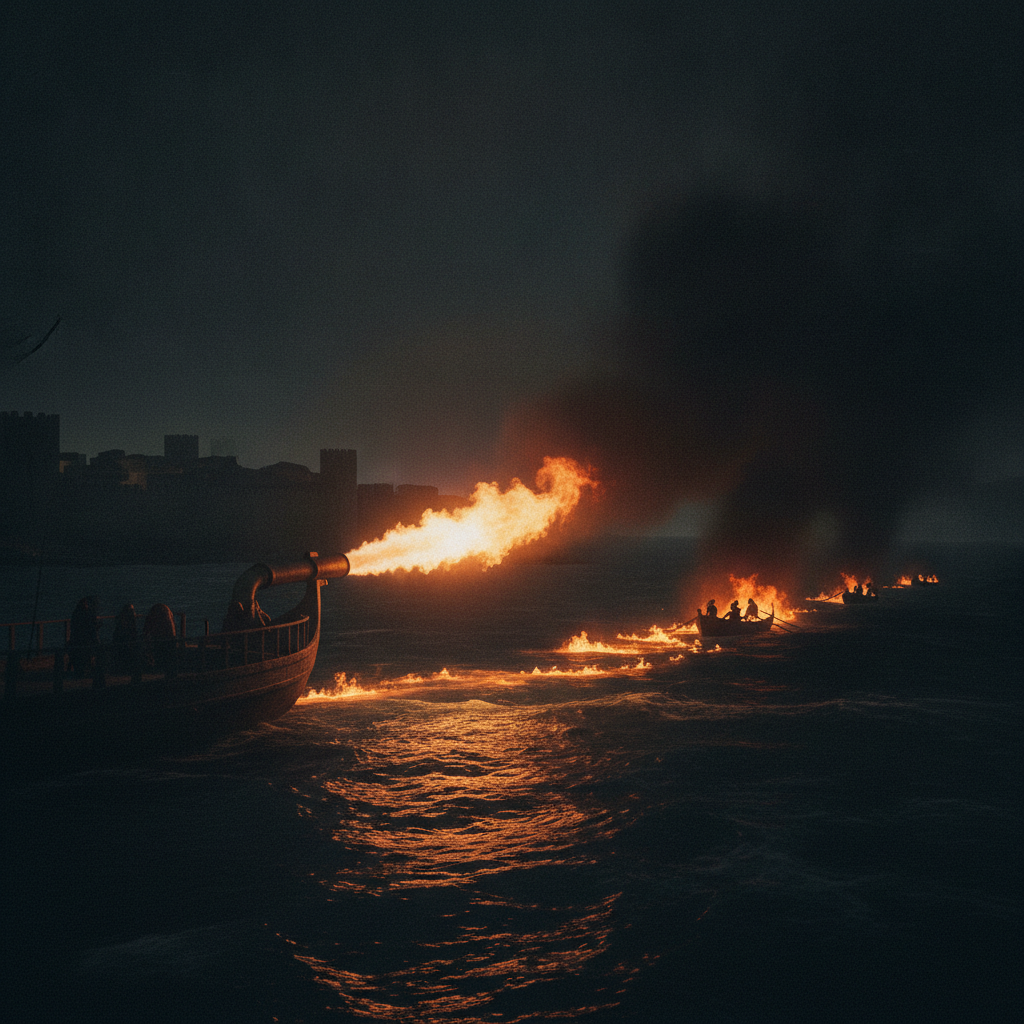
The timing was clever. The Byzantine navy was far away, fighting Arab fleets in the Mediterranean Sea. In the harbours of the capital, the officials found 15 old warships that had been taken out of service. They repaired them in a hurry. Then they fitted each one with fire tubes at the front and at the back.
The 15 ships sailed out to meet the fleet at the mouth of the Bosporus, the narrow strait that leads to the city.
The prince of Kyiv saw only 15 ships. According to the Byzantine account, he ordered his boats to surround them, so that he could capture them and their crews.
When his boats came close, the tubes opened.
Out of them came jets of fire. The fire stuck to the wooden hulls. It kept burning on the water.
The attack on the capital was broken. The Rus fleet turned away.
What it was, and what is missing
The weapon used that day has a name in English: Greek fire. The Byzantines themselves did not call it that. They called it "sea fire", "liquid fire" or "manufactured fire".
This, in short, is the mystery. Greek fire is one of the best documented weapons of the Middle Ages. It was used for about 700 years, in dozens of battles described by eyewitnesses. But the recipe was a state secret. It was never written down in any document that has survived. Somewhere along the way it was lost. To this day no one knows exactly what was in it.
Where it came from
The story begins more than 260 years before that battle, in the 670s.
The Arab armies of the new Islamic caliphate were sweeping across the Middle East. They had taken Syria, Egypt and much of North Africa from the Byzantines. Now they were besieging Constantinople itself.
According to a Byzantine monk who wrote a chronicle about 140 years later, a refugee arrived in the city around the year 672. He was an architect from a city in Syria, which had fallen to the Arabs. He brought with him a new kind of fire.
The same chronicle says that the Byzantines used the fire against the Arab fleets during the siege of 674 to 678. The siege failed.
There is a complication. The same chronicler also mentions Byzantine ships equipped with fire tubes a year or 2 before the architect arrived. So some historians think he did not invent the weapon from nothing. He may have improved something that already existed.
In 717 and 718 the Arabs besieged the city a second time, by land and by sea. Again the fire was used against their fleet. Again the siege failed.
In 941 it broke the Rus attack described above. In 1043, when the Rus came again, it was used again.
How it worked
What the sources describe is a whole system, not just a liquid.
The main weapon was a tube, called a "siphon", mounted at the front of a warship. Sailors pumped the liquid through it. At the mouth of the tube it was set alight, and it shot out as a jet of flame.
Eyewitnesses describe a noise like thunder, and thick smoke.
The fire floated on water. It kept burning on the surface of the sea. It stuck to wood, sails and men.
There were also smaller versions. A military handbook written by an emperor around the year 900 describes a hand-held tube for soldiers on land. Other sources describe clay pots filled with the liquid and thrown by hand, like grenades, and loads hurled by catapults.
Water did not put it out. According to the sources, only a few things worked: sand, strong vinegar and old urine. Arab sailors learned to hang felt or hides soaked in vinegar over the sides of their ships.
A secret kept by splitting it up
The Byzantines treated the formula as the most important secret of their state.
In the 10th century an emperor wrote a book of advice for his son, the future emperor. In it he warns him never to give the fire to any foreign people, whatever they offer in return. He writes that the secret was given to the first Christian emperor by an angel, and that it must be made only in the capital.
Modern historians believe the real protection was more practical. The knowledge was split up. One group of people knew how to make the liquid. Another knew how to build the pumps and the tubes. Another knew how to handle the fire at sea. No single person knew the whole system.
The proof that it worked comes from the enemies.
In 812 or 814, the Bulgarians captured 2 Byzantine coastal cities. Inside they found 36 siphons and a supply of the liquid. They could not use any of it.
In 827 Arab forces captured at least 1 fire ship intact. They could not copy the weapon either.
Here is where the trail breaks
In the 12th century a Byzantine princess and historian described the fire being used in a naval battle in 1099. She also described an incendiary mixture used in 1108, and many historians treat her description as a partial recipe. It mentions pine resin and sulphur. It is not the full formula, and it may not be the naval fire at all.
After that, the reports become thin.
In 1204 an army of Western crusaders captured and looted Constantinople. There is no reliable report that the defenders used Greek fire against them.
In the 13th century a French knight wrote that Arab armies used "Greek fire" against the crusaders in Egypt. But by then the name was being used for many kinds of incendiary weapons. There is no proof that this was the same thing.
**From here on, the record goes silent. No surviving document says when the last person who knew the full recipe died, or whether the secret was lost slowly, piece by piece, as the empire shrank.**
The Byzantine Empire itself fell to the Ottoman Turks in 1453. If anyone still knew the secret then, it died with them.
The attempt to rebuild it
Since the 19th century, chemists and historians have tried to reconstruct the fire.
In 2002 a team led by a British historian of Byzantium built a full-size working model for a television documentary. They used a bronze tank, a pump, a brazier to heat the liquid and a nozzle that could turn.
The first design failed. The welded bronze tanks could not hold the pressure. They moved the pump so that it pushed the liquid straight into the nozzle.
The second design worked. It produced a jet of flame hotter than 1,000 degrees Celsius, with a range of about 15 metres. The jet did not arc upward. It dropped down toward the water. That matters, because the enemy ships of the time were low galleys, and a high arc would have flown over them.
The experiment proved that such a weapon could be built with materials the Byzantines had. It did not prove that this was the real recipe.
That is where the story stands: the weapon is well recorded, its effects are well recorded, and the one thing that made it work, the exact recipe, is not recorded anywhere.
Conclusions and Open Questions
There are 4 main answers to the question of what Greek fire was. None of them can be proven.
**It was based on crude oil.** This is the view most scholars hold today. The Byzantines had access to natural oil seeps around the Black Sea. Oil floats on water, keeps burning on the surface, and sticks to wood. Resin may have been added to make it thicker and burn longer. The problem: crude oil was known to many peoples of the region. If the base was so simple, it is hard to explain why the Arabs and the Bulgarians, who captured both the liquid and the equipment, could not reproduce it.
**It contained saltpetre, like gunpowder.** This is the oldest theory. It would explain the noise like thunder and the smoke that eyewitnesses described. The problem: there is no evidence that saltpetre was used in warfare in Europe or the Middle East before the 13th century, about 600 years after the fire first appeared. Arab chemists, who wrote a great deal about incendiaries, do not mention it before then.
**It contained quicklime, which heats up when it touches water.** This would explain the idea that the fire "lit itself" on the sea. The problem: the fire was poured onto ship decks and packed into grenades, so it did not need water to ignite. Experiments showed that the heat from quicklime at sea would be far too weak.
**The secret was not the liquid at all, but the machine.** Some historians argue that the hardest part to copy was the system: the heated, pressurised pump, the tube, and the trained crews. That would explain why captured liquid was useless without the people who knew how to fire it. The problem: this is supported by the fact that enemies failed to copy it, but there is no Byzantine document that describes the pump in detail.
Some questions remain open. Was the architect from Syria the inventor, or only the man who improved it? When was the full recipe last known? And was the fire of the 13th-century reports the same weapon, or only the same name?
For 700 years, Greek fire helped keep the gates of Constantinople closed. The recipe that did it is still missing.