The Halifax Slasher: The Attacker a Whole Town Saw, Who Never Existed
On a dark November evening in 1938, 2 young women were walking home from work on a lane outside Halifax.
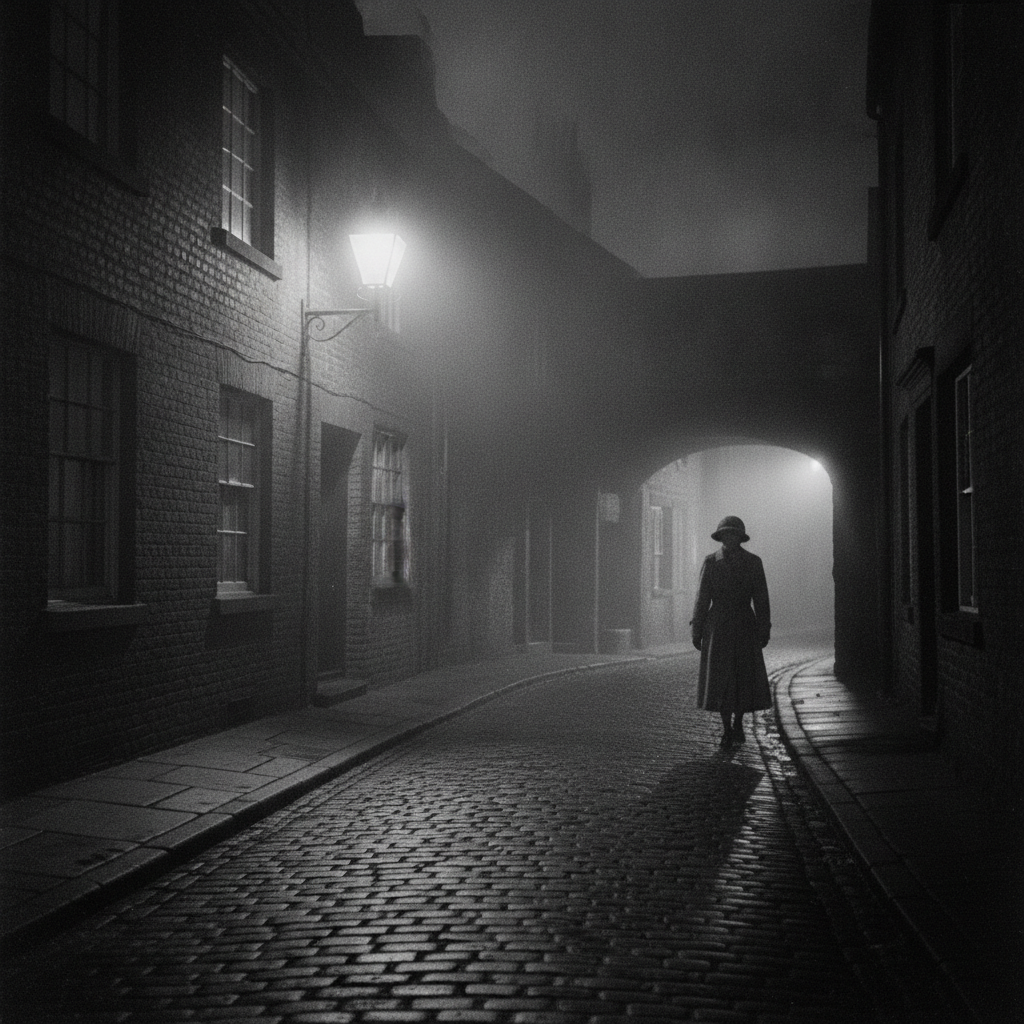
Halifax was a wool and textile town in the north of England, about 280 km north of London. Its streets were steep and cobbled, and many of its alleys led into dark back yards.
Both women were 21. Later they told the police that a man had come at them out of the dark and struck at them with a mallet. They remembered one detail clearly: the man had bright buckles on his shoes.
That was 16 November. Within 2 weeks, Halifax was a town under siege.
This is the story of an attacker whom dozens of people reported, whom hundreds of people hunted, and whom Scotland Yard finally concluded had never existed at all. In one sentence: a town became convinced that a man with a blade was attacking people in the streets, and the investigators found that most, and perhaps all, of the attacks had been invented or self-inflicted.
The first cuts
On the night of 21 November, just after 10 o'clock, another young woman of 21 was walking home from her shift at a toffee factory.
She said a man attacked her on the street and cut her. She had a wound on her wrist that needed 4 stitches, and she missed 2 weeks of work.
The local paper reported it. The police treated it as a real attack. Many people in town connected it at once with the attack on the 2 women a few days earlier.
On 24 November, at a quarter to 7 in the evening, the caretaker of a church said he had been struck on the head and hand in a street not far from the second attack. This time there was a description: a red-haired man of about 30, stooping, about 1.75 m tall, in a light brown raincoat.
The police arrested a man within half an hour. They released him the same evening.
In a nearby art school, more than 200 girls were locked into their classrooms while the streets outside were searched. The police offered a reward of 10 pounds for the arrest of the attacker.
The newspapers now had a name for him: the Halifax Slasher.
A town gripped by fear
On 25 November there were 2 more reports.
A 38-year-old manager of a cooperative store, in a small town next to Halifax, said a man had attacked him on the road and cut his hand. He said he had fought back and torn a tab off the sleeve of the attacker's coat. A razor blade was found near the spot. The next day, a coat with a missing sleeve tab was found lying in a football field.
To the town, this looked like proof.
On the same day a woman said she had been attacked while going out to buy vinegar. She had cuts on her face and arms.
On 27 November, at half past 7 in the evening, an 18-year-old woman said she was passing a dark yard when an arm came out of the shadows and she felt a blow. Her arm was cut. She ran to the fire station, and a dozen firemen went out to search the streets.
On 28 November there were 3 more reports in a single day. A young weaver said she had been knocked down near her home. A woman of 35 said she had been attacked from behind on a flight of steps and had struggled with the man for 2 or 3 minutes. And the young woman from the toffee factory said she had been attacked a second time, this time in her own back yard. The police raised the reward to 25 pounds.
The mobs
By now the fear had turned into something worse.
Men formed patrols and walked the streets at night with sticks. Women stopped going out after dark. Shops closed early. Business in the centre of town almost stopped.
Anyone who looked like the description was in danger. Any man in a raincoat could be chased.
On the night of 27 November, a 15-year-old boy was set upon by a group of 5 or 6 people armed with pokers. One of them was later fined in court.
A local man who had gone to help one of the victims was himself accused of being the Slasher. A crowd gathered around him and began to chant for his death. The police had to escort him home.
On another occasion a crowd of about 200 people trapped a man against a wall.
The panic did not stay in Halifax. Reports of slashers began to come in from other towns in the north of England, and then from further away.
Scotland Yard arrives
The chief constable of Halifax asked Scotland Yard in London for help. Detectives arrived at the end of November.
They did something simple. They went back through every report, one by one, and interviewed every victim again, carefully.
Even before they arrived, the local police had begun to have doubts. There were never any witnesses. Nobody but the victim ever saw the attacker. The wounds were almost always small cuts on the hands, arms or face, in places a person could reach themselves. On 28 November the chief constable publicly said that some incidents had been "created unnecessarily".
On 29 November, the store manager who had torn the tab off the attacker's coat confessed.
There had been no attacker. He had cut his own hand. The coat in the football field was his own. He had torn the tab off it himself.
The confessions
After that, the case collapsed quickly.
The woman who had gone out for vinegar admitted that she had scratched herself with glass from a broken vinegar bottle. She told the police she did not know what had made her do it.
The 18-year-old from the dark yard admitted that she had bought a razor blade and cut herself. According to local accounts, she wanted attention from her boyfriend.
Others admitted they had made up their stories, or had turned an ordinary accident into an attack. The weaver's injuries, the doctors found, had come from a fall.
In the end, 5 local people were charged with public mischief, the crime of wasting police time with false reports. 4 of them were sent to prison. The store manager was bound over to keep the peace.
On 2 December, the local newspaper told its readers that there had never been any real danger to the public.
Scotland Yard's conclusion was that there had been no Halifax Slasher.
**This is where the documented record ends: the attacks that were investigated turned out to be false, and nobody ever found an attacker. Whether the very first reports were also false has never been clearly settled.**
The published sources disagree on that point. Some accounts say that Scotland Yard concluded that not a single attack was genuine. At least one local historian points out that the first wound, the 4 stitches from the toffee factory walk, happened in a well-lit, busy street and was treated as genuine at the time. The young woman's second report, from her own back yard, with her mother and neighbours nearby and nobody seen, made the police doubt her. And in the sources we could check, the first 2 women, with the mallet and the shiny buckles, are not recorded as having confessed.
Conclusions and Open Questions
The Halifax Slasher is now one of the best-known examples of what sociologists call mass hysteria, or a moral panic: a fear that spreads through a community faster than the facts, until people begin to see, and even produce, the thing they fear.
The question is not whether most of the attacks were false. The confessions settle that. The question is how it started, and why so many people joined in.
**It was mass hysteria from the very beginning.** The evidence: Scotland Yard found no attacker, many of the victims confessed, and the wounds were of the kind people can give themselves. Halifax also had a memory to feed on. In 1927 a local man had been convicted of slashing the clothes of 6 women. And similar "phantom slasher" panics have been recorded elsewhere, for example in Taiwan in 1956, where sociologists studied a wave of reported slashings that also turned out to have no attacker. The problem: it does not explain the very first reports, which were never retracted in any record we have.
**A real attacker started it, and the town did the rest.** The evidence: the first attacks came before the panic existed, and one of them, according to at least one account, looked genuine. The problem: no attacker was ever found, and nothing in the documented record connects the first reports to any real person.
**Each false report had its own private reason.** The evidence: the confessions give reasons that are small and human: to get attention, to be taken seriously, or for reasons the person could not explain even to themselves. The problem: private reasons explain one person. They do not explain why a whole town believed, why crowds formed, or why other towns reported slashers of their own.
There is also the timing to consider. The panic came in November 1938, only weeks after Europe had come to the edge of war over Czechoslovakia. People in England were being fitted for gas masks. That may have made a frightened town more ready to believe in a hidden enemy. It is a suggestion, not something that can be proved.
What remains open is small, but real. Who, if anyone, attacked the first 2 young women on that dark lane on 16 November 1938? And how does a town of ordinary, sensible people come to see a man who is not there, and then go out in crowds to find him?