The Mad Gasser of Mattoon: The Phantom Who Poisoned a Town — or Didn't
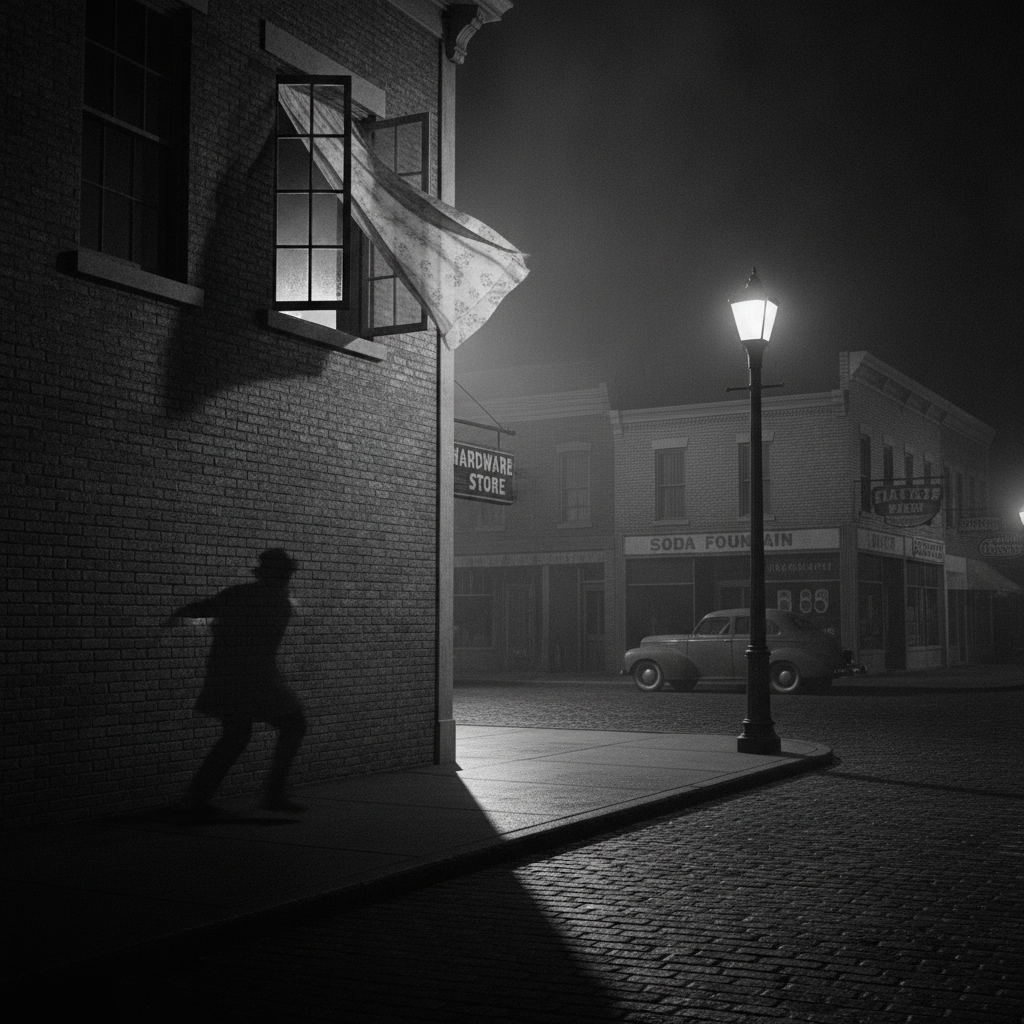
On the night of 1 September 1944, a young housewife in Mattoon, Illinois named Aline Kearney lay in bed with her small daughter while her husband Bert worked his shift driving a taxi. The war was a year from its end, and this quiet railroad town in the flat farm country of central Illinois had felt it mainly through ration books and casualty telegrams. Then Aline noticed a smell. It was sweet, sickly and unfamiliar, seeping in as if through the open bedroom window, and within moments her legs grew heavy and a dryness burned in her mouth and throat. She called out to her sister, who alerted the neighbors and telephoned the police. When Bert came home in the early hours and rounded the house, he later said he glimpsed a man at the window who turned and ran into the dark. The next afternoon the local Daily Journal-Gazette put the story on its front page under a headline about an anesthetic prowler loose in Mattoon.
Over the following two weeks the reports multiplied. More than two dozen households came forward, and the accounts were strikingly similar: a strange sweet odor near a window, then sudden nausea, dizziness, a pounding heart, a burning in the mouth, and a weakness or partial paralysis of the legs. The symptoms lifted within an hour or so and left no lasting mark. Most of those who reported an attack were women, many of them home alone at night while their husbands worked or served. Doctors who examined the affected found nothing that required treatment beyond rest.
One of the most detailed accounts came from Beulah Cordes, who found a white cloth lying on her porch, picked it up and held it to her face. She reported a violent burning, swelling of the mouth and bleeding. Near the house, according to the reports of the time, a skeleton key and an empty tube of lipstick were also found. Those objects, along with the cloth, were the closest thing the case ever produced to physical evidence.
The town armed itself. Families stopped sleeping through the night. Men sat up until dawn with shotguns across their laps, and after 5 September groups of armed citizens began patrolling the streets in cars, stopping strangers and chasing shadows. Police and city officials appealed for calm, warning that the patrols were more dangerous than the prowler, and it came very close to a tragedy in which one frightened neighbor shot another.
The story did not stay local. Wire services carried it across the country, and for a fortnight readers from Chicago to both coasts followed the hunt for a phantom who could enter a bedroom, drop his victims with a puff of gas and vanish before police arrived. As the coverage grew, the descriptions arriving at the police station grew more uniform, and the volume of calls rose with the volume of print.
The investigation, meanwhile, produced nothing. The Mattoon police, assisted by the Illinois state crime laboratory and by outside investigators, found no physical evidence of any kind. There were no reliable footprints, no forced or damaged windows, and no residue that a chemist could identify. No gas known to medicine could drop a healthy adult into partial paralysis for an hour and then disappear without a trace and without an aftereffect. The white cloth was tested and yielded nothing conclusive. Police had been called to the Kearney house twice on that first night and had found no prowler either time.
As the reports piled up, the official mood turned from alarm to open doubt. On 12 September the city's commissioner of public safety, Thomas V. Wright, issued a carefully worded and much quoted statement: he did not entirely rule out that some gas maniac existed, but he declared that many of the reported attacks amounted to nothing more than hysteria. Chief of Police C. Eugene Cole reached much the same conclusion. Almost as abruptly as they had begun, the reports stopped.
The following year the case acquired its lasting interpretation. Donald M. Johnson, a psychology researcher, published a study titled The Phantom Anesthetist of Mattoon in the Journal of Abnormal and Social Psychology in 1945. Johnson argued that Mattoon had lived through a textbook episode of mass hysteria: a community strung tight by wartime dread, already primed by fear of poison gas on distant battlefields, whipped by sensational newspaper coverage into a state where ordinary night odors and the ordinary physical sensations of fear were read as the work of a prowler with a spray gun. The symptoms, he noted, matched acute anxiety far better than any known poison. The case has been taught in psychology courses ever since.
There was one earlier precedent on the record. Between December 1933 and February 1934, farm families in Botetourt County, Virginia had reported an almost identical wave of nighttime gassings. It began at the home of Cal Huffman in the hamlet of Haymakertown, where on the night of 22 December a sweet odor and a wave of nausea struck three separate times, sickening some eight members of the household and a guest. More reports followed across the county over the following weeks, with the same sweet smell, the same nausea and swelling, and the same complete failure to catch anyone. Those events were written off, then as later, as nerves and rumor.
Conclusions and Open Questions
Eighty years on, the Mattoon file is closed but not settled, and each of the competing explanations carries a real strength alongside a real weakness.
Johnson's mass hysteria reading remains the consensus, and its advantage is that it fits the shape of the events almost perfectly: the wartime nerves, the heavily female roster of witnesses, the total absence of physical proof, and above all the sudden collapse of the whole affair the moment officials called it imagination. Its weakness is that it can feel too convenient, a label that explains everything and therefore risks explaining nothing, and it strains to account for the handful of witnesses with visible injuries.
The rival view, held at the time by Bert Kearney and by some later writers, is that there was a real attacker, at least at the start, perhaps a prowler using some industrial or homemade chemical. Its strength is that it takes the physical symptoms seriously. Its weakness is that no such chemical was ever recovered, no attacker was ever caught, and no gas matching the reports exists in the form described.
A milder version blames drifting industrial fumes from a nearby wartime plant, with the Atlas Imperial Diesel Engine works among the candidates named. That could plausibly send odd smells across a neighborhood, but it explains neither a figure fleeing a window nor a cloth left on a porch.
The most concrete accusation came much later. In a 2003 book, the researcher Scott Maruna set the hysteria consensus aside and named a suspect: Farley Llewellyn, a local man who had studied chemistry at the University of Illinois, kept a home laboratory and lived isolated from a community that regarded him with suspicion. Maruna noted that many early incidents clustered near Llewellyn's home and that several of the first people affected had been his high school classmates, and he proposed that the agent was something like nitromethane or a related sweet-smelling solvent. It is the most intriguing theory available and also the most fragile: Llewellyn was never charged and never publicly accused in his lifetime, the evidence is circumstantial and was assembled decades after the fact, and reports are said to have continued after he was supposedly confined or watched, which forced Maruna into the further speculation that Llewellyn's sisters carried on the attacks to shield him. A theory that must keep adding accomplices to survive is a theory under strain.
One theory holds that the truth was never a single thing: that Mattoon began with one real incident, a genuine prowler or a genuine whiff of something industrial at the Kearney window, and that the spark then fell into the dry tinder of a frightened wartime town. In that reading hysteria and a real trigger are not rivals but two stages of the same event. It cannot be tested now, because everyone who breathed that September air is gone.
What remains unexplained is narrower than the legend but harder to dismiss. The earliest reports, filed before the newspapers spread the story, already carried the same distinctive detail, and a sweet smell is a strangely concrete thing for separate households to invent in unison. A small number of witnesses showed swelling, vomiting and burned lips. The cloth, the skeleton key and the lipstick tube were never accounted for. And a decade earlier, hundreds of miles away, Botetourt County had reported the same script.
The open questions are these. Was there a prowler at the Kearney window on the first night, and if so was he connected to anything that followed? Can hysteria explain a flood of reports without explaining the spark that lit it? Why did two towns, a decade and hundreds of miles apart, converge on the same strange details? And what were ordinary people in Mattoon actually experiencing, given that they were genuinely and badly frightened and deserve to be taken seriously rather than laughed at across eighty years?