Solved

The Sailing Stones of Death Valley: A Century-Old Mystery That Melted Away

2026-06-22 · Enigmatic Places · 8 min read

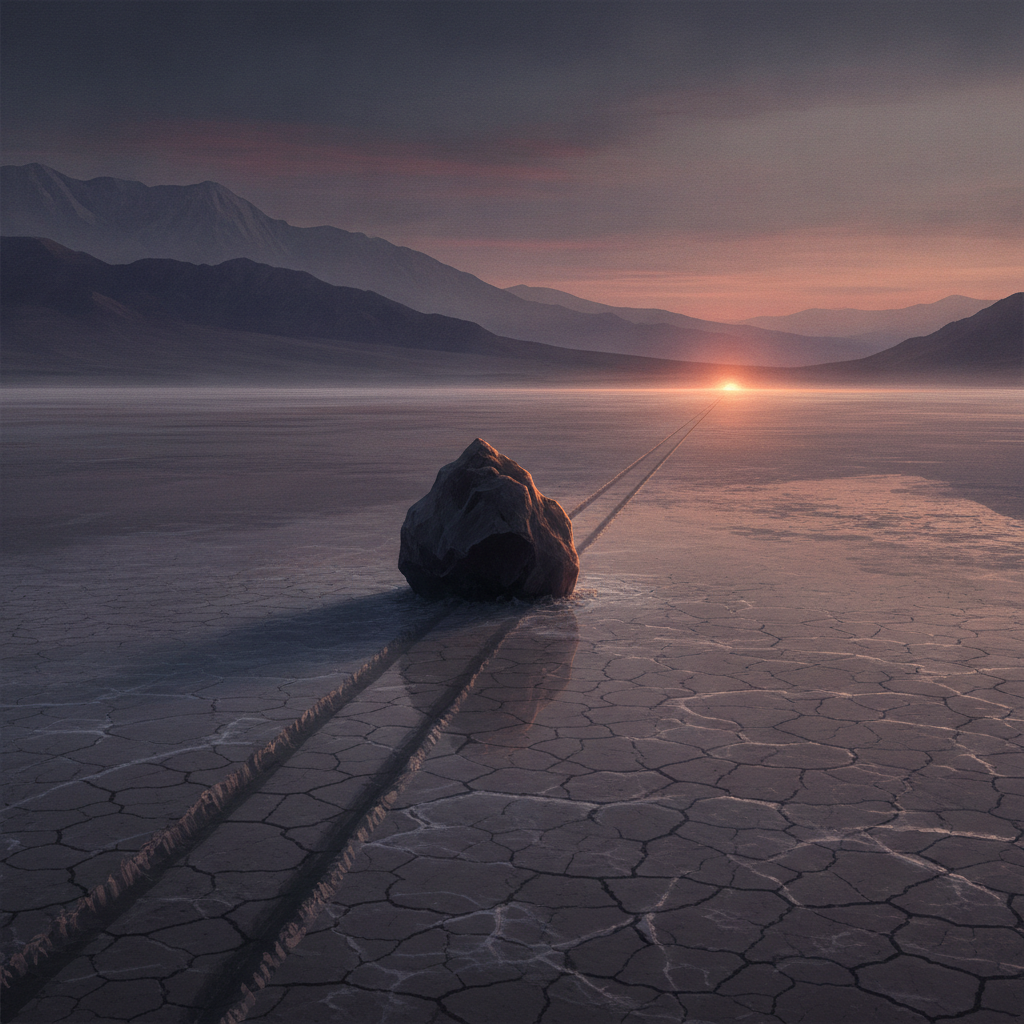
Racetrack Playa is a dry lakebed in a remote northern corner of Death Valley National Park, almost five kilometres long, flat to within a few centimetres across its whole expanse, ringed by dark mountains and hours of rough road from the nearest pavement. The mud has dried into a mosaic of cracked hexagons that runs to the horizon. Scattered across it lie hundreds of stones, some no bigger than a fist, a few weighing more than three hundred kilograms, and behind each one trails a long groove pressed into the clay. The grooves run for tens and sometimes hundreds of metres. They curve, they zigzag, and here and there several run side by side and bend in unison, like ships holding formation.

The stones had plainly moved. That was never in dispute. What nobody had was the event itself. For most of a century, no living person had reported seeing a single one of them so much as twitch. A visitor could camp on the playa for a season and see nothing but stillness, then return the following winter to find that a boulder had travelled two hundred metres in the interval, leaving a fresh scar in the mud and not a single footprint beside it. The behaviour was also inconsistent: some rocks stayed put for decades while their neighbours crossed the flat, and nobody could say why one moved and another did not.

Systematic study began in 1948, when two geologists mapped the trails and published the first scientific description of the phenomenon. Twenty years later, a far more patient effort started. From 1968 the geologists Robert Sharp and Dwight Carey staked out about thirty stones on the playa, gave each of them a name, and returned year after year to measure how far each had crept. Over roughly seven winters, twenty eight of their thirty marked stones moved. They tied the movement to particular wet seasons, concluded that a thin skirt of mud and water was central to it, and published their results in 1976. Across all those years of observation, neither man ever saw a stone move.

The next real advance came from a laboratory that was, in fact, a kitchen. Ralph Lorenz is a planetary scientist at the Johns Hopkins Applied Physics Laboratory whose research includes the frozen lakes of Titan, a moon of Saturn. In 2006 he froze a small pebble into an inch of water in an ordinary plastic food container, tipped the resulting slab upside down into a tray of sand and water so that the pebble just touched the bottom, and blew on it. The pebble slid, cutting a clean trail through the sand. The force that moved it was not a thick raft of ice dragging the stone but a thin collar of buoyant ice reducing the friction beneath it, so that even a breath was enough to start it going. Lorenz had a working model. He did not have an observation.

Getting one required somebody to be standing on the playa at the exact moment the conditions aligned. In the winter of 2011 the paleobiologist Richard Norris and his cousin James Norris set out to do precisely that. The National Park Service would not allow them to fit instruments to the playa's own stones, so they carried in fifteen rocks of their own, drilled to hold GPS loggers, and set them out alongside a weather station and a bank of time lapse cameras. Richard Norris expected to wait years. The stones were believed to move perhaps once in several winters, and always out of sight.

What happened was far quicker. In December 2013 the cousins arrived to find the playa flooded by a pond only a few centimetres deep, which had frozen overnight into a skin of ice. Around midday, under a mild sun, the ice began to break apart into large floating panes just three to six millimetres thick, no stouter than a windowpane. A breeze of roughly three to five metres per second, light enough that it was barely felt on the face, pushed those floating panes across the meltwater, and the panes shoved the rocks ahead of them through the soft mud beneath. The two men stood on the lakebed and watched the sailing stones sail.

The motion was almost comically slow, a few metres per minute, so gradual that anyone not fixing their eye on a stationary marker would have concluded that nothing was happening at all. That single winter, running into January 2014, more than sixty rocks moved, some of them travelling over two hundred metres, and the GPS units logged every centimetre of it. Ralph Lorenz, whose frozen pebble in a plastic tray had described this mechanism years earlier, was among the authors of the resulting paper. The kitchen model had been right: the work was done by thin, buoyant, friction cutting ice, not by a heavy grinding raft.

The study appeared in the journal PLOS ONE in August 2014, reporting the first direct observation of the rocks in motion. A case that had been open since 1948 was closed, and the mechanism is no longer in dispute. Ice shove on a shallow frozen pond, driven by a light wind, moves the stones of Racetrack Playa.

The paper also explained why it had taken so long. The recipe is improbably specific for one of the hottest and driest places on the planet. It requires enough rain to flood the playa; then a night cold enough to freeze the flood; then a morning sunny enough to shatter the ice into panes; then a wind gentle enough to push the fragments without destroying them. All four are needed, in that order, in a spot most people can barely reach in winter and where almost nobody lingers. Miss any step and there is nothing to see, and the window in which all four hold at once may open for only a few minutes on a handful of days in a decade. The authors added a further observation of their own: visitors may well have watched the stones move over the years without ever realising it, because ice a few hundred metres away, gliding a few millimetres thick under a pale winter sun, is very nearly invisible.

Ad

Conclusions and Open Questions

The 2014 observation settled the mechanism, but it arrived only after a long line of explanations that each looked reasonable and each failed the same test: nobody could produce the event.

The two geologists who mapped the playa in 1948 suggested dust devils, the spinning columns of air that cross the desert floor on hot afternoons. The idea had the virtue of using a force that is genuinely present at the site, but no dust devil was ever recorded moving a stone, and the hypothesis was untestable by anyone actually watching.

Another camp blamed winds of near hurricane force, imagining gales strong enough to skid a heavy rock bodily across the flat. Racetrack does get fierce winter winds, which was the argument's strength. Its weakness was arithmetic: the wind needed to shift a three hundred kilogram stone from a standstill on bare ground is far greater than anything recorded there, and such gusts would have scoured the delicate mud surface in ways the trails do not show.

Others proposed slick films of algae or wet clay that could make the surface nearly frictionless. This neatly lowered the force required, but nobody could demonstrate the films forming at the right moment, and they did not account for the long straight runs. One study tested the playa for magnetic effects, wondering whether something in the ground was tugging at iron bearing stones. It found nothing.

A darker suggestion was that the whole thing was a prank, with people coming out at night to push the stones for the sake of the legend. The trails never showed the footprints such a hoax would require, and hauling a three hundred kilogram rock two hundred metres for a joke with no audience makes little sense.

Even the ice explanation was wrong in its first form. Some argued for thick, heavy floes gripping the stones and dragging them along. That version was genuinely weak, because such ice would have plowed and gouged the mud in ways the delicate trails do not show. It was Lorenz's thin ice, buoyant rather than crushing, that corrected the picture.

What remains open is narrower than the old mystery but real. Nobody can predict which stones will move: weight, shape, and the accident of where the ice panes happen to be all seem to matter, and the rule connecting them has not been written. The very largest boulders on the playa have not been observed moving under the 2014 mechanism, and some argue that the heaviest trails may need conditions nobody has yet measured. One theory holds that older trails, cut in decades or centuries with a wetter climate, formed under deeper water and thicker ice than the panes the Norris cousins watched, which would mean more than one process has been at work on that lakebed. Repeat observations are scarce, because the window is rare, so the 2013 event stands as a single well documented sample of a phenomenon that has been running for a very long time.

There is also a question the authors raised and could not answer. If the motion is that quiet and that easy to miss, how many people stood on that lakebed across the decades, looking straight at the thing they had come to explain, and saw only a flat sheet of water and some rocks. The desert's strangest mystery did not yield to a strange answer. It yielded to water, ice, sunlight and a light wind, arranged in a sequence that almost never occurs, and the open question the sailing stones leave behind is how many other riddles are waiting not for a bolder theory but for someone to be present when the ice finally cracks.

Free reads left this month: 0

Share this story:

Reader comments (0)
Only active subscribers with verified payment can post comments. Get full access