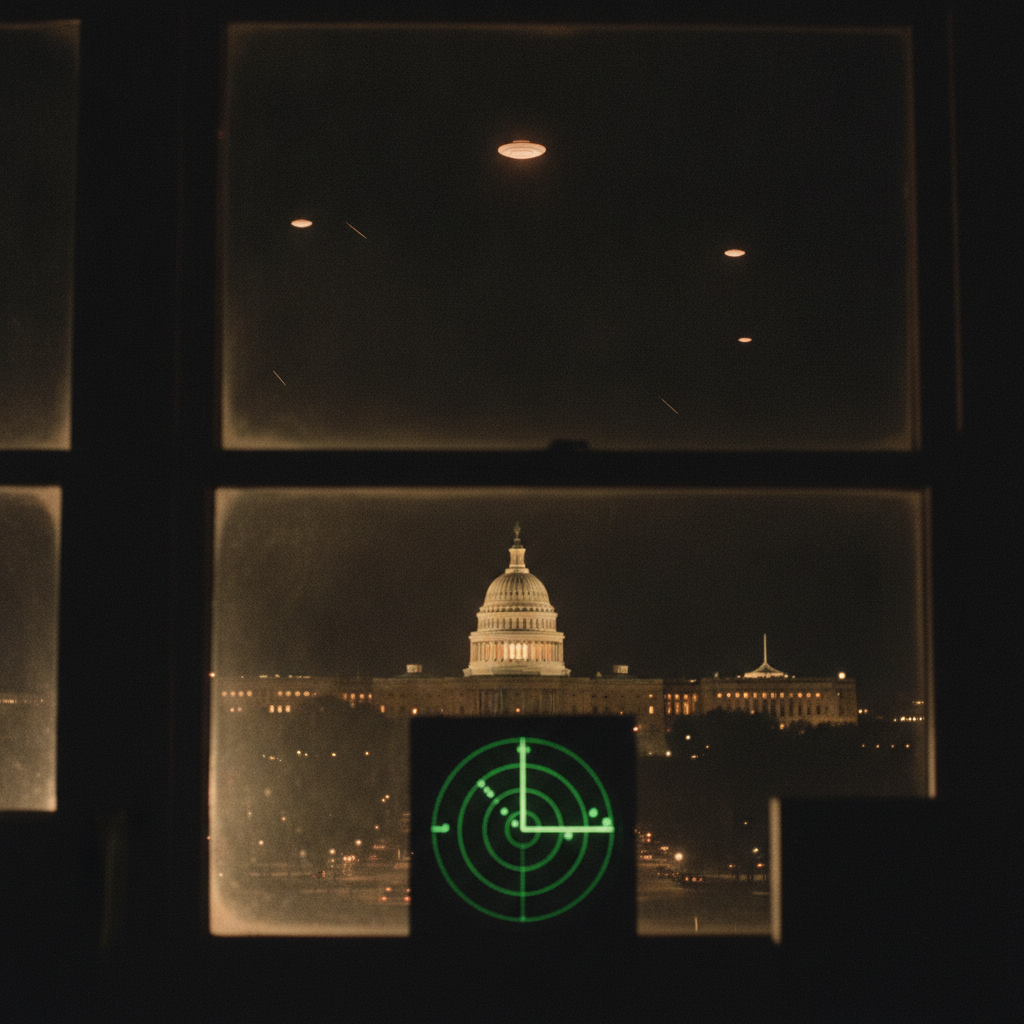
Blips Over the White House: The Washington flap of 1952
Just before midnight on Saturday 19 July 1952, an air traffic controller at Washington National Airport looked at his radar screen and saw 7 objects that should not have been there.
They were about 24 km south-southwest of the city. No aircraft were expected in that area. They were not following any flight path. They moved slowly, then suddenly sped up.
He called his senior controller over. The senior man looked, and saw them too.
Over the next 2 weekends, radar operators at the airport and at a nearby military air base tracked dozens of unidentified objects over the capital of the United States. Some crossed the closed airspace over the White House and the Capitol. Airline pilots reported lights where the radar showed objects. Jet fighters were sent up to catch them.
The events became known as the Washington flap. The Air Force said they were caused by the weather. Many of the people who sat in the radar rooms on those nights never accepted that.
What exactly was on those screens is still argued about more than 70 years later.
A summer full of saucers
To understand those nights, it helps to know the mood of that summer.
5 years earlier, in 1947, a private pilot on the west coast of the United States had reported a line of fast, shining objects, and the newspapers had invented the phrase "flying saucers". Since then the reports had kept coming.
In 1952 they exploded. The Air Force ran a small office to investigate them, at an air base far from the capital. In that summer alone it received more than 700 reports, more than in the previous 4 years put together. A popular weekly magazine had run a cover story asking whether visitors from space were here.
It was also the height of the Cold War. Military planners feared a surprise Soviet attack. Anything unknown in the sky over the capital was a serious matter.
The first night
When the objects appeared, the controllers at National Airport called the control tower. The men in the tower had their own radar, and they saw the objects too. One of them looked out of the window and saw a bright orange light.
After midnight the objects spread across every sector of the screen. Some passed over the White House and the Capitol. The senior controller called Andrews Air Force Base, about 16 km away. The radar there was tracking the same thing.
At Andrews, an airman outside saw what he described as an orange ball of fire with a tail. A sergeant saw an orange-red light moving in an erratic way.
An airline pilot, waiting to take off, watched 6 white, fast-moving lights over about 14 minutes. The senior controller later said that each time the pilot reported a light, they could see a blip near his plane on the screen.
At one point, the controllers said, an object hovered over a radio beacon. It showed up on 3 separate radars at once. Then it vanished from all 3 at the same moment.
At about 3 in the morning, 2 jet fighters finally arrived from an air base in a neighbouring state. As they came over the city, the objects disappeared from the screens. When the jets ran short of fuel and left, the objects came back.
The last one was seen on radar at about 5:30, around sunrise.
The headlines
By Monday the story was on front pages across the country. One newspaper's headline read: "Saucers swarm over capital."
By coincidence, the officer in charge of the Air Force's UFO office was in Washington that weekend. He learned what had happened from the newspapers, like everyone else.
When he tried to go and investigate, he asked for a staff car. He was told that cars were only for generals and senior colonels. He could take a taxi at his own expense. He flew back to his base instead.
Before he left, a radar specialist he spoke to suggested that unusual weather might have caused false targets on the screens. It was the first time that explanation was raised. It would become the official one.
The second weekend
On Saturday 26 July, it happened again.
At about 8:15 in the evening, the pilot and a stewardess of an airliner approaching Washington saw strange lights above their plane. Within minutes, the radars at National Airport and at Andrews were both tracking unknown objects.
This time a press officer from the UFO office came to the radar room. He asked reporters and photographers to leave, saying the radar equipment was secret.
The controllers tracked objects in every sector. Some, by their calculations, moved at up to 11,000 km/h. Others hovered, reversed, and changed direction.
At about 11:30 at night, 2 more jet fighters arrived. The flight leader saw nothing, even when he was guided straight towards blips on the radar. His wingman saw 4 white glows ahead of him and chased them at full speed. He said he could not close the distance, and gave up.
The press officer later described the moment. The pilot came on the radio, said the lights were all around him, and asked what he should do. According to that account, nobody answered, because nobody knew what to tell him.
After midnight, the UFO office's liaison officer at the Pentagon arrived, together with a Navy radar expert. The local weather station told them there was a slight temperature inversion that night. The Navy expert felt it was far too weak to explain such solid returns. The liaison officer later said everyone in the room believed the targets were probably solid metal objects.
The President asks
The second weekend reached the White House.
According to the head of the UFO office, President Truman's air force aide telephoned him and asked for an explanation. The President listened on another line.
The officer had not yet interviewed a single witness. He said a temperature inversion might be the cause.
The answer from the Pentagon
On 29 July, the Air Force's director of intelligence held a press conference at the Pentagon.
His message was calm. The lights the witnesses saw were most likely stars and meteors. The objects on radar were most likely false echoes caused by a temperature inversion: a layer of warm air sitting on top of cool air. Such a layer can bend radar beams down towards the ground, so that the screen shows cars, buildings or boats as if they were in the sky.
Inversions had been present on both weekends, he said. The objects were not solid, and they were no threat to the country.
He also gave examples. On one night, a bomber crew was guided again and again towards unknown targets and saw nothing. In the end, the radar turned out to be tracking a pleasure boat on the river. An officer at Andrews who had watched a light changing colour and dipping later concluded himself that it was a star, distorted by the atmosphere.
Later, a government aviation research centre studied the radar reports for the Air Force. It reported that an inversion had been present in almost every case where objects were seen.
The Air Force filed the case as explained.
Here the facts end and the argument begins. The records show what the witnesses said and what the Air Force concluded. They do not settle which side was right.
What happened behind the scenes
In private, the government was more worried than it said.
Documents released years later show that the intelligence services studied the summer of 1952. They were not mainly afraid of visitors from space. They were afraid that a flood of UFO reports could jam military communications, or cause panic, at the moment of a real attack.
In January 1953, a panel of scientists met for 4 days to review the best cases. It found nothing that threatened national security. It recommended that the Air Force strip UFOs of their "aura of mystery" by explaining cases to the public.
After that, the Air Force UFO office stopped publicising the cases it could not solve.
Conclusions and Open Questions
The facts on the record are these. On 2 weekends in July 1952, controllers on several radars tracked objects over Washington. Pilots and people on the ground reported lights. Jets were sent up and found little or nothing. Temperature inversions were present.
What is still disputed is whether the inversions explain everything.
The weather explanation. This is the official answer. It was backed by 2 well-known skeptics, a Harvard astronomer and a senior editor of a leading aviation magazine. Radar in 1952 had no filters to remove clutter from the ground, birds or weather. When better filtering arrived decades later, UFO sightings on radar fell sharply. The problem: the controllers were trained to recognise weather echoes and said they ignored them. The Navy expert present that night judged the inversion too weak. In 1966, a researcher for a government-funded scientific study of UFOs found that the radar witnesses still rejected the explanation. One of the controllers told a newspaper in 2002: "I saw it on the screen and out the window."
Stars, meteors and city lights. This would explain most of the visual sightings, and at least one officer on duty reached that conclusion himself. The problem: it does not explain the moments when a pilot's report and a radar blip matched, if those accounts are accurate.
Something real and unknown. This is the view of the witnesses who were sure the targets were solid. The problem: no jet got a clear look at anything solid. No photograph exists. Even a well-known UFO researcher later called it a "rather poor" case, despite its fame.
What the records do not contain is a single measurement that settles the matter. Nobody captured the radar screens. The controllers' certainty and the Air Force's explanation still stand side by side.
More than 70 years later, the Washington flap remains the most famous case of UFOs over a capital city, and it is still unresolved.