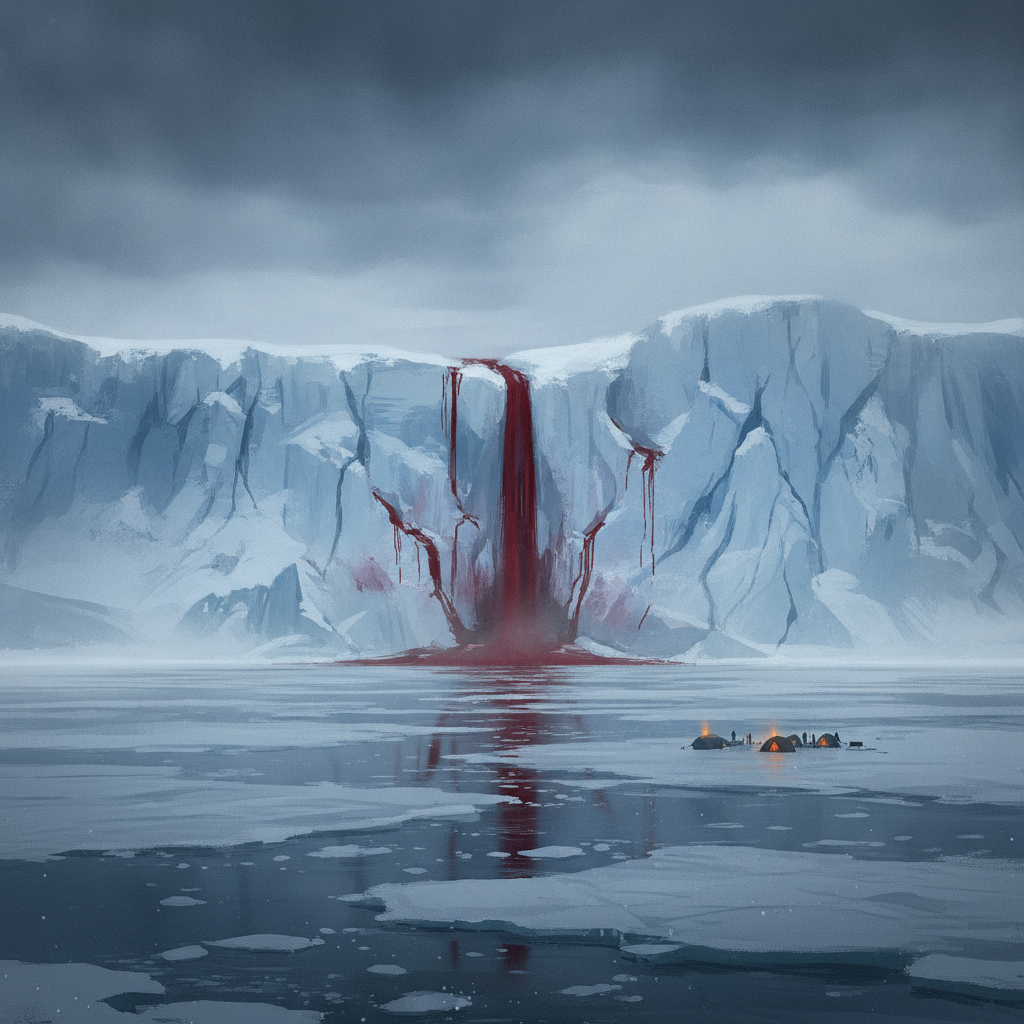
Blood Falls: The Antarctic Glacier That Bleeds, and the Century It Took to Explain
Stand at the foot of Taylor Glacier, in the frozen desert of Antarctica's McMurdo Dry Valleys, and for a moment your eyes tell you something has gone horribly wrong. The Dry Valleys are among the driest, coldest, most lifeless-looking places on the planet, a landscape of bare rock and blue-white ice where it has scarcely rained for two million years. And out of a fissure in the wall of that ancient ice, a stream the colour of dried blood spills down the pale face and pools on the frozen surface of Lake Bonney. It looks, unmistakably, like a wound. It looks like the glacier is bleeding. There is no wound, and there is no blood. And yet for more than a hundred years, nobody could say with confidence what the red water actually was.
The falls were found in 1911 by the Australian geologist Thomas Griffith Taylor, who was mapping the valley that now carries his name during Robert Falcon Scott's Terra Nova expedition, the same expedition from which Scott and four companions would never return. Taylor looked at the red stain and guessed that the colour came from red algae growing in the ice. It was a sensible first thought for a careful naturalist of his era, and it was wrong. The algae idea held for decades, partly because the real source lay somewhere no one could reach, and partly because the truth would turn out to be stranger than any living stain.
You have used your free reads for this month.
Unlock all 208 documented mysteries - in 8 languages, ad-free.
Get full access