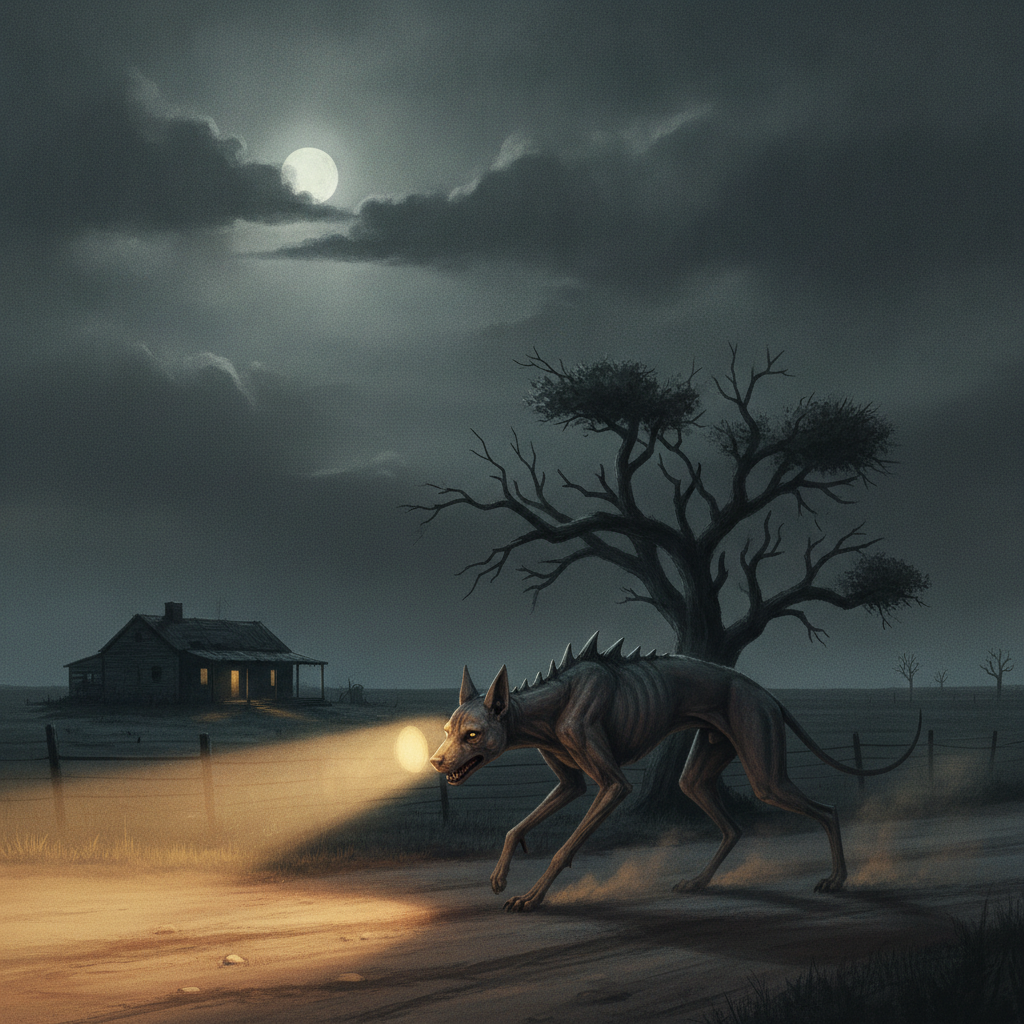
The Chupacabra: A Monster Born in 1995 and Solved in Fifteen Years
The report that started everything read like the opening of a horror film. In March 1995, on the farms outside the Puerto Rican town of Canovanas, eight sheep were found dead in a single morning, each marked by three small puncture wounds to the chest and, so the story spread from farm to farm, emptied of every drop of blood. Something was killing without eating. Sheep, goats and chickens went on turning up in the fields the same way through that spring, and within weeks the island had given the killer a name that has never left it: el chupacabra, the goat-sucker, a coinage usually credited to the Puerto Rican comedian and radio host Silverio Perez, who used it on air as the panic took hold.
The panic was real and it was large. By the end of 1995 more than two hundred separate sightings had been logged across Puerto Rico, and hundreds of dead animals were being blamed on the creature, as many as 150 of them in Canovanas alone. The town's mayor, Jose Ramon "Chemo" Soto, decided that official reassurance was not enough, and led armed weekly expeditions into the brush around the town, sometimes with a caged goat as bait, hunting a thing nobody could describe with any two accounts agreeing. A farmer's dead animals had become front-page news, and a monster had become a civic project.
The creature acquired a face that August. In Canovanas, a woman named Madelyne Tolentino described watching a beast move past her mother's window: upright, roughly a metre tall, with enormous dark eyes, thin clawed arms and a row of spines running down its back. Her account was vivid, specific and endlessly repeated, reproduced in newspapers and on television until it hardened into the standard portrait, and it became the template for nearly every chupacabra sighting that followed. From August 1995 the chupacabra looked like the thing Madelyne Tolentino had seen.
A documented coincidence surrounds that first portrait. A science-fiction horror film called Species had opened in Puerto Rican cinemas on 7 July 1995, four weeks before Tolentino's sighting. Its alien, named Sil and designed by the Swiss artist H. R. Giger, is a lean biped with huge dark eyes and a row of dorsal spines. Tolentino had seen the film, and she acknowledged the resemblance herself, later telling an interviewer that the creature in Species looked like the chupacabra, "with spines on the back and all".
The island also carried an older memory of the same crime. Twenty years earlier, in 1975, Puerto Rico had panicked over el Vampiro de Moca, the Moca Vampire, when cattle, goats and birds were found punctured and, it was said, drained through small circular incisions, while the police pointed wearily at packs of wild dogs. The pattern of bloodless livestock was not new in 1995; it was a fear the island had felt before.
Whatever its origin, the idea travelled with astonishing speed. Through the late 1990s and 2000s, reports spread across the Dominican Republic, Mexico, Chile, Argentina, Brazil, Colombia and into the southern United States, carried by newspapers, then by television, then by the early internet, each retelling adding and subtracting details. And as the creature moved north, it shed its skin entirely. The Texas chupacabra was no upright alien but a four-legged animal: hairless, grey, wrinkled, quickly nicknamed the "blue dog". Ranchers photographed these beasts, and some shot them. For once, a monster left evidence that could be put under a microscope.
It was. In 2007 a rancher named Phylis Canion, near Cuero, Texas, found several of these hairless carcasses on her land and kept a head in her freezer, convinced she had the real thing. When biologists at Texas State University tested the DNA, it came back as a coyote; a later analysis attributed the animal to a coyote crossed with something like a Mexican wolf. A separate 2010 case from Hood County, Texas, tested at Texas A&M, returned a coyote-dog hybrid riddled with mange and internal parasites. The blue dogs were real animals. They simply were not new ones.
In 2010 the University of Michigan biologist Barry O'Connor drew the strands together. The Texas chupacabras, he explained, were coyotes and dogs ravaged by severe sarcoptic mange, an infestation by the mite Sarcoptes scabiei that strips an animal's fur, thickens and folds its skin into grey wrinkles, and leaves it gaunt, reeking and unrecognisable. A coyote in that condition barely looks like a coyote at all; it looks like nothing the eye has a name for. His explanation carried a bonus: it accounted for the vampire itself. A predator that ill can hardly hunt. Too weak to run down healthy prey, a mange-ridden coyote turns to penned livestock that cannot flee, kills clumsily, and often leaves the carcass largely uneaten. To a farmer who finds a dead goat with puncture marks and its flesh untouched, it can look as though the blood, and not the meat, was the point. No fangs are needed to produce a "drained" corpse, only a hungry, dying animal and a grieving owner's eye reading purpose into a mess.
The blood itself was rarely tested. The puncture wounds and the reports of truly bloodless bodies were seldom, if ever, examined by anyone at the time; they passed from mouth to mouth as fact, and were written down as fact, without a veterinarian ever weighing the blood in one of these animals or checking whether it was in fact gone. A dead goat with two holes and its blood pooled invisibly in the body cavity, or simply soaked into the ground, looks exactly like a dead goat that has been drained to anyone already primed to see a vampire. Within roughly fifteen years of the first reports, the documented core of the case had settled into something plain: sick coyotes in Texas, a vivid eyewitness portrait in Puerto Rico, and not one carcass, anywhere, that ever turned out to belong to an unknown species.
Conclusions and Open Questions
Several explanations compete for the Puerto Rican original, and none is without a flaw. The investigator Benjamin Radford spent five years on the question and, in his 2011 book Tracking the Chupacabra, argued that the film Species was the true source: the near-exact match between Sil and Tolentino's creature, and the four-week gap between the premiere and her sighting, are his strongest evidence. Radford was careful not to call her a liar; his claim is subtler, that a frightening real experience was unconsciously reshaped around a vivid image she had recently absorbed. The theory's weakness is 1975, when the same island feared the same crime with no film to blame.
A second view holds that island folklore came first, and that Species, at most, handed an old fear a new face. This answers the Moca Vampire of 1975 handsomely, but it struggles to explain why the 1995 monster took that one very particular upright, spiny shape rather than any other.
The mange-and-coyote explanation is the best supported of all, resting on actual DNA and a known parasite. Its limit is geographic: it belongs to Texas and to the four-legged blue dog, and cannot by itself account for the upright biped that Puerto Rico described in 1995.
A darker theory circulated on the island itself. Canovanas sits at the edge of El Yunque, a rainforest partly ringed in those years by United States military and government installations, and some argued that the chupacabra was the escaped product of secret American genetic experiments conducted there. The idea had a certain political logic on an island long uneasy about what its distant government did on its soil, but it has never had a shred of documentary support: no leaked file, no defecting technician, no laboratory ever found.
The last theory, that a genuine unknown animal is still out there, founders on the plainest fact of the case: every carcass ever tested has turned out to be an animal science already had a name for.
What remains unexplained is smaller and stranger than any monster. The drained-corpse detail, the claim on which the whole legend rests, was almost never verified at the time. One theory holds that there were really two chupacabras from the start, sharing a name and almost nothing else: a Puerto Rican one, born of vampire folklore and a horror film and never captured because it was never flesh, and a Texan one, entirely flesh, a diseased coyote onto which a ready-made legend was draped. The name travelled north faster than any animal could. The open question is no longer what the creature was, but why so many people, across so many countries, needed the story to be true, and told it to one another until it was.