The Copper Scroll: The Dead Sea Treasure List No One Has Ever Cashed In
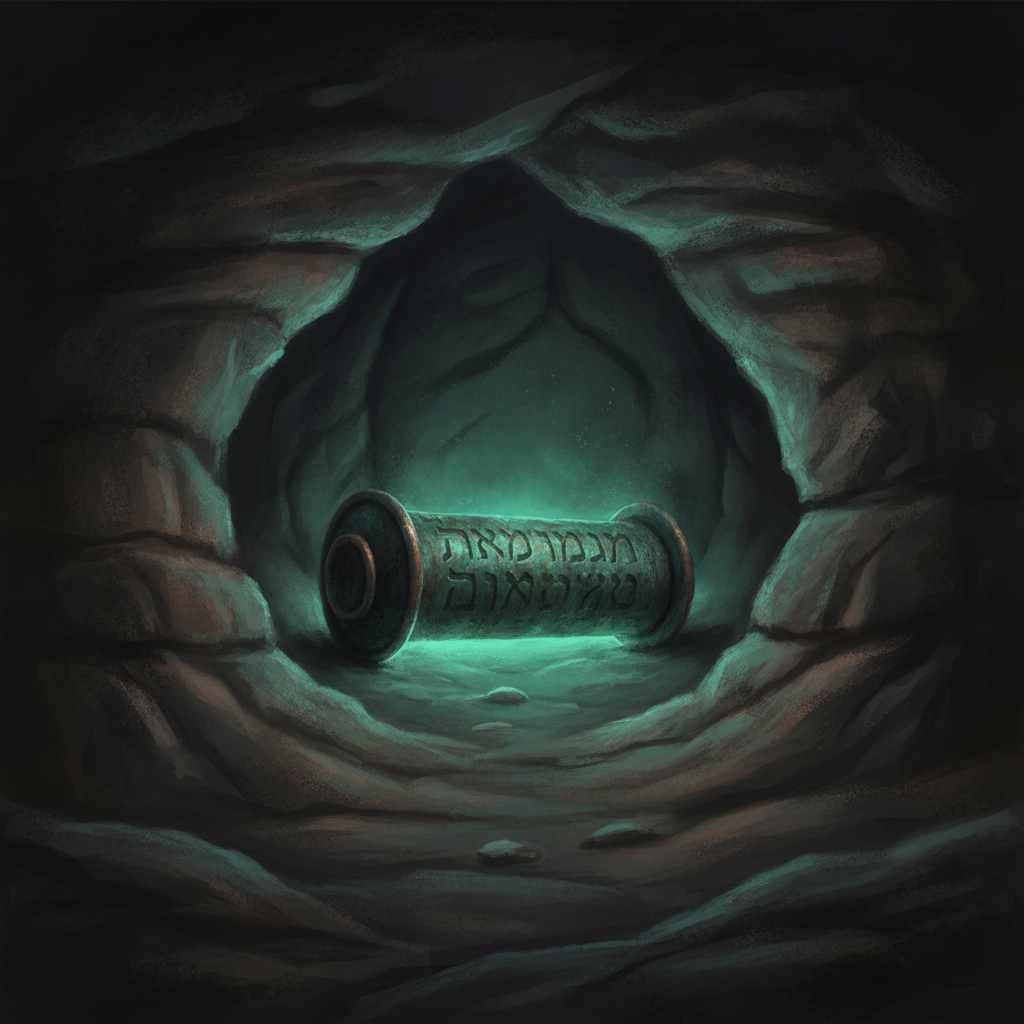
On the morning of 14 March 1952, a survey team led by the French archaeologist Henri de Contenson was working its way through a partly collapsed cave in the marl cliffs above the Dead Sea, near the ruins of Qumran in what was then Jordanian territory. The archaeologists were in a quiet race with the local Bedouin, who for five years had been finding - and selling - the Dead Sea Scrolls faster than any scholar could reach them. Cave 3, as it was soon catalogued, had so far given up only broken storage jars and a handful of parchment scraps. Then, at the very back, propped against the rock, a lamp caught two rolled sheets of green, mineralized metal. Every other scroll from these caves is ink on parchment or papyrus, and almost all of them contain religious literature - hymns, biblical books, the rulebook of a sect. This object, designated 3Q15, had been hammered into almost pure copper. And when it finally gave up its text, there was not a single line of scripture in it. It was an inventory of buried treasure.
For three years nobody could read a word. Two millennia of oxidation had turned the metal into something like eggshell; any attempt to unroll it would have shattered the text into flakes. The solution came from an engineer, not an archaeologist. In 1955 the Jordanian authorities sent the rolls to the Manchester College of Science and Technology in England, where Professor H. Wright Baker coated them in adhesive and, beginning on 1 October 1955, sliced them into 23 curved strips with a saw blade a fraction of a millimetre thick. By early 1956 the full text lay open: twelve columns of terse, administrative Hebrew listing around 64 hiding places and a running total of roughly 4,600 talents of gold and silver. What a talent weighed in the first century is itself disputed, but on any reasonable conversion the totals run to dozens of tonnes of precious metal - some estimates reach 26 tonnes of gold and 65 of silver. It is more than any private fortune of the period could plausibly account for.
Break the totals down and the strangeness only deepens. Roughly 1,285 talents are logged as gold, some 666 as silver, another 600 in gold and silver vessels, and the remainder - well over two thousand talents - as mixed precious metal. A few caches are almost modest, a scatter of coins beneath a step; others are staggering, hundreds of talents heaped in a single pit.
Consider, too, the sheer labour of the thing. Someone chose copper over cheap papyrus knowing the work would take a skilled metalworker weeks, letter by hammered letter, and knowing that copper survives fire and flood as parchment never could. That is not the choice of a storyteller entertaining a community on a winter evening. It is the choice of someone who needed the record to outlast a catastrophe he could see coming. Whatever the list contains, the medium itself insists that its maker believed every word of it.
The entries read like a clerk's checklist, flat and specific: a sum buried in a cistern beneath a flight of steps, another under a courtyard threshold, another sealed inside a tomb, another in the mud of an old reservoir. Seven of the entries are followed by small clusters of Greek letters - two or three characters, like a shorthand or an initial - that no one has convincingly explained. Then comes the entry treasure hunters quote in a whisper. In a pit north of a place the scroll calls Kohlit, it says, lies a duplicate of this very document, with explanations, measurements and a full inventory, item by item. The Copper Scroll, in other words, presents itself as the short version - the index to a master list held somewhere else. No trace of that second scroll has ever been found.
If the treasure was real, no one has found it. Allegro's own expeditions in 1959 and 1960 dug at the likeliest sites and recovered nothing, and freelance treasure hunters have quietly damaged the landscape ever since. The scroll's directions depend on landmarks - reservoirs, gates, tombs, courtyards, a specific staircase - obvious to the writer and unidentifiable today. Two thousand years of war, rebuilding and erosion have wiped the reference points from the ground. Modern science has sharpened the text without softening the riddle: between 1994 and 1996, laboratories of Electricite de France X-rayed, cleaned and made facsimiles of the strips, and the epigrapher Emile Puech used the results for a new edition. The reading improved. The mystery did not.
Today the strips are displayed, still in their 23 cut segments, at the Jordan Museum in Amman, where they were moved in 2013.
Conclusions and Open Questions
From here the questions multiply faster than the answers. Why would anyone engrave a fantasy onto copper - the most expensive and durable writing surface of its day - in dry bookkeeping prose, without a hero, a curse or a single narrative flourish? Yet if the list is real, how could any community of the first century control wealth on this scale? Why is the Hebrew of the scroll unlike that of every other Qumran text, closer to the everyday speech of the later rabbis than to the sect's own literary idiom? Why are place names given as though the reader already knew the district intimately, with no map and no route? And why hide a treasure ledger in the library of a community whom ancient writers praised precisely for its poverty? Not one of these questions has an answer that satisfies everyone.
The scroll's first appointed editor, the Polish priest Jozef Milik, cut the knot by declaring the treasure imaginary. The list, he argued, was folklore - a legend of buried riches committed to writing around 100 CE, of a piece with later Jewish tales of the lost vessels of the Temple. His edition appeared in 1962 in the official Discoveries in the Judaean Desert series, and for a generation it carried the weight of orthodoxy. The reading explains the impossible totals elegantly. But it collides with the object itself: folklore is not usually punched, at enormous cost, into sheet copper by a craftsman whose mistakes, letter by letter, suggest he was mechanically copying a text he barely understood.
John Allegro took the opposite view, and took it loudly. He had pushed for the Manchester opening, and when the official publication dragged on he lost patience and brought out his own translation in 1960, The Treasure of the Copper Scroll. His logic was blunt: so costly a medium means real accounting, and sums of that size mean an institution - the Temple in Jerusalem, its treasury scattered into the desert before the Romans burned the city in 70 CE. Roland de Vaux, who headed the whole scrolls project, condemned the book as sloppy and unauthorised, and the personal feud that followed did the theory no favours. The weakness is real regardless: Qumran's sectarians appear to have rejected the Temple priesthood outright, so why would its treasurers trust their deepest secret to this particular library?
A third reading, from the scholar Manfred Lehmann, dates the deposits after the destruction rather than before it. Religious taxes, he noted, kept being collected even with no Temple to receive them, and the scroll records where the collectors banked that money in the decades between the two Jewish revolts. It accounts neatly for the institutional sums and the accountant's tone. Its weakness is that it hangs on a contested dating of the script, which other epigraphers read differently. A newer variant pushes the date later still and reads the caches as a war chest - coin and bullion stockpiled for the Bar Kokhba revolt of 132 to 135 CE - which would explain the military scale of the hoard, though it strains against the earlier palaeographic estimates most experts still favour.
There are wilder readings still. The metallurgist Robert Feather argued that the scroll's treasure, and even the roots of its language, pointed back to Egypt and the monotheist pharaoh Akhenaten - a thesis most specialists file under ingenious rather than convincing. It is worth naming only because it shows how strongly the vacuum pulls: when a document promises tonnes of gold and names places no one can locate, almost any theory can be poured into the empty space. The discipline lies in knowing which ones the evidence will actually bear.
One has to wonder, too, whether the hunt was over before it began. Jerusalem fell to an army practised at extracting hidden wealth from conquered cities, and anyone who helped bury the caches could later have quietly unburied them. A possibility rarely given its due is that the Copper Scroll was already a dead document when it was hidden - a record kept out of duty for accounts that had long since been emptied, filed away like a receipt for money already spent. And one cannot help staring at those seven clusters of Greek letters. If the rest of the scroll is a genuine ledger, they read less like decoration than like a key: the initials of couriers, perhaps, or a cross-reference to that vanished master scroll. Both ideas are only guesses; nothing documented settles either, and honesty requires saying so.
Visitors file past the only surviving ancient text that reads like a bank's safe-deposit ledger, and each of them has to decide what it is: the one authentic ancient treasure map in existence, or the most expensive piece of fiction ever engraved. Somewhere in the desert east of Jerusalem there may be a second scroll that would settle the question in a sentence. Until someone finds it, the Copper Scroll keeps its accounts closed, and its silence is worth more than any of the gold it claims to hide.