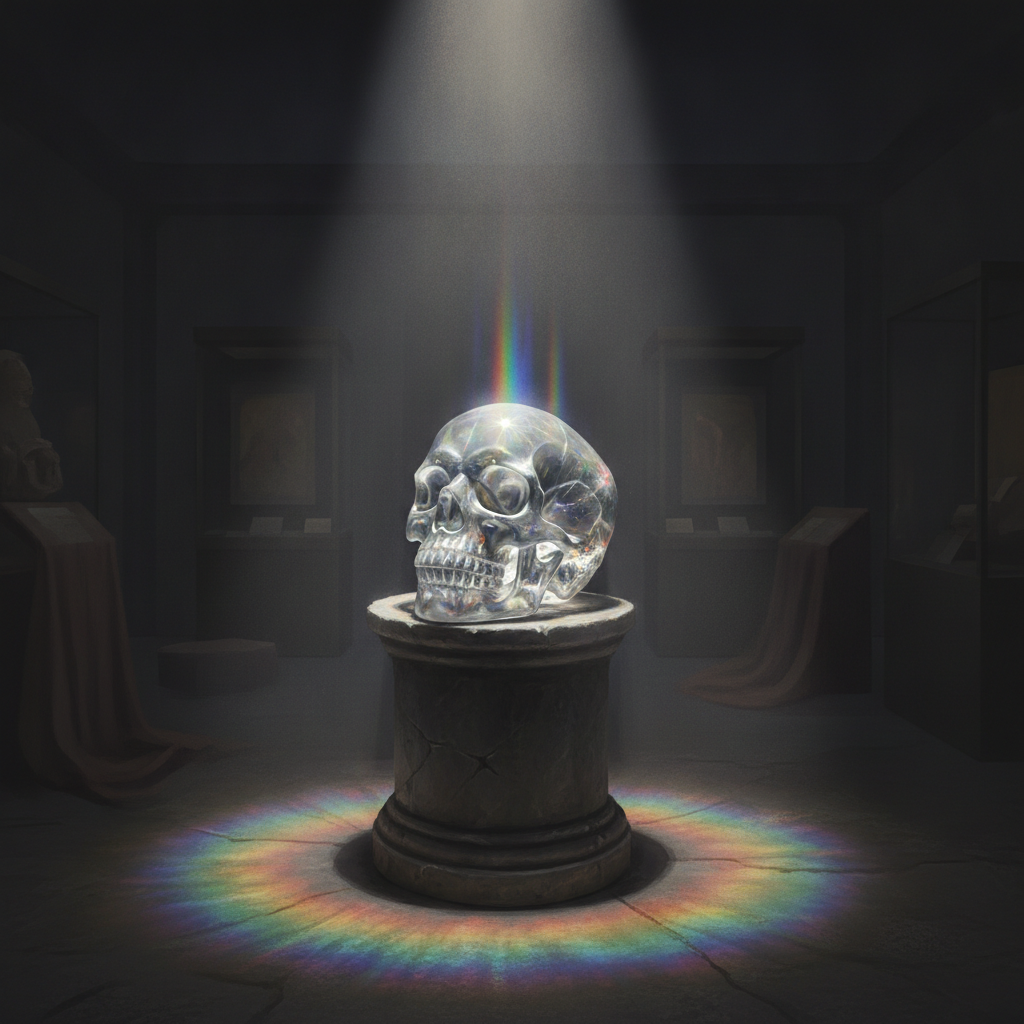
The Crystal Skulls: How a Jeweller's Wheel Betrayed the Ancient Maya Legend
In 1881 a life-size human skull, carved from a single block of polished rock crystal, went on sale in the Paris shop of the antiquities dealer Eugene Boban. Boban was no marginal figure. He had served as official antiquarian to the court of Emperor Maximilian during the brief French imperial adventure in Mexico, and he understood exactly what a European market hungry for the vanished New World would pay. He had already tried and failed to sell crystal skulls to Mexico's national museum as genuine Aztec finds. The Paris skull passed through auction to the New York jeweller Tiffany and Co., which bought it from Boban for 950 dollars and in 1897 passed it to the British Museum, where it was catalogued as Aztec and put on display. A second skull, also traceable to Boban, entered French public collections; it is held today at the Musee du quai Branly in Paris.
In July 1936 readers of Man, the journal of the Royal Anthropological Institute in London, were given a piece of forensic theatre: two life-size human skulls of polished rock crystal, photographed and measured point by point. One was the British Museum's. The other stood in the London gallery of the art dealer Sydney Burney. The anatomist G. M. Morant reported that the two objects resembled each other far too closely to be independent works. Adrian Digby of the British Museum answered him in print. Nobody in that polite exchange imagined that Burney's skull would end up the most famous Maya relic on earth.
You have used your free reads for this month.
Unlock all 208 documented mysteries - in 8 languages, ad-free.
Get full access