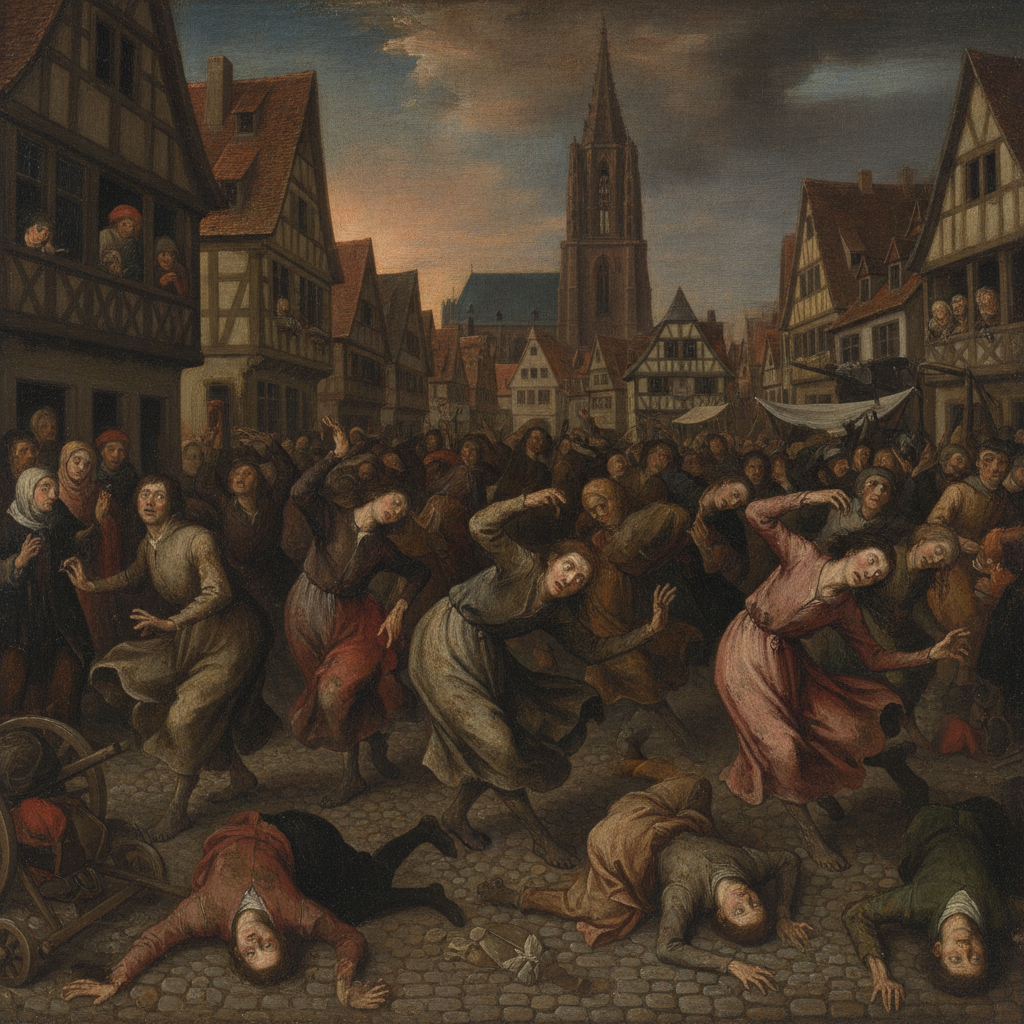
The City That Couldn't Stop Dancing: Strasbourg, 1518
On the morning of 14 July 1518, a woman known to history only as Frau Troffea stepped out of her narrow half-timbered house into a Strasbourg street and began to dance. There was no music, no wedding, no festival, no drink taken. Witnesses described something closer to torment than to joy: a grim, contorted, trance-like persistence, hour after hour, her limbs jerking as though driven by a will that was not her own. Her husband, the chronicles say, pleaded with her to stop. She did not, or could not. She danced until she collapsed in sweat and exhaustion, slept a few hours, then rose and danced again on feet that were already swelling and bleeding. By some accounts she kept it up for four to six days, in the punishing heat of one of the hottest summers the city could remember, while a crowd thickened around her: first to laugh, then to stare, and then, most unsettling of all, to join her.
Within a week roughly three dozen people were dancing. Within a month, chroniclers claimed, as many as 400. Modern scholars sifting the same papers put the number of afflicted somewhere between 50 and 400. Even the low figure would make it one of the strangest public-health events ever set down on paper.
You have used your free reads for this month.
Unlock all 208 documented mysteries - in 8 languages, ad-free.
Get full access