Documented

The Airship That Came Home Without Its Crew: The L-8 Mystery

2026-08-25 · Vanished Without a Trace · 8 min read

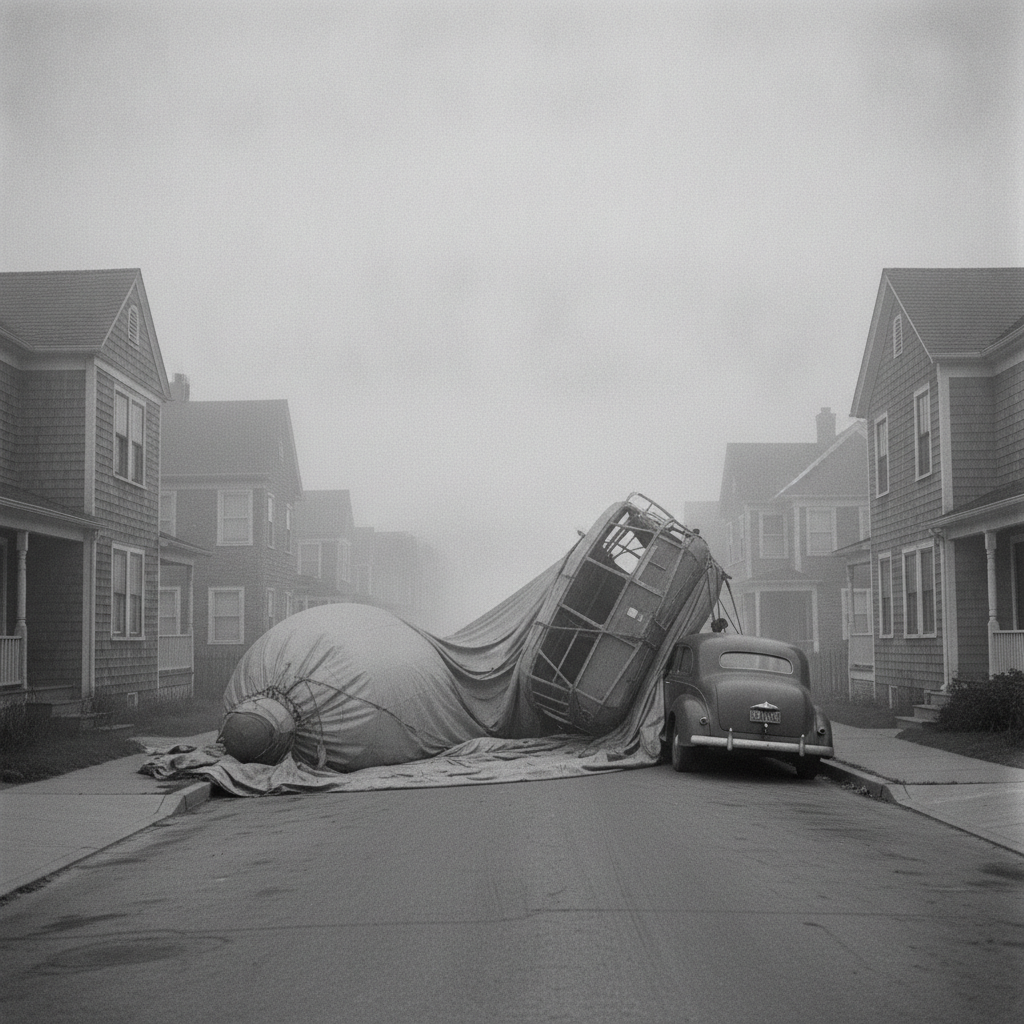
The first thing anyone on Bellevue Avenue noticed was the shadow. It slid across the rooftops of Daly City a little after eleven on a Sunday morning in August 1942, dragging a mooring rope through the coastal fog, and by the time people came out onto their porches a United States Navy airship was already settling onto their street. It clipped the house at number 419, crumpled against a parked car and came to rest with its collapsing envelope spread over the pavement like a fallen tent. Firefighters from a station a block away ran up with knives and cut through the fabric to reach whoever was trapped inside.

The control car was empty.

The radio was working. The parachutes were still stowed. The inflatable life raft was still lashed in place, the ignition switches were set, there was fuel in the tanks, and the two doors of the gondola stood open. Of the two officers who had lifted off from Treasure Island five hours earlier there was no sign at all. There has been no sign of them since.

The airship was L-8, a small non-rigid patrol blimp built as a commercial Goodyear ship and taken into naval service after Pearl Harbor. She belonged to Airship Squadron ZP-32 and flew out of Treasure Island in San Francisco Bay. The work was unglamorous and, in the summer of 1942, entirely serious. Japanese submarines had operated off the American west coast that year, and in February one of them had shelled an oil installation on the California shore. A blimp was slow and fragile, but it could hang over a patch of ocean for hours at a time, look down through clear water at a submerged hull, and drop a smoke marker or a depth charge.

At 6:03 on the morning of Sunday 16 August 1942, L-8 lifted off for a routine anti-submarine patrol over the approaches to the Golden Gate. Two men were aboard: Lieutenant Ernest DeWitt Cody, twenty-seven years old and in command, and Ensign Charles Ellis Adams, an experienced airship man who had recently been commissioned and was making his first patrol as an officer. A third crewman, Machinist's Mate James Riley Hill, had been ordered off the ship minutes before departure. Cody judged the airship too heavy for the conditions that morning, and Hill stayed on the ground. He would spend much of the rest of his life being asked about that decision.

At about 7:40 the crew radioed Treasure Island. They had spotted an oil slick on the water a few miles from the Farallon Islands and were going down to investigate it. The message was ordinary, unhurried and complete. It was the last thing anyone ever heard from them.

What happened over the slick was not unobserved. Two vessels were close enough to watch, and both crews later gave accounts. The fishing boat Daisy Gray was working nearby; her first mate could see two men in the gondola, close enough to note that one of them had dark hair. The Liberty ship Albert Gallatin watched through binoculars as the blimp dropped smoke floats onto the water to mark the slick and then circled it, first at two or three hundred feet, then lower, at one point coming down to roughly thirty feet above the swell. The manoeuvres looked deliberate and professional. Nobody on either vessel saw anyone fall, saw anyone in the water, or saw anything approach the airship.

Then L-8 climbed away. She rose, drifted off her assigned patrol track and turned east toward San Francisco, and she did it without a word. Treasure Island called her and got nothing back. The radio in the gondola was later found in working order and correctly set. Whatever ended the flight of Cody and Adams did not damage their equipment and did not give them time, or reason, to use it.

By late morning the airship was over the city itself, low and unsteady, sagging as helium bled out of her. She came in over Ocean Beach and touched the sand, and for a moment two surf fishermen caught hold of a trailing line and tried to hold her down. She was too much for them. She lifted again, struck the cliff near the Olympic Club golf course, damaged a propeller and shed one of her two depth charges, which fell onto the fairway and did not explode. Lightened, she rose once more, drifted inland over Mission Street and finally came down on Bellevue Avenue in Daly City, trailing hundreds of onlookers behind her.

Ad

The search that followed was immediate and enormous. Aircraft, surface vessels and small craft covered the water off the Farallons and the approaches to the Golden Gate. Nothing was found: no bodies, no life jackets, no debris, no oil in the wrong place. No submarine was ever located near the slick, and the slick itself was never conclusively explained, although a routine discharge from a passing ship was the obvious candidate and the one most investigators accepted.

A Navy board of inquiry took evidence for weeks. It established what had not happened with reasonable confidence. L-8 had not been shot at or attacked. There had been no fire, no explosion and no structural failure. She had not gone into the sea and been recovered. The board found nothing in the conduct or the records of either officer to suggest misconduct. It also recorded doubts about the adequacy of the safety latch on the gondola door, which is the closest the Navy ever came to a mechanism. What the board could not do was say where the men had gone. It conceded, in effect, that the answer was a matter of conjecture. Cody and Adams were declared legally dead in 1943.

Two details from the wreck have shaped every argument since. The parachutes were aboard, unused. And both of the men's life jackets, the inflatable vests every crew wore over the water, were gone from the ship. Whatever took Ernest Cody and Charles Adams out of that gondola, they went out of it wearing the equipment that was supposed to keep them alive in the sea, and they were never found in it.

Conclusions and Open Questions

The explanation the Navy leaned toward is also the least dramatic. In this reconstruction, one man opened the after hatch or the door to deal with a smoke float, lost his footing and fell part way out, and the other, trying to pull him back, went out with him. It fits a good deal of the evidence. It explains the open doors, the missing life jackets and the stowed parachutes, which no one would have had time to reach. It also explains the airship's sudden climb: an L-class blimp trimmed for two men aboard would rise hard the moment roughly three hundred and fifty pounds left her, and a rising, unmanned ship drifting inland is exactly what the rest of the day describes.

The weakness of the accidental-fall theory is the silence and the audience. Two ships' crews were watching the blimp through the whole of that low, slow circuit, and no one on either of them saw a man go into the water. The aviation historian Dan Grossman has made the further objection that the sequence contradicts how the crew were trained to behave: an officer whose colleague is hanging from an open door has a radio at arm's length, and the first thing he is supposed to do is call it in. Neither man did. And the ocean off the Golden Gate is heavily worked water. Two men in inflated life vests, in daylight, within sight of shipping, are not usually lost without trace.

The wartime theories ran in the other direction. It was suggested at the time, and repeated for decades afterwards, that the men had been taken off by a Japanese submarine, or that they had deserted, or defected. These have very little to support them. No Japanese naval record of such an action has ever been produced, and none of the extensive postwar work on Japanese submarine operations off California has turned one up. A submarine surfacing in daylight, in sight of a fishing boat and a Liberty ship, to take two men off an airship without either vessel noticing, is a great deal harder to believe than a fall. Desertion runs into the same problem in reverse: it requires a plan that begins with an airship that then flies itself into a suburb, and there was nothing in the records of either officer, or in the lives they left behind them, that pointed that way.

Darker readings, that the two men fought, or that a stowaway was aboard, have circulated since 1942 and survive mainly because the case is empty enough to hold them. Both leave the same hole: somebody would have had to remain in the gondola, and somebody would then have had to leave it too. A woman who watched the descent through binoculars reported seeing three men aboard, but the witness accounts from the city that morning contradict each other badly. Others said they saw no one at all, and some reported parachutes that the wreck proved were never used. Bystander testimony of a distant airship in fog is exactly the kind of evidence a board of inquiry learns to weigh lightly.

What remains is a set of facts that no theory has yet closed. Two trained officers left a working aircraft, in daylight, over water that was being watched from two directions, wearing their life jackets and leaving their parachutes behind, without touching a radio that was on and functioning. The sea gave nothing back. The airship itself was repaired within weeks and flown again; after the war her gondola was sold to Goodyear, carried advertising over American cities for years, and is preserved today at the National Naval Aviation Museum in Pensacola, restored to her wartime markings. The vessel survived the mystery by more than eighty years. The men did not, and the record still has no line in it that says where they went.

Free reads left this month: 0

Share this story:

Reader comments (0)
Only active subscribers with verified payment can post comments. Get full access