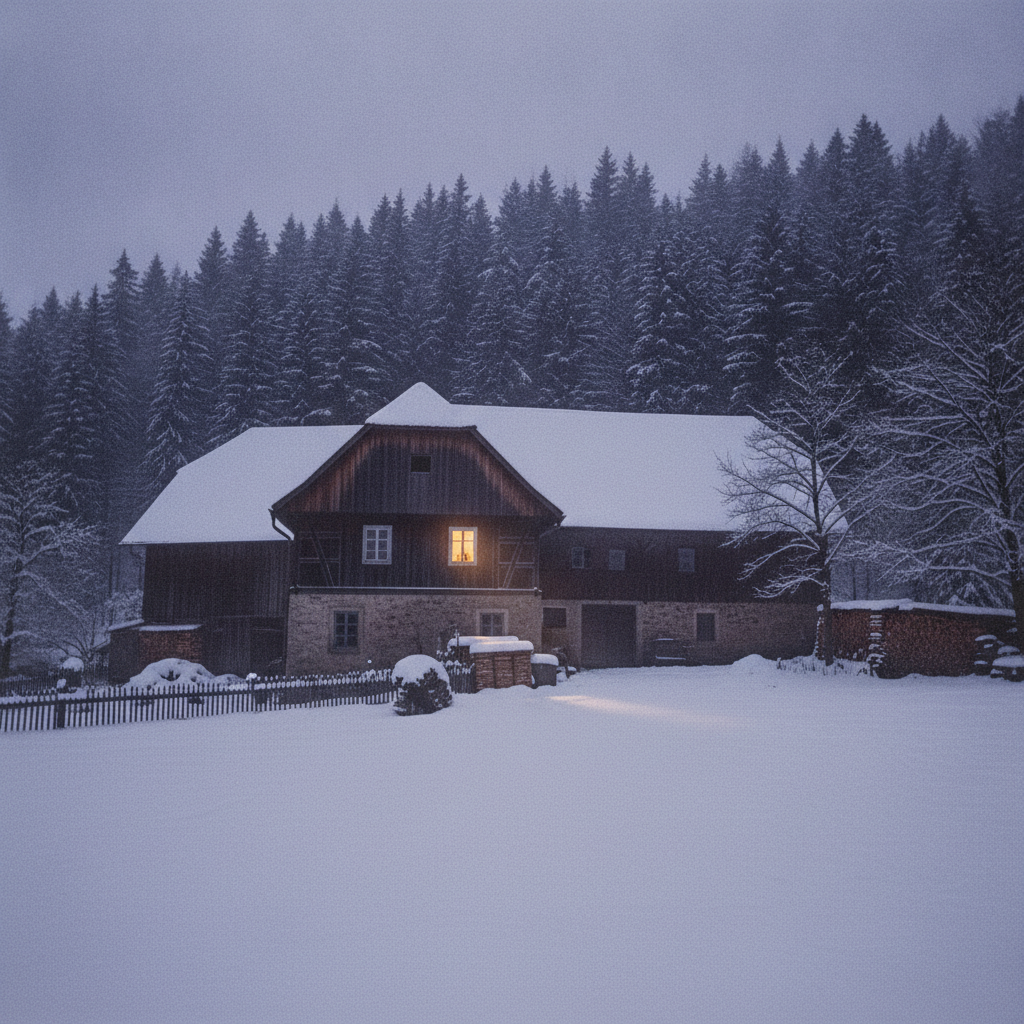
Footprints in the Snow: The Hinterkaifeck Farm Murders
In the last days of March 1922, a Bavarian farmer named Andreas Gruber found a set of footprints in the fresh snow around his land. They came out of the forest and led up to his farmstead, to the door of the machine room, whose lock had been broken. What unsettled him was what he could not find: there were no tracks leading away. Whoever had crossed the snow had walked to the farm and, so far as the snow showed, had never left it. Gruber mentioned the tracks to his neighbours. He did nothing further. Within about a week he and five other people were dead.
Hinterkaifeck was not a village but a single farm, an Einoedhof standing alone in the fields between Ingolstadt and Schrobenhausen, north of Munich. Six people lived there. Andreas Gruber was sixty-three; his wife Cäzilia was seventy-two. Their widowed daughter, Viktoria Gabriel, was thirty-five and lived on the farm with her two children, seven-year-old Cäzilia and two-year-old Josef. The sixth resident was the maid, Maria Baumgartner, forty-four, who had arrived to take up her post only on the afternoon of the killings. Her predecessor, Kreszenz Rieger, had left the farm about six months earlier, and it was later widely reported that she gave notice because she had heard unexplained noises in the house and believed it to be haunted.
The footprints were not the only warning sign in those final days. Andreas Gruber spoke of footsteps heard in the attic when no one was up there, of a set of house keys that had gone missing, and of an unfamiliar Munich newspaper found on the property that no member of the household admitted to having bought. Together, and read in the light of what followed, these details suggest someone who had already found a way into the buildings and was moving through them unseen.
The household also had a history that its neighbours knew well. Viktoria had married Karl Gabriel in 1914; within months he was reported killed on the Western Front, at the Battle of Arras. In 1915 Andreas Gruber and his daughter Viktoria were convicted of incest, he serving a year and she a month. Some people locally, among them Viktoria's later suitor Lorenz Schlittenbauer, believed that little Josef had been fathered by Andreas. This is the documented background to the case: a household already marked by scandal, grief and coercion long before the night of the killings.
On the evening of 31 March 1922, all six were killed. The evidence indicates that four of them, Andreas, the elder Cäzilia, Viktoria and seven-year-old Cäzilia, were drawn one at a time into the barn, and there struck down with a mattock, a heavy farming tool that belonged to the family and was later recovered on the property. Two-year-old Josef and the maid Maria Baumgartner, who had been on the farm only a few hours, were killed inside the house. The court physician who examined the bodies, Johann Baptist Aumueller, concluded from the scene in the barn that the young Cäzilia had not died at once but had lain injured in the straw for some hours. It is the hardest detail in the record, and it is set down here plainly and left there.
The bodies were not discovered until 4 April, four days later, and through those days the farm did not stand empty. The livestock had been fed and milked. Food from the kitchen had been eaten. Neighbours later said they had seen smoke rising from the chimney. Whoever killed the six people of Hinterkaifeck, the evidence indicates, did not flee that night. He remained on the farm, cared for the animals, ate at the family's table and in all likelihood slept under the same roof as the dead.
The discovery came almost by accident. A mechanic named Albert Hofner arrived on the morning of 4 April to repair an engine, waited in vain for anyone to appear, worked alone for several hours and then left. Only that afternoon did a group of neighbours, among them Lorenz Schlittenbauer, come to check on the silent farm. They opened the barn and found four bodies stacked and covered with hay and an old door. Inside the house they found the maid in her room and the toddler in his cot. The next day, 5 April, Aumueller carried out the autopsies on the spot, inside the barn where the four had died.
The investigation was compromised from the beginning. Curious neighbours had already walked through the scene and moved the bodies before the police from Munich, led by Inspector Georg Reingruber, could secure it. Fingerprints, already an established technique in 1922, were never properly taken. In a decision that reads today as part science and part superstition, the victims' heads were severed and sent to Munich, where clairvoyants were reportedly consulted over the skulls in the hope of drawing some impression from them. Nothing usable resulted. The skulls themselves were later lost in the upheaval of the Second World War, so the six lie buried in the local churchyard beneath a memorial, but without their heads.
Robbery was ruled out early, because a considerable sum of money was found untouched in the house. Over the following decades more than a hundred people were questioned. The file was formally closed in 1955, though the last interrogations took place as late as 1986. No one was ever charged. The farm itself was pulled down within a year of the murders; the site today is a field with a small shrine.
The most rigorous modern review came in 2007, when fifteen students at the Bavarian police academy in Fuerstenfeldbruck re-examined the case as a cold-case exercise, applying methods the original investigators did not have. They praised the thoroughness of much of the 1922 inquiry while condemning its failure to take fingerprints, and they concluded that the crime can no longer be definitively solved: too much evidence is gone, and every suspect is long dead. The reviewers also reported that they had independently arrived at the same most likely suspect as earlier investigators, and then declined to name him, out of consideration for that person's living descendants.
Conclusions and Open Questions
The theories have circled the same small group of people for a century, and each of them explains part of the case and fails on some fixed detail of the scene.
The most enduring suspicion, held by many investigators and by much of local opinion from the first days onward, points to Lorenz Schlittenbauer, the neighbour who had courted the widowed Viktoria and who may have believed himself to be the father, or the disputed father, of little Josef. He knew the farm intimately, he was among those who found the bodies, and by his own account he handled and moved them, entering the barn with a composure that struck some observers as the ease of a man who already knew what he would find. The weakness is equally clear: investigators could never place him at the farm on the night itself, he had reasons of grief and paternity to touch the bodies, and a century of suspicion never became proof.
A stranger theory, circulated as local legend rather than by any investigator, fastens on Karl Gabriel, Viktoria's husband, the soldier reported killed at Arras in 1914. Some claimed his body was never brought home or conclusively identified, and the story holds that he survived the war, returned in secret to find his household transformed by scandal, took revenge and vanished. Its strength is that it accounts for a great deal at once: an intruder who knew the buildings, tracks that led in and not out, a killer at ease enough to stay for days. Its weakness is decisive. There is no evidence that Karl Gabriel lived past 1914; he was recorded as fallen, and the theory rests on the absence of a body in a war that left countless dead without graves.
Two further explanations were raised and largely discarded. A wandering robber or vagrant was an early police favourite, but the untouched money undercuts the motive, and no drifter would have remained on the farm for four days. A theory that Andreas killed his own family and then himself collapsed against the medical evidence, since none of the wounds could have been self-inflicted.
That leaves the 2007 review, the most methodical look the case has ever received. Its weakness is structural: it is a sealed opinion, an unnamed conclusion that no one outside the exercise can examine or test.
Some argue, on the pattern of the crime rather than on any evidence, that the answer was never truly hidden but simply unprovable, and that it sat within the narrow circle of people who knew the farm well enough to enter unremarked, to move through the attic, and to stay for days without fear of surprise. That remains a reading of behaviour, not a finding of fact.
The open questions are as sharp now as they were in 1922. What kind of person kills six people and then lives beside their bodies for four days, milking the cows by day and sleeping in the house by night? How could footprints lead to the farm and never lead away, unless the person who made them was still there when the snow was read? Who walked in the attic in the nights before, and who took the keys? Why did a crime with so many warnings, spoken aloud by the victim to his neighbours, end without a single usable piece of physical evidence? And what, in the end, was wanted, since the money was left where it lay? A century on, the honest answer is that nobody knows, and those who did know took it with them.