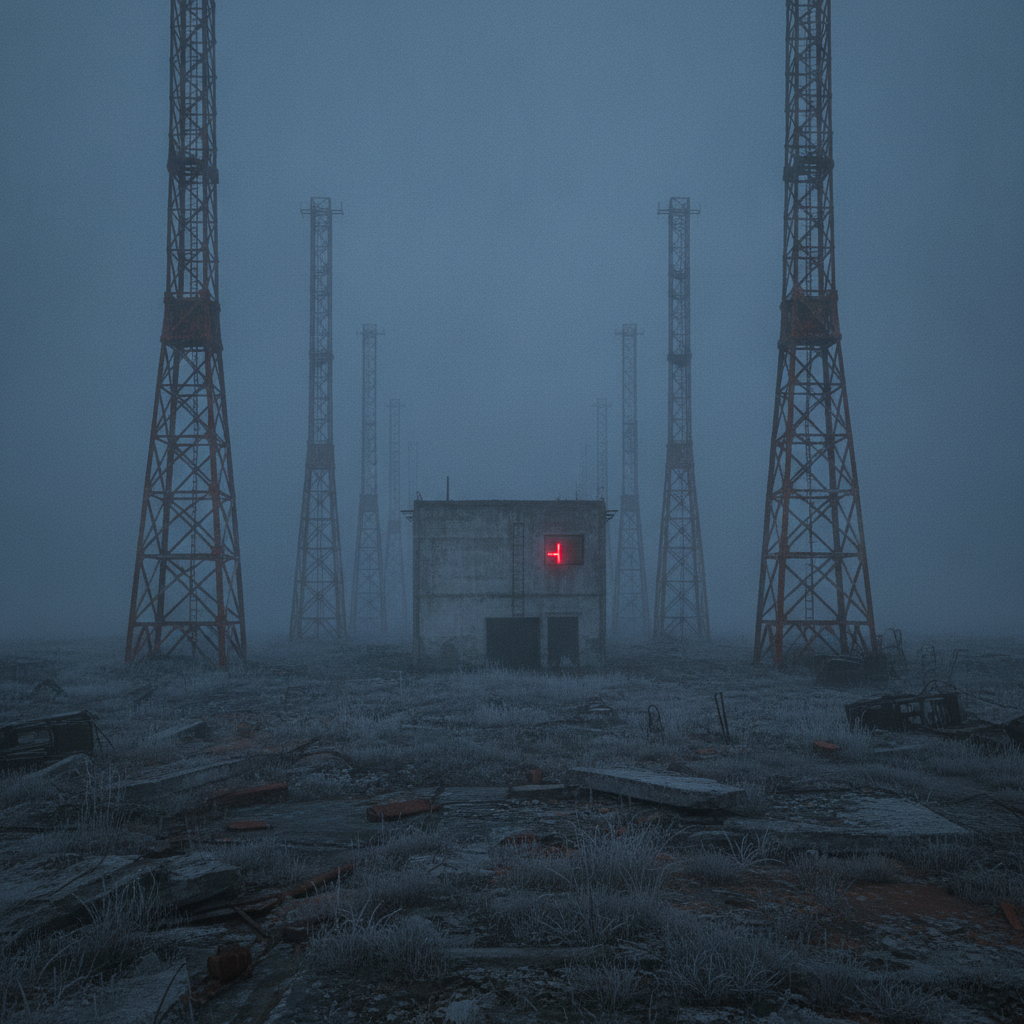
UVB-76: The Russian Radio Station That Never Stops Buzzing
Turn the dial of a shortwave receiver to 4625 kHz and it is there, as it has been for more than forty years: a short, harsh, rasping buzz, repeating roughly twenty-five times a minute, hour after hour, night after night, without stopping. Radio hobbyists across the planet know it simply as The Buzzer. The monitoring community that catalogues such signals lists it drily as station S28. It has run through the fall of the Soviet Union, through two wars and through several changes of address, and in all those decades no government has ever officially acknowledged that it exists or stated what it is for.
The signal was first noticed on the frequency in the late 1970s, and the earliest confirmed recordings date to 1982. In its early life it transmitted a simpler repeating tone. Around 1990 it settled into the now famous buzz, and the pattern has remained broadly stable ever since.
One technical detail separates the station from an ordinary automated transmitter: the sound is not a recording on a loop. Listeners have repeatedly caught faint background noises bleeding into the transmission, distant voices, shuffling, what sound like doors and chairs in a room. That points to a live, open microphone placed in front of the buzzing source, in a space where people come and go.
The frequency itself explains how the whole world came to know about it. At 4625 kHz the signal sits in the shortwave range, where transmissions refract off the ionosphere and travel far beyond the horizon, so a transmitter in western Russia can be picked up by anyone with a receiver in Europe, Asia or North America. That is why hobbyists have been able to record the station continuously for decades, and why their logs of every interruption to the buzz are public and freely searchable.
The Buzzer does not stand alone. Since the Cold War the shortwave bands have carried so-called numbers stations, anonymous broadcasts that read out endless strings of digits or phonetic letters. They are widely understood to be one-way channels for sending coded instructions to agents in the field, untraceable because a plain radio receiver leaves no record of who is listening. Enthusiasts have catalogued hundreds of them under dry designations, and a well known 1997 compilation, The Conet Project, gathered four discs of their recitations. What sets the Buzzer apart within that world is that almost no other station fills the long silences between messages with an unbroken, live tone.
For years the buzz simply buzzed. Then, without warning, it speaks. The moment that fixed the station in public memory came on December 24, 1997, when the tone abruptly cut out and a flat male voice recited in Russian: "Ya - UVB-76... BROMAL: Boris, Roman, Olga, Mikhail, Anna, Larisa," followed by strings of numbers. The names are the Russian phonetic alphabet, spelling a code word letter by letter. Since then monitors have logged dozens of such intrusions.
The station's name comes from those voice transmissions. Hobbyists called it UVB-76 because that was the call sign the announcer read out, and the designation S28 is simply the number the monitoring community assigned it in its own catalogue of unidentified signals. Neither name was ever issued by an authority. Everything the outside world knows about this station, including what to call it, has been assembled by listeners from what the transmitter itself gives away.
A typical intrusion follows a rigid, bureaucratic shape. The buzz stops. A voice states the call sign of the day. Then comes a code word spelled out in names, followed by number groups that may indicate a message, a recipient or an order. Then silence, and the buzz resumes. Monitors have transcribed thousands of these fragments over the years and built large shared logs, comparing timings and wording. Occasionally a message appears to brush against military terminology; occasionally the words look like garble or plain repetition. In more than four decades of listening there has not been a single confirmed decoding of what a complete message means.
The station has also moved and renamed itself. In 2010 it changed its call sign from UVB-76 to MDZhB, and its transmitter appears to have moved from a military site near Povarovo, northwest of Moscow. In 2011 urban explorers who entered the abandoned Povarovo compound reported finding a logbook confirming operations on 4625 kHz. The signal is now believed to originate from transmitters near St Petersburg and Moscow, and the call sign has changed several more times; by late 2020 monitors were logging the identifier NZhTI.
A small international community of listeners, coordinating through sites such as priyom.org, keeps a permanent watch on the frequency, and their logs document a pattern in the timing of the voice messages. Traffic grew unusually heavy in January and February 2022, in the days before Russia launched its full-scale invasion of Ukraine. On December 11, 2024, the Buzzer had what monitors called the most verbose day in its recorded history: around two dozen coded messages in a single stretch, some of the words apparently nonsensical, threaded with unusual sounds. Monitors have also logged bursts of activity around earlier flashpoints, including the 2014 annexation of Crimea.
The frequency is not especially strong, and over the years pranksters and pirate broadcasters have repeatedly hijacked it, piping in music, injecting images into its spectrogram and, on one occasion, a scream. In the summer of 2025 intruders briefly seized the channel again and played their own clips over the buzz. Each intrusion has been cleared and the buzz has resumed within hours.
That is perhaps the plainest fact in the whole file. Governments fell, the Soviet Union dissolved, budgets collapsed, the transmitter was relocated more than once, the call sign changed at least three times, and the buzz went on. Whatever organization keeps it running has outlasted the state that built it, and it has never issued a word of explanation.
Conclusions and Open Questions
The best supported explanation, and the one most signals monitors and radio analysts hold, is also the least cinematic. The buzz, in this view, is a channel marker: a placeholder tone whose only job is to keep a valuable military frequency occupied and audibly claimed, so that no one else drifts onto it and so the channel is known to be alive. When orders or readiness checks need to go out to distant units, the buzz stops and the coded voice takes over. Its strength is that it explains everything mundane about the station: the open microphone, the continuous tone, the sudden formatted messages. Its weakness is that it explains almost nothing about content. It tells us why the buzz exists, not what a single one of those code words commands.
A related theory, argued by analysts who study the message logs, holds that the voice traffic is a military messaging and mobilization system, activating specific units or units in waiting with pre-agreed code words, the radio equivalent of a sealed envelope opened only on the right day. This would account neatly for the clustering around crises. Its weakness is that it rests entirely on correlation: the clustering is documented, the meaning is not, and no message has ever been matched to a known event.
A third reading, common among Cold War historians, treats the station partly as a relic, a circuit that was never switched off and is kept running by institutional inertia long after anyone remembers deciding to build it. It fits the endurance of the signal, but sits awkwardly with the fact that someone still moves the transmitter, still changes the call sign and still reads new messages into a microphone.
The most dramatic theory is the doomsday one: the claim, circulated widely online and in popular articles rather than by specialists, that the Buzzer is somehow wired into Perimeter, the semi-legendary Soviet-era "Dead Hand" system built to guarantee nuclear retaliation if the country's leadership were destroyed. In this telling the buzz is a heartbeat, and if it fell silent, missiles would fly. It is chilling and it suits the Cold War aura, but it should be stated plainly: there is no evidence for it at all. No document, no defector testimony, no technical link has ever been produced, and researchers who study the station treat the connection as folklore.
Some argue that the endurance of that folklore is itself useful to Moscow. A state that never confirms or denies anything about such a station gets something valuable at no cost: the possibility, which an adversary cannot rule out, that the tone matters enormously. Others go further and suggest the deliberately distinctive sound was a choice rather than an accident, since a silent held carrier would occupy the frequency just as well and attract none of this attention. Both ideas are unfalsifiable and should be read as speculation.
What remains unexplained is the content. Not one complete message has been decoded in over forty years of organized listening. Nor is there any accepted explanation for the open microphone, which leaks the incidental sounds of a working room to the entire world, a strange choice for any secure system. The ease with which hobbyists have hijacked the frequency raises a further problem for every theory that treats it as mission-critical.
The open questions are these. Who reads the names into the microphone, and who is meant to hear them? Do the code words correspond to real units and real orders, or to routine drills? Why has no defector, archive or leaked document ever described the station from the inside? And what, if anything, would it mean on the day the buzzing finally stops?