72 Seconds from Sagittarius: The Signal That Made an Astronomer Write "Wow!"
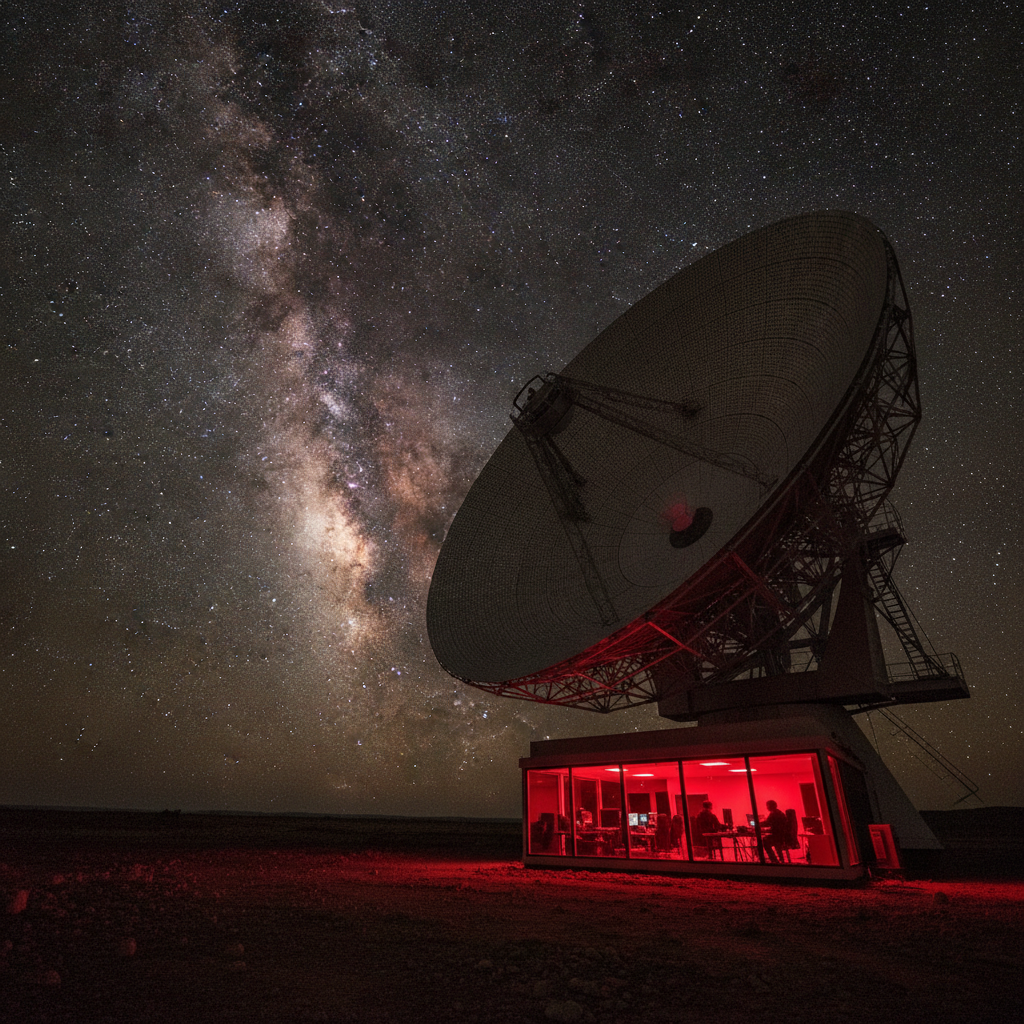
On the night of 15 August 1977, no human being was listening to the sky over Delaware, Ohio. The instrument that watched it was a radio telescope so large that locals struggled to describe it: a flat aluminium listening surface roughly the size of three football fields, built years earlier by the astronomer John Kraus and known to everyone as Big Ear. It could not turn to follow a star. It simply lay tilted toward the heavens while the rotation of the Earth dragged its fixed field of view across the cosmos, minute by minute, night after night. Whatever drifted overhead was not heard by anyone at the time. It was printed. A computer translated the incoming radio energy into columns of numbers and letters and spat them onto fan folded paper, where they waited, silent and unread, for a volunteer to find the time to check them.
Some days later a volunteer named Jerry Ehman sat down with a fresh batch of those printouts. Ehman worked without pay for the Ohio State University SETI program, at the time the longest running search for extraterrestrial intelligence anywhere on Earth, and the work was mostly tedium: endless low numbers, the faint and even hiss of a quiet universe. Then his eye caught a vertical run of characters that did not belong there. 6EQUJ5. He knew at once what those symbols meant, and he reached for a red pen, circled the sequence, and wrote a single word in the margin. Wow! The name stuck. Nearly fifty years later, that is still what the signal is called.
To understand why a plain looking string like 6EQUJ5 could make a scientist stop short, you have to know how Big Ear wrote down what it heard. The machine measured signal strength in steps above the ordinary background noise, and it ran out of digits quickly: after 9 it simply kept counting with letters, so A meant ten, B eleven, and onward. Read that way, 6EQUJ5 is not gibberish at all but a shape, a curve drawn in code. The signal climbs from 6, up through E and Q, peaks at U, roughly thirty times louder than the background and the strongest thing the telescope had ever logged in this search, then falls away through J and back down to 5.
It was intense, it was clean, and it was narrow. The energy was concentrated in a single thin sliver of the radio spectrum near 1420 megahertz, the natural frequency at which hydrogen, the most abundant element in the universe, quietly radiates. Decades earlier the pioneers of SETI had argued that this exact frequency was the obvious place to broadcast or to listen, a kind of cosmic common ground that any technological civilisation would recognise. The signal had landed almost precisely on that channel, and it carried none of the broad smear of energy that ordinary machinery and ordinary astrophysical sources tend to produce.
It came from the direction of Sagittarius, toward the crowded heart of the Milky Way, and it lasted exactly 72 seconds. That number is itself a piece of evidence. Because Big Ear could not move, any genuine object in deep space should take precisely 72 seconds to drift through its beam as the Earth turned, swelling as it entered, peaking at the centre, fading as it left. The Wow! signal rose and fell in exactly that shape. Local interference, whether a passing aircraft, a microwave oven, a truck ignition or a satellite, almost never mimics that smooth, telescope shaped rise and fall. In every measurable way the detection behaved like a source far beyond the Earth.
There is a further detail in the record that rarely survives into the headlines. Big Ear listened through two feed horns, two slightly separated ears aimed at marginally different patches of sky. Any true celestial source sweeping past should register in one horn and then, about three minutes later, in the other. The Wow! signal appeared in only one of them. Its twin heard nothing. Because the data cannot tell us which of the two horns did the hearing, the source has never been fixed to a single point. To this day it is pinned only to one of two narrow candidate patches of sky, a few minutes of arc apart, and no one can say which.
Then it was gone. Ehman and his colleagues swung Big Ear back to the same coordinates, night after night in the following weeks. Nothing answered. In the decades that followed, the astronomer Robert Gray pursued it with instruments far more powerful than Big Ear had ever been: the Very Large Array in New Mexico, and a radio telescope in Tasmania on the opposite side of the planet. Dozens of careful re-observations, spread across years, all came back empty. No repetition of the 72 seconds has ever been recorded by any instrument, anywhere.
The archives, however, kept yielding new numbers. A team led by the astrobiologist Abel Mendez of the University of Puerto Rico, working through the records of the now collapsed Arecibo Observatory, reported in 2024 that Arecibo data from 2020 contained several similar narrowband flickers near the hydrogen line, weaker than the Wow! event and from other directions, but real. In 2025 the same group published a fresh analysis of the original Ohio recordings, sharpening the signal peak to more than 250 janskys and its frequency to about 1420.726 megahertz, slightly off the true rest frequency of hydrogen. That small offset implies a source moving fast, and therefore one lying deep within the galaxy rather than close to home.
Big Ear itself cannot be consulted any more. The telescope was dismantled in 1998 and the land cleared to make room for a golf course; where the great dish once strained to hear the universe, people now play through on summer afternoons. What survives of the most famous 72 seconds in the history of radio astronomy is almost unbearably small: a yellowing sheet of computer paper, six characters ringed in red ballpoint, and one scientist's single word written in the margin. Nearly half a century of far more sophisticated listening equipment has never heard those 72 seconds again.
Conclusions and Open Questions
The first explanation came from Ehman himself. Always the careful scientist, he floated the idea that a stray signal from Earth had ricocheted off a piece of orbiting space debris. It is the most down to earth answer on offer. Its weakness is the clean 72 second drift, because debris tumbling in orbit moves at its own pace and would not normally trace the slow arc of the fixed stars. Ehman never once claimed to have solved the case. His most quoted remark on the whole affair was a warning against overreaching: that one should not draw vast conclusions from half vast data.
In 2017 the researcher Antonio Paris offered a tidier culprit. Two comets, he proposed, had been drifting through that region of Sagittarius in 1977, and the clouds of hydrogen gas surrounding them might have produced the burst at the hydrogen frequency. The criticism was swift: other astronomers pointed out that comets do not emit at 1420 megahertz in the sharp, powerful way the theory required, that the comets in question were far too faint, and that the geometry did not line up. The comet explanation has largely been set aside.
The most serious recent proposal comes from the Mendez team. One theory holds that the Wow! signal was never a message at all, but a rare astrophysical flash: a cold cloud of interstellar hydrogen, ordinarily invisible, briefly lit up from behind by a sudden blast of radiation from a magnetar or a soft gamma repeater, and stimulated into a natural maser on exactly the frequency Big Ear recorded. Its strength is that it accounts for the narrowness, the intensity and the loneliness of the event at once. Its weakness is that no one has ever caught a magnetar in the act, the 2020 flickers are cousins at best, and the authors describe their own work as preliminary. They also warn plainly that if they are right, they have uncovered a brand new way for nature to counterfeit an alien signal.
The oldest theory of all is still on the table. Some argue that the signal was exactly what it looked like, a deliberate narrowband beacon placed on the hydrogen line because that is where any technological civilisation would think to listen. Its strength is the stacking of coincidences: the frequency, the bandwidth, the intensity and the drift profile. Its weakness is the silence that followed. A beacon built to be found would repeat itself patiently, so that it could not be dismissed as a fluke, and this one spoke once and then stopped.
Several things remain genuinely unexplained. Nobody knows which feed horn made the detection, so the source is still divided between two candidate patches of sky, and nothing catalogued in either patch obviously accounts for it. No natural process has ever been observed producing a thirty sigma narrowband flash on the hydrogen line and then falling silent for half a century.
The open questions are easy to state and hard to answer. How could a signal be the strongest thing in an entire survey and leave no echo across fifty years of far more sensitive listening? Why did it land on the hydrogen line, the one frequency that both a thoughtful sender and a curious searcher would circle as special, while coming from a direction with no obvious star and no catalogued planet? If it was nature, why has nature never repeated the trick in the same spot? And if it was us, why did the signal wear the flawless 72 second signature of the deep sky? Every available answer still requires looking away from at least one of those facts.