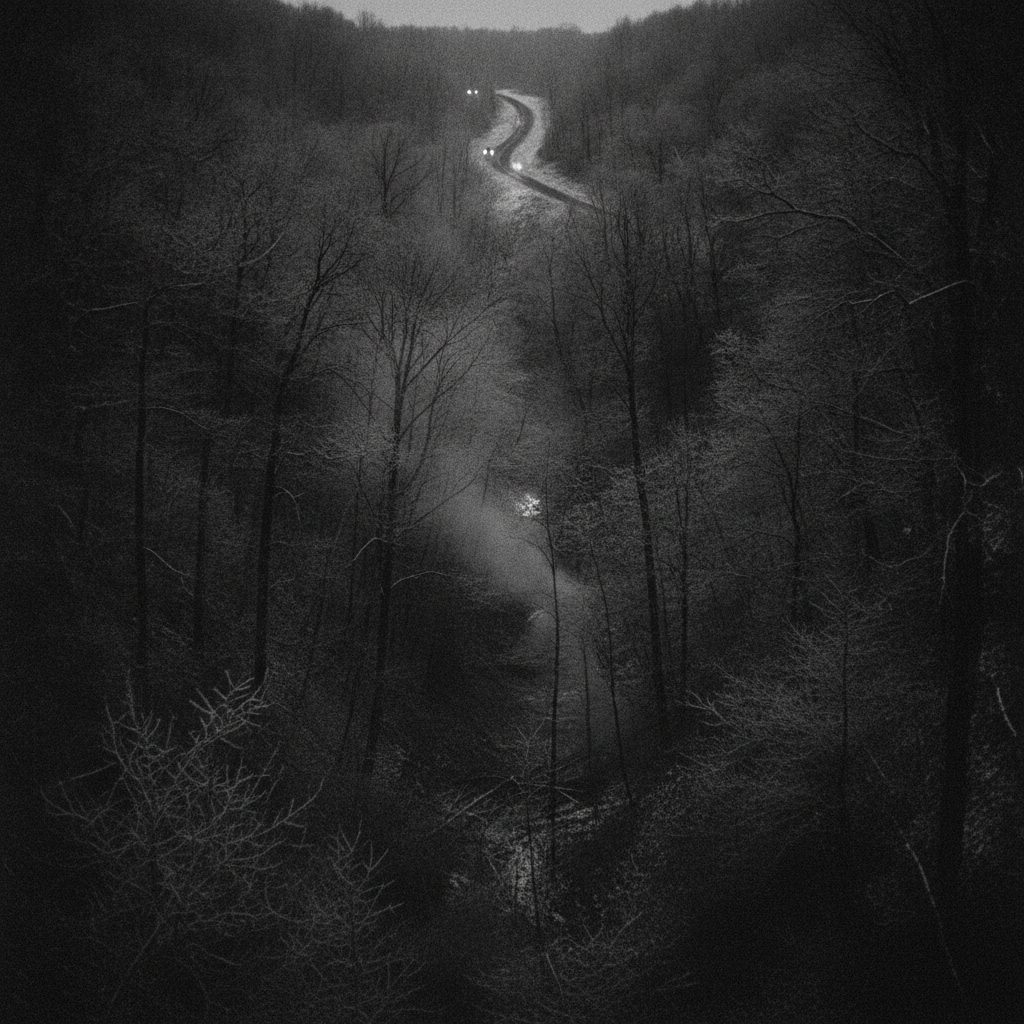
The Night Something Fell on Kecksburg
At about a quarter to five on the afternoon of 9 December 1965, the sky over the northern United States caught fire.
A bright ball of flame crossed it from horizon to horizon. Pilots in the air saw it. Families driving home saw it. In 2 states, pieces of hot metal were reported falling to the ground, and small grass fires started where they landed.
Minutes later, in a small village in the hills of Pennsylvania, children came running home to say that something had come down in the woods.
That evening, soldiers closed the road.
This is the story of the night something fell near a village called Kecksburg, in the state of Pennsylvania, about 50 km southeast of the city of Pittsburgh. The next morning's local newspaper said an object had fallen and the army had sealed off the area. The same newspaper's later edition said nothing had been found. 60 years later, nobody can say for certain what fell, where exactly it fell, or what, if anything, was taken away.
What the whole region saw
The fireball was not a local event. It was one of the most widely witnessed in the region's modern history.
People reported it in at least 6 states and in the Canadian province of Ontario. It streaked across the sky above the border area between the US state of Michigan and Canada.
The US aviation authority logged 23 reports from pilots, starting at 4:44 in the afternoon.
Hot fragments were reported falling over Michigan and the north of Ohio. Grass fires broke out in several places. Near Pittsburgh, people heard sonic booms, the heavy thump of something moving faster than sound.
A seismograph about 40 km southwest of the city of Detroit recorded a shock wave.
On the same day, 4 astronomers who were asked about it gave the same answer: this was very likely a bolide, a large meteor burning up as it entered the atmosphere. A spokesman for the US Department of Defense said the first reports pointed to a natural phenomenon.
If the story had ended there, it would be a short entry in an astronomy journal.
What the village said
In Kecksburg, the story was different.
Residents reported blue smoke drifting through the trees. They reported a vibration and a thump, as if something heavy had hit the ground. Some said they had seen the object come down into a wooded ravine near the village.
The volunteer fire department went out to look.
The local county newspaper printed 2 editions the next morning, 10 December.
The first edition, sent out to the county, carried a headline saying an unidentified flying object had fallen near Kecksburg, and a second headline saying the army had roped off the area. It reported that the area was sealed off on the orders of the US Army and the state police.
The later edition, printed for the city, carried a different headline: searchers had failed to find the object.
According to the official version, state police officers and Air Force personnel had searched the woods with Geiger counters, instruments that detect radiation. They found, in their words, absolutely nothing.
What the government file says
The US Air Force at that time ran a program that investigated reports of unidentified flying objects. Its files were later made public.
The file for that night contains one short line. It says that a team of 3 men had been sent to a nearby town to investigate and to pick up an object that had started a fire.
That line is real, and it is often quoted. But it does not say what the object was, whether it was found, or whether it was connected to the fireball at all.
According to that file, 3 Air Force men were officially present. Nothing in the documents describes a large recovery operation.
What the witnesses said, 25 years later
For 2 decades the story stayed local.
Then, in 1990, an American television program about unsolved mysteries broadcast an episode about Kecksburg. Residents went on camera and described what they said they had seen that night.
Their accounts went much further than the newspapers.
Some said they had reached the ravine and seen an object half buried in the ground. They described it as metallic and shaped like a giant acorn, about the size of a small car. Around its base, they said, was a band carrying markings that looked like ancient Egyptian writing.
Others said they had seen soldiers everywhere, and that armed men had ordered civilians and reporters out of the woods. A musician from Pittsburgh later said that soldiers had pointed rifles at him.
Several witnesses said that late that night they saw a military flatbed truck leave the area at speed, carrying a large object covered with a tarpaulin.
The news director of a Pittsburgh radio station had been one of the first reporters on the scene. According to his former wife, he told her he had gone into the woods and seen the object. He did not broadcast that account at the time.
A local researcher who began collecting testimony in the 1960s, and who still lives in the region, has spent his life gathering these accounts. He says many witnesses who did not know each other told him the same thing: that the object came down slowly, as if in a controlled landing.
**All of these accounts are testimony given years or decades after the event. None of them is backed by a photograph, a piece of the object, or a document that describes it. This is where what can be proven ends.**
What the scientists calculated
While the witnesses spoke of a crash in the woods, astronomers were doing the opposite work: calculating where the fireball actually went.
In February 1966, 2 months after the event, a leading astronomy magazine published an analysis of the reports. It concluded that the fireball moved roughly from northwest to southeast and ended in or near the western part of Lake Erie, the large lake on the border between the US and Canada.
In 1967, 2 Canadian-based astronomers published a more detailed study. They used the seismograph records and photographs of the fireball's trail taken from 2 different places, and calculated its path by triangulation.
Their result: the object came in steeply, from southwest to northeast, and most likely came down on the northwest shore of Lake Erie.
Lake Erie is more than 200 km from Kecksburg.
If they were right, the fireball that the whole region saw did not fall in Kecksburg at all.
The Soviet satellite that did not fit
Another explanation appeared early and never quite went away.
On the same date, a Soviet space probe, launched toward the planet Venus, failed and fell back into the atmosphere. It was called Kosmos 96. Some researchers suggested that what fell in Kecksburg was that probe, and that the army had rushed to recover a piece of Soviet space technology before anyone else could see it.
The problem is time. According to US Air Force tracking data, the Soviet probe re-entered over Canada at about 3:18 in the morning. The fireball was seen at about 4:45 in the afternoon, more than 13 hours later.
Later, Russian officials also stated that the probe had nothing to do with Kecksburg. Several analyses have since ruled it out completely.
The lawsuit and the missing boxes
In 2002, an American investigative journalist began a formal request for records under the US Freedom of Information Act, the law that lets citizens demand government documents. The campaign was supported by a television channel.
In 2003 the request became a federal lawsuit against the US space agency, NASA.
In 2005, while the case was running, NASA issued a statement. It said that its experts had examined metal fragments from the area and determined that they came from a Soviet satellite. It also said that the records of those findings had been lost in the 1980s.
That statement created as many questions as it answered. It did not fit the Soviet probe's timing. And the records supporting it were gone.
In October 2007 the case was settled. NASA agreed to search for records under the court's supervision and to pay the journalist's legal costs. A NASA official testified that 2 boxes of papers from the period of the incident were missing.
NASA's search was completed in August 2009. It produced hundreds of documents. Among other things, they described a program in which the US government collected fallen space debris.
None of them described a craft recovered in Kecksburg.
A space historian who wrote about the case suggested a simpler reason for the confusion: that in the 1960s, Air Force investigators sometimes identified themselves as working for NASA, so NASA may never have held these records at all.
What is known, and what is not
Here is what is documented. A very bright fireball crossed the sky on 9 December 1965 and was seen in several states. Hot debris fell in some places. The army and state police went to the woods near Kecksburg. The official search reported finding nothing. A 3-man Air Force team was sent to collect an object that had started a fire.
Here is what is not documented. That anything was lying in the ravine. That anything was loaded onto a truck. And where the fireball itself came down.
Conclusions and Open Questions
Over 60 years, 4 main explanations have been offered. Each has something in its favour, and each has a gap.
**It was a meteor, and nothing fell in Kecksburg.** The evidence: astronomers said so on the same day. 2 separate calculations, one with seismograph data and photographs, put the end of the fireball over Lake Erie. NASA's own later analysis agreed. The problem: it does not explain why the army and state police sealed off a wood in Kecksburg, or why an Air Force team was sent to pick up an object. It also leaves many local witnesses who say they saw something physical.
**It was a piece of Soviet space hardware.** The evidence: NASA's 2005 statement said fragments from the area came from a Soviet satellite. The problem: the only Soviet craft known to have fallen that day came down more than 13 hours earlier, and the records behind NASA's statement were lost. Russian officials denied any connection.
**It was a secret American object, such as a returning military capsule.** The evidence: this would explain the speed of the military response and the secrecy. A local researcher group has proposed a US Air Force re-entry vehicle. The problem: its own proposers say it needs confirmation from the Air Force or NASA, and none has been found. No document released in the lawsuit supports it.
**It was a craft of unknown, possibly non-human, origin.** The evidence: this is the theory of some witnesses and of the journalist who sued NASA, who concluded that what happened there remains an unanswered question. The acorn description, the markings and the slow descent come from people who say they were there. The problem: every part of it rests on testimony given years later. There is no photograph, no fragment and no document. And the scientific track of the fireball points somewhere else.
What remains unexplained is a gap between 2 records that do not meet. On one side, a fireball whose path was measured and ends over a lake more than 200 km away. On the other, a village that remembers soldiers, a closed road and a truck in the night.
Today, in the centre of Kecksburg, stands a large metal acorn. It is a prop, built for the 1990 television program. It is the only acorn anyone has ever photographed.