Documented

The Script We Can Pronounce but Cannot Understand: Linear A

2026-08-29 · Unsolved Ciphers · 8 min read

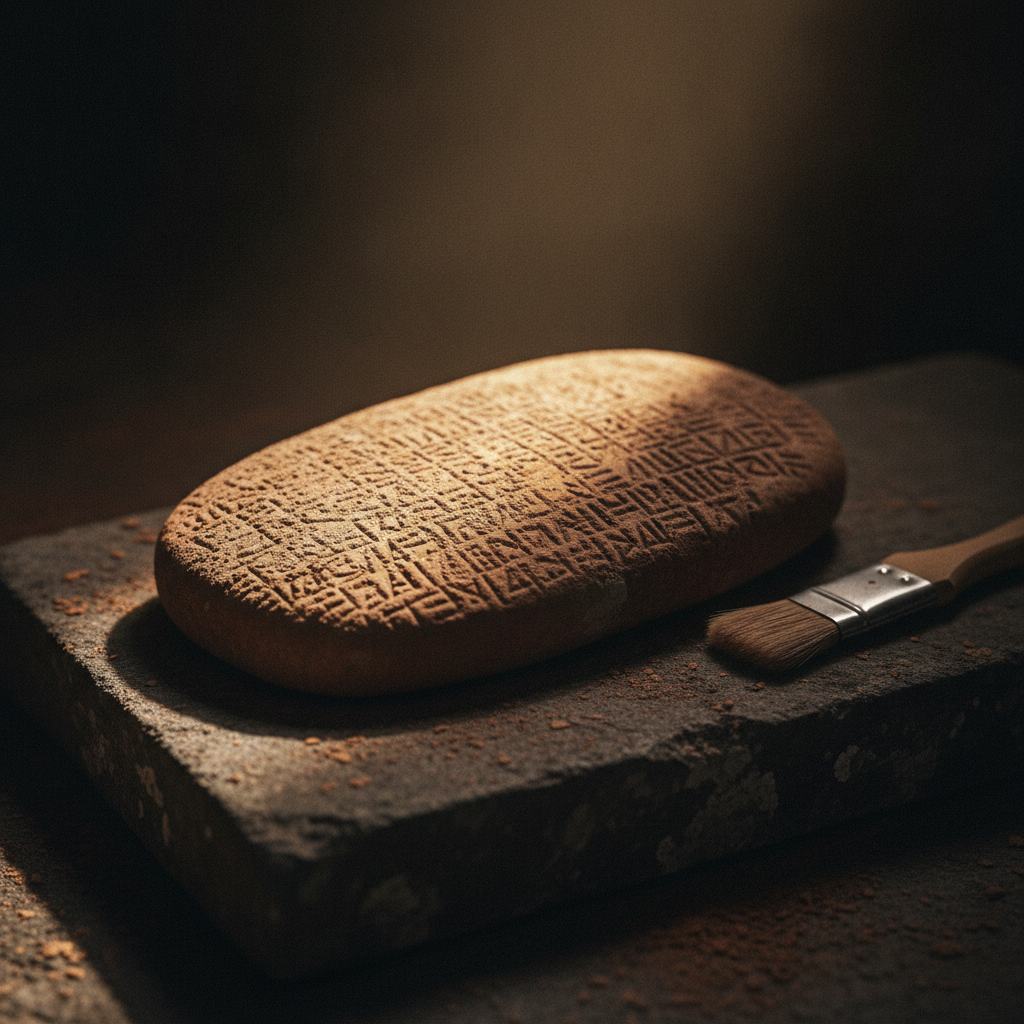
In the spring of 1900 a short-sighted Englishman with a walking stick stood on a hillside south of Heraklion and watched his workmen strip the soil from a building that had lain buried for three and a half thousand years. Arthur Evans had bought part of the land with his own money. He had come to Crete looking for one thing above all others: writing. He believed the Aegean world had been literate long before classical Greece, and within days of breaking ground his crews began handing him exactly what he wanted. Small tablets of sun-dried clay, ruled into lines, covered in tidy rows of signs.

They were not Greek letters. They were not Egyptian hieroglyphs. They were something no living person had ever seen.

Evans named the palace Knossos, called the civilisation Minoan after the legendary King Minos, and sorted the writing into three systems. The oldest and most pictorial he called Cretan hieroglyphic. The two later scripts, built from simpler strokes, he named Linear A and Linear B. Then he set out to read them. He worked at it for the rest of his life, published the tablets slowly and jealously, and died in 1941 without having read a single sentence.

Linear A was the script of the Minoan palaces, in use from roughly 1800 BC until about 1450 BC, when those palaces burned. It was a working script, not a monumental one. Scribes pressed it into wet clay with a stylus, scratched it around the rims of stone libation tables, painted it inside cups and cut it into pins of gold and silver. Roughly 1,400 legible inscriptions survive, carrying something like 7,400 individual sign tokens. About half of everything we have came out of a single site: Hagia Triada in southern Crete, which has produced more than 1,200 Linear A objects. Zakros yielded nearly 600, Khania a little over 300. Isolated pieces have turned up off the island entirely, at Mycenae and Argos on the Greek mainland and at Miletus on the Anatolian coast, which tells us the script travelled with Minoan trade.

The system uses more than 300 distinct signs. About 90 of them occur often enough, across enough sites and centuries, to form a stable core. That shape, a manageable set of frequent signs plus a long tail of rare ones, is the signature of a logosyllabic script: syllable signs that spell words out, mixed with word signs standing for a whole commodity, plus numerals.

Then, around 1450 BC, the Cretan palaces fell and Mycenaean Greeks took over the island. They did not invent a script of their own. They took the one already there, adjusted it, and used it to write their own language. That adapted version is Linear B.

Linear B is the reason Linear A is such a peculiar kind of mystery.

For half a century Linear B resisted everyone, Evans included, who insisted to the end that it could not possibly be Greek. It fell in 1952 to Michael Ventris, a London architect who had been obsessed with the problem since hearing Evans lecture when he was a schoolboy. Ventris did not guess at meanings. He built grids, sorting the signs by which ones alternated with which in the same position inside inflected words, until the grid began to behave like a syllabary with rows of consonants and columns of vowels. When he finally forced sound values onto it, the words that came out were Greek: ko-wo for boys, ko-wa for girls, pa-te for father. Evans had been wrong. Ventris, working with the philologist John Chadwick, published the decipherment and died in a road accident four years later, aged thirty-four.

Because Linear B grew directly out of Linear A, the two scripts share most of their signs. So the obvious move, made almost at once, was to run Ventris's sound values backwards into the older script and see what came out.

It works, in a sense. It works alarmingly well.

Read that way, Linear A stops being silent. The numerals resolve into a clean decimal system: vertical strokes for units, horizontal strokes for tens, circles for hundreds, circles with rays for thousands, plus a set of fraction signs whose exact values are still argued over. The documents resolve into what they obviously are, which is accounting. Lists of commodities, quantities, people, places. At the foot of many tablets sits the word ku-ro, followed by a number that turns out to be the sum of the numbers written above it. Another word, ki-ro, marks what looks like a deficit, an amount still owed. Dozens of place names on the tablets reappear, spelled almost identically, in Linear B documents written centuries later by Greeks who had inherited the same landscape.

There is even a formula. Around forty-one inscriptions from twenty-seven different Cretan sites, most of them cut into stone libation tables from mountain and cave sanctuaries, carry a repeating religious phrase that scholars simply call the libation formula. The same opening sequence, then a variable slot that is probably the name of a place or a deity, then more fixed words. It is plainly a liturgical text. We can pronounce every syllable of it.

Ad

And that is the whole problem. We can pronounce Linear A. We cannot understand a word of it.

No one has ever matched the language underneath to any language recorded anywhere else on earth. Not Greek. Not Hittite or Luwian. Not Phoenician or any other Semitic tongue. Not Egyptian, not Etruscan, not anything in the Uralic family. The Minoans kept their books in a language that appears, on the present evidence, to be related to nothing.

Conclusions and Open Questions

The obstacles are unusually easy to name, which is part of what makes the case so frustrating.

The corpus is small. About 1,400 inscriptions against nearly 6,000 for Linear B, while cuneiform runs to hundreds of thousands of tablets. Worse, most Linear A texts are short, broken and administrative. There is no literature, no letter, no treaty, no narrative, nothing with enough running grammar to expose how the language inflects.

And there is no bilingual. Egyptian hieroglyphs fell because the Rosetta Stone carried the same decree in Greek. Nothing of that kind has ever come out of Crete, and after 126 years of excavation the odds of one surfacing are not improving.

The theories divide roughly into three camps, and each is strong in a different place.

One holds that Minoan is Semitic. This was argued most forcefully from the 1950s onward by Cyrus Gordon, a formidable Near Eastern scholar who applied the new Linear B values to Linear A and read Semitic words in the results, noting among other things that ku-ro sits close to a Semitic root meaning "all". Its strength is context: Crete traded constantly with the Levant, and Semitic loanwords in the Aegean would be entirely unremarkable. Its weakness is that it never generalised. Critics, including scholars who admired Gordon's range, judged that the readings worked only on selected words, and that the same method applied to a longer stretch of text produced nothing coherent. Gordon remained certain to the end. He convinced very few of his colleagues.

A second camp holds that Minoan is Indo-European. Gareth Owens, working in Crete, has argued that Minoan is a distant cousin of Greek and Armenian which split from Proto-Indo-European after the Hittite branch but before the others, and has proposed readings for parts of the libation formula on that basis. The strength of the argument is that some of the resulting words do look reasonable. Its weakness is arithmetical: with only a few thousand sign tokens, and a hypothesis flexible enough to permit heavy sound change, a handful of plausible matches is roughly what pure chance would be expected to produce. Mainstream Aegean scholarship has not accepted it.

A third position, and the current default, is that Minoan is a language isolate, a genuine orphan like Basque, with no surviving relatives to compare it against. Its strength is that it accounts for the failure of every comparison attempted so far. Its weakness is that it is not really a theory at all. It predicts nothing and can never quite be proved.

Meanwhile some of the most serious recent work has deliberately stopped trying to read the script. Ester Salgarella's SigLA project hand-copied some 300 sign forms from around 400 inscriptions to build a paleographic database, on the reasoning that before anyone can decipher Linear A, scholars first need to agree on which scratched shapes are the same sign and which are not. Computational and machine-learning attacks appear every few years, most recently in 2026, and meet the same objection every time: a statistical method fed 7,400 tokens will always report a best-fitting language family, and a best fit is not a decipherment.

Underneath all of it lie two questions that are rarely asked out loud. The first is whether the borrowed sound values are even correct. They rest on the assumption that a sign in Linear B kept the value it had carried in Linear A. That is a reasonable assumption, since the Greeks adapted the script rather than inventing it, but no independent evidence has ever confirmed it. If it is wrong even in part, every reading built on it is wrong along with it. The second is whether Linear A records a single language at all. The script was in use for three and a half centuries across an island of separate palace centres, and nothing guarantees that the scribes of Hagia Triada and the scribes of Zakros were writing the same tongue.

What survives, then, is a strange and very specific kind of silence. We know what the Minoans counted, and how much of it they had, and roughly where they kept it. We can stand in a museum and say aloud the syllables of a prayer carved into a stone bowl on a Cretan mountaintop thirty-five centuries ago. We simply have no idea what we are saying.

Free reads left this month: 0

Share this story:

Reader comments (0)
Only active subscribers with verified payment can post comments. Get full access