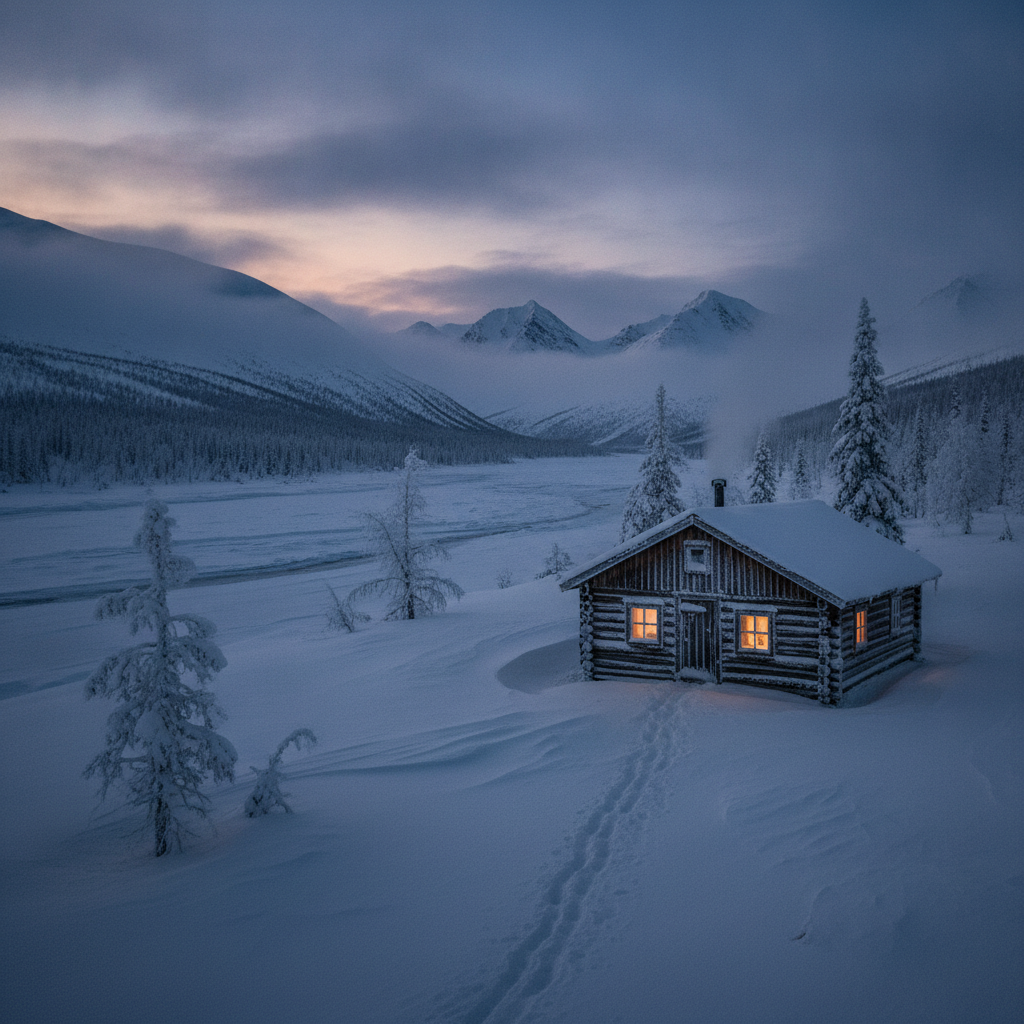
The Mad Trapper: The Man Nobody Could Catch, and Nobody Can Name
On 9 July 1931 a stranger came down the river to a small trading post in the far north of Canada.
He was alone. He was in his thirties, fit and clean, and he spoke very little. When he did speak, the people at the post thought they heard a Scandinavian accent.
He bought supplies and paid in cash. He had a lot of cash.
A police constable in the area stopped him and asked who he was. The stranger said his name was Albert Johnson. He said he had come from the prairies. That was almost all he said.
Then he went up a small river, into country where very few people lived, and built himself a cabin.
Within months he had fought off the police for 48 days in the Arctic winter, killed a constable, and been shot dead. The newspapers called him the Mad Trapper. The mystery is simple: nobody has ever found out who he really was.
A cabin by the river
The place he chose was the bank of the Rat River, in the far north-west of Canada, above the Arctic Circle. The nearest real settlement was Aklavik, a police post and trading town about 100 km away.
His cabin was tiny, about 2.5 by 3 metres. He had not bought a licence to trap animals, which every trapper in the area needed.
For a few months, nobody bothered him.
In December, local Indigenous trappers came to the police in Aklavik with a complaint. They said the stranger had been interfering with their traps, springing them and hanging them up in the trees.
The door that would not open
On 26 December 1931, a constable and a special constable set out by dog sled for the cabin. The journey was about 100 km through snow.
Smoke was coming from the chimney. The constable knocked and called out. No answer. When he tried to look through the small window, someone inside covered it with a sack.
The two men had no warrant to enter. They went all the way back to Aklavik to get one.
On 31 December they returned, this time with 2 more men. The constable knocked again and said he had a warrant.
The answer was a gunshot, fired through the wooden door. The constable was hit in the chest.
His companions got him onto the sled and drove the dogs through the night, back to Aklavik, in extreme cold. He survived.
15 hours at 40 below
On 9 January 1932 a much larger party came back to the cabin: police officers, special constables and local volunteers, with dog teams. The temperature was about minus 40 degrees.
They surrounded the cabin and called on him to come out. He fired back.
The siege lasted 15 hours. The posse fired hundreds of shots into the cabin. Late in the night they threw dynamite at it and blew part of the roof off.
It did not work. He had dug a pit under the floor, about 1.5 metres deep, and he kept firing from it. At about 4 in the morning the posse gave up and went back to Aklavik for more men and more explosives.
When they returned on 14 January, the cabin was empty. He had gone.
A man who left almost no tracks
In snow, a man leaves tracks. This man seemed to know how not to. He walked on hard wind-packed ridges where his feet left little mark. He walked backwards in his own footprints. He walked inside the trails of caribou herds, so that his steps were lost among thousands of hoofprints. He made fires with dry wood that gave almost no smoke.
On 30 January the pursuers found his camp in a thicket of trees. There was an exchange of fire. A constable was shot through the heart and killed.
The man vanished again.
Over the mountains
West of the area was a range of mountains, and beyond it lay the Yukon, another northern territory of Canada. The police guarded the 2 known passes through them. They believed nobody could cross the mountains anywhere else in that weather.
In early February, during a blizzard, he crossed them anyway, over the open mountainside.
The police would not have known for days, except for one new thing.
The eye in the sky
On 5 February a bush pilot landed at Aklavik in a small plane on skis. It was one of the first times in Canada that an aircraft had been used to hunt a fugitive.
Flying over the land, he found tracks on the far side of the mountains. The man had crossed.
On 14 February, the pilot spotted tracks along a river on the Yukon side. The man was walking in the middle of the frozen river, inside a caribou trail, where the snow was packed hard and he did not need snowshoes. He only left the caribou trail at night, to make camp on the bank. From the air, those short lines of footprints up to the bank gave him away.
The last day
On 17 February 1932, a party of about a dozen men came round a bend of that river.
There he was, a few hundred metres ahead, on the ice.
He tried to run for the bank. But he was not wearing his snowshoes, and the snow was too deep. He dropped into the snow and began to fire.
One of the pursuers, a signals sergeant from the army, was badly wounded. The others fired back.
A bullet hit the fugitive in the side of the pelvis. He died on the ice.
The pilot landed his plane on the river, loaded the wounded sergeant aboard, and flew him to hospital. The sergeant lived.
The chase had lasted 48 days, most of it at temperatures far below zero.
What was in his pockets
He was carrying 2,410 Canadian dollars and 10 American dollars in cash, a very large sum for a trapper in 1932. He had 5 small pearls, and a little gold, including pieces of gold dental work. He had a compass, a razor, a knife, fish hooks, and a dead squirrel and a dead bird for food.
He had no papers, no letters, no photographs. Nothing with a name on it.
The dental work in his mouth was of very high quality for the time. That suggested a man who at some point had money and lived near a good dentist.
During the entire chase, not one of the pursuers had heard him say a word.
He was buried at Aklavik, under the name he had given, Albert Johnson. Even the police believed the name was probably false.
**From here on, the documented record only tells us what he did. Nobody has ever documented who he was.**
Searching for a name
One researcher believed he was a loner who had lived further west in Canada under another name, and who had carried the same kinds of guns. Nobody could prove the two were the same man.
A book in 1989 claimed he was a Norwegian-born criminal who had served time in American prisons. Dental records and later DNA testing against a relative ruled him out.
A family on Canada's east coast believed he was a relative of theirs who had left home during the Great Depression. That was not confirmed either.
In August 2007, a documentary film team, working with forensic scientists and with permission, opened his grave.
The scientists found a man of about 35. His spine was curved, which would have given him chronic back pain. The chemistry of his bones suggested that he grew up either in Scandinavia or in the American Midwest, where many Scandinavian immigrants lived.
He was then reburied, this time with full religious rites from a local priest and Indigenous elders.
In 2021, an American genetics laboratory that works on unidentified remains announced the latest result. His DNA pointed firmly to Sweden. His genetic matches traced back to one couple who lived in the late 1700s and early 1800s, and to a small cluster of villages in the south of Sweden.
More than 20 families have been compared. None has turned out to be his. The laboratory has asked people with roots in that part of Sweden to come forward.
So we know roughly where his family came from, how old he was, and how he died. We do not know his name.
Conclusions and Open Questions
Several explanations have been offered for who he was and why he fought.
**He was a criminal on the run from something else.** The evidence: the large sum of cash, the false name, the way he refused any contact with police from the first day, and his willingness to shoot rather than answer a simple question about traps. The problem: no crime anywhere has ever been linked to him. Every named suspect has been ruled out.
**He was a man who simply wanted to be left alone, and panicked.** The evidence: he went to one of the emptiest places on the continent, alone, and asked nothing of anyone. The problem: he shot through a closed door at a man who had only knocked, and later killed a constable. That goes far beyond a wish for privacy.
**The trapline complaint was never proved.** The evidence: nobody ever showed that he actually tampered with the traps, and later accounts disagree on who threatened whom. The problem: even a false complaint does not explain the gunfire that followed.
What remains unexplained is almost everything about the man himself. Where he had been before July 1931. Where the money came from. Why he carried pearls and gold. And above all, why a man who had clearly lived among other people, and paid a good dentist, would choose to die on a frozen river rather than say his own name.
The DNA has narrowed the search to a few villages. One day a relative may take a test, and the Mad Trapper of Rat River will have a name at last.