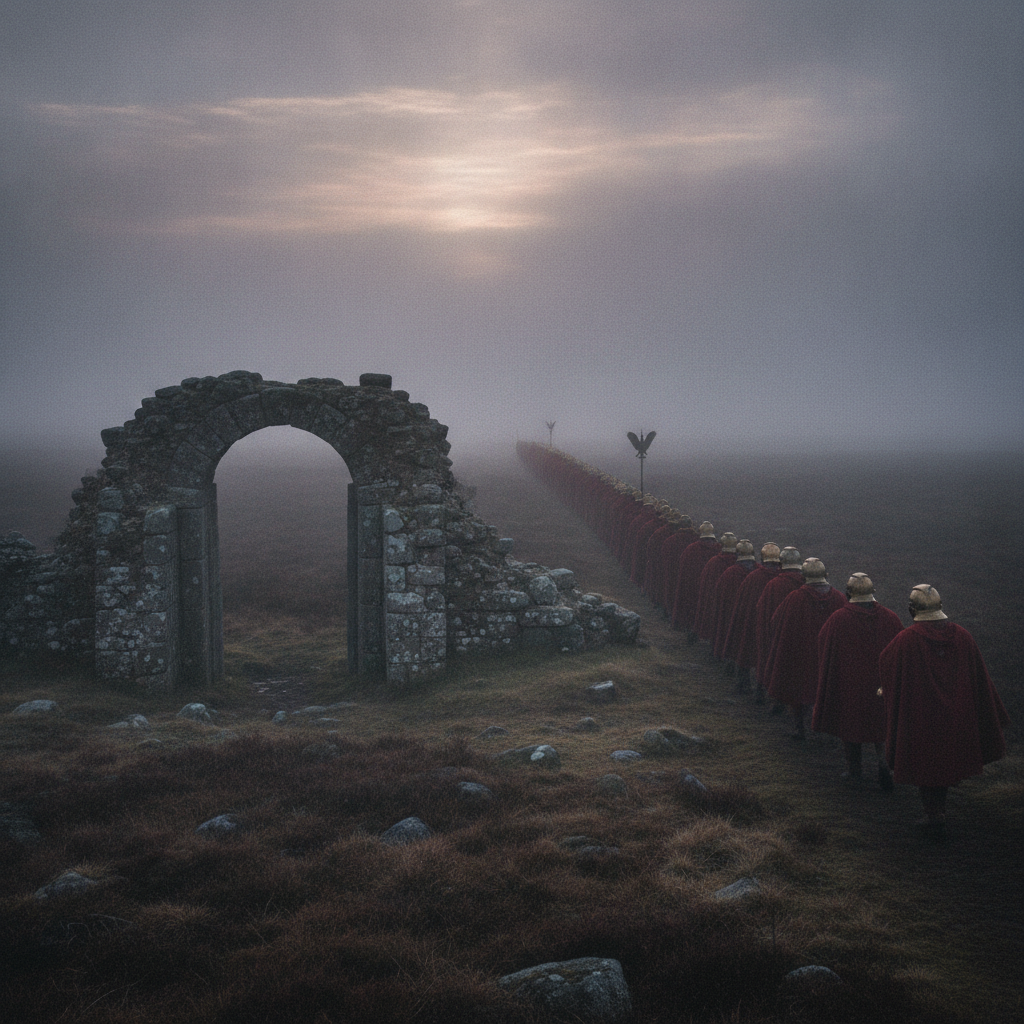
The Ninth Legion: The Roman Army That Built a Gate in York and Then Disappeared From History
Over a gateway in the north of England, a stone slab was set into the wall.
The letters were cut deep and neat. They said that the emperor Trajan had built this gate, and that the work had been done by the Ninth Legion Hispana.
The year was AD 108. The place was York, which the Romans called Eboracum. It was the great fortress of the north, and the Ninth had lived there for decades.
That stone is still there, in a museum in York. It is the last thing anyone in Britain ever wrote about the Ninth Legion.
What the Ninth Legion was
A Roman legion was not a word for "some soldiers". It was a fixed unit with a number, a name, its own officers and its own sacred eagle standard. By one estimate the Ninth had about 5,400 men.
Legions lasted for centuries. They were recorded on stone, in lists, in the careers of their officers, and on the stamps they pressed into their bricks and tiles. Roman bureaucracy tracked them closely.
That is why the Ninth is a mystery. Here is the whole puzzle in one sentence: **a unit of thousands of men, in an army that wrote everything down, stops appearing in the records after about AD 120, and no surviving Roman text says where it went or how it ended.**
A long and hard career
The Ninth was an old legion. It had fought under Julius Caesar in Gaul. It took the name "Hispana" from its service in Spain under the first emperor, Augustus.
In AD 43 it was part of the Roman invasion of Britain.
In AD 61 it was almost destroyed. A British queen led a great revolt in the east of the island, and the Ninth marched to stop it. By one account about 2,000 of its soldiers were killed. The survivors were reinforced with men brought over from Germany, and the legion went on.
In the early 80s AD it fought in the north, in what is now Scotland. A Roman historian recorded that the Britons attacked its camp at night and got inside, and that the fight ended only when Roman cavalry struck the attackers from behind.
Its base was York. In the early 2nd century it rebuilt the fortress there in stone.
The last stone in Britain
The gate inscription of AD 108 belongs to that rebuilding in stone. It is a routine building record. Nothing about it suggests trouble.
And then, in Britain, silence.
There is no later inscription in York that names the Ninth. There is no tombstone of a Ninth Legion soldier that can be dated after this. Soon afterwards another legion, the Sixth, arrived in Britain and moved into the fortress at York. The Sixth stayed there for the rest of the Roman period.
So by the 120s the Ninth was no longer at York. That much is certain.
Clues from across the sea
Then clues turned up somewhere else.
At Nijmegen, in the Netherlands, close to the German border, archaeologists found roof tiles stamped with the name of the Ninth Legion. They also found a silver-plated pendant of the kind soldiers wore, marked with the legion's name.
From the nearby city of Aachen comes a stone altar. It was set up by a senior officer who described himself as a former chief centurion of the Ninth.
To many historians this means that the Ninth, or at least part of it, was stationed at Nijmegen in about AD 120. Some think the whole legion was there for a few years. Others think only a detachment was sent.
But even this is argued over. Some of the stamped tiles are dated to between 104 and 120. Other researchers say the tiles come from the 80s AD, when small detachments of the Ninth are known to have been on the Rhine. If they are right, the Nijmegen finds say nothing about the legion's last years.
There is one more piece. The career of one Roman officer is recorded on stone. It shows that he served as a tribune in the Ninth Legion some time between about AD 122 and 127. So the legion, it seems, still existed in the 120s, somewhere.
Here is where what we know ends
After that, there is nothing.
No inscription. No tile. No soldier's grave. No officer's career that mentions the Ninth after the 120s.
**This is the last point anyone can stand on: the Ninth Legion was still in existence in the 120s, possibly on the Rhine. From here on, nobody knows what happened to it.**
And then it is missing from the list
Much later, someone wrote down the full list of the Roman army's legions.
Two such lists survive. One is carved on a stone column found in Rome. The other is in the work of the Roman historian Cassius Dio. Both list 33 legions. Both were made at the end of the 2nd century or later, after about AD 197.
The Ninth is not on either list.
So the legion vanished at some point between about 120 and about 197. A gap of some 75 years, and not a single line about how.
For a Roman legion this is extraordinary. When legions were destroyed or disbanded, it was usually because of a disaster, a defeat or a mutiny. Those things tended to leave marks. The Ninth left none.
The eagle in the ground
In 1866 a clergyman digging at the Roman town of Silchester, in southern England, found a small bronze eagle, about 15 centimetres tall.
To the Victorians it looked like the lost eagle standard of a legion. In 1954 it inspired a British children's novel, The Eagle of the Ninth, about a young Roman officer who goes beyond Hadrian's Wall to recover the eagle of his father's lost legion. The book was hugely popular, and it fixed one version of the story in the public mind: the Ninth marched into Scotland and was wiped out.
The museum that holds the Silchester eagle today says that it is not a legionary eagle at all.
The novel did not invent the idea of a massacre in the north. It took it from historians. But it made it famous, and later a 2010 film, Centurion, told a similar story.
Here is where the documented story closes. The Ninth was at York in 108. Part or all of it may have been at Nijmegen around 120. An officer served in it in the 120s. By about 197 it was gone. Every account of how it ended is a reconstruction from scraps.
Conclusions and Open Questions
There are 4 main answers. Each has supporters, and each has a hole.
**It was destroyed in Britain, around 117 to 120.** This was the view of a famous German historian of the 1800s, and it is the version the novel made famous. A British archaeologist has defended it strongly in recent years. His evidence: a letter from a Roman scholar to the emperor Marcus Aurelius, recalling how many soldiers were killed by the Britons under the emperor Hadrian; an inscription from Italy recording more than 3,000 reinforcements sent to Britain early in Hadrian's reign; the arrival of the Sixth Legion at York; and the start of Hadrian's Wall in about AD 122, which suggests serious trouble in the north. The problem: no source names the Ninth as the unit that suffered. No battlefield or mass grave from that period has been found. And if the Nijmegen finds and the tribune of the 120s are dated correctly, the Ninth outlived this supposed disaster.
**It was moved to the Rhine and then disbanded or merged.** A British historian has argued that the legion left York around 117, perhaps to join a war in the east, and ceased to exist not long after. The problem: Rome did not usually erase a legion quietly. There is no record of a disbanding, and no reason for one has been found.
**It was destroyed in the Jewish revolt of AD 132 to 135.** The great revolt in Judea was extremely bloody. Rome brought in troops from all over the empire. Some historians think the Ninth may have been sent and lost there. The problem: another legion, the Twenty-Second, is already the main candidate for a unit lost in that war. Losing 2 whole legions there would have been a catastrophe on the scale of the worst defeats in Roman history, and no source mentions it.
**It was destroyed in Armenia, in AD 161.** The historian Cassius Dio says that a Roman legion was wiped out by the Parthians at a place called Elegeia, in Armenia. He does not say which one. The problem: there is no evidence that the Ninth was ever in the east between 130 and 160. Other legions that might fit are known to have survived, and some scholars give this defeat, too, to the Twenty-Second.
What remains open is simple to say and very hard to answer. Where did the Ninth Legion go after York? Was it at Nijmegen as a whole unit, or only in part? Did it die in battle, or was it simply dissolved? And if it was destroyed, why did a state that recorded everything leave its end unrecorded?
One new stone, one tombstone or one dated tile could change the whole picture. Until one turns up, the last word we have from the Ninth Legion is the gate it built in York.