Over the Horizon: The Waratah and the 211 People Who Went With Her
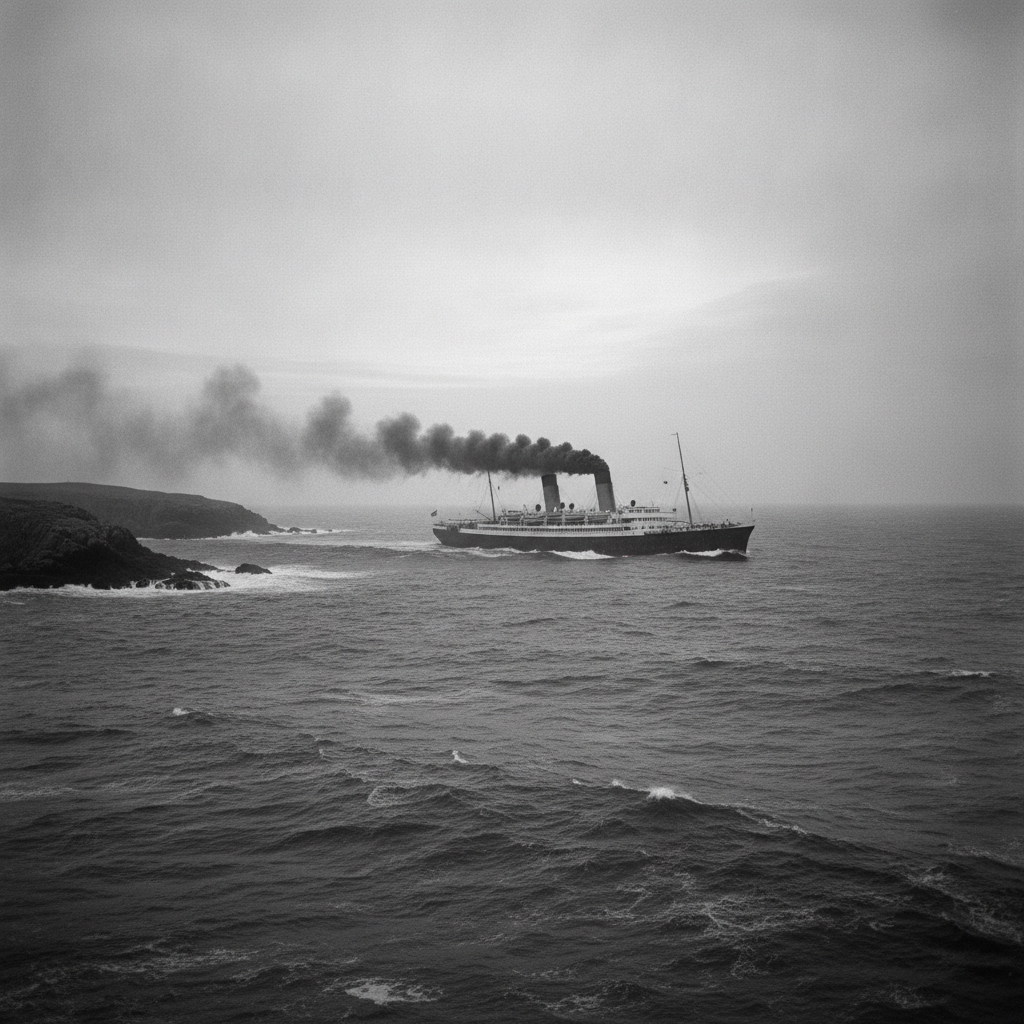
Just after six in the morning on 27 July 1909, the officer of the watch aboard the cargo steamer Clan MacIntyre saw a large ship coming up fast astern. The sea off the Wild Coast of South Africa was moderate that morning, the winter light was grey and clean, and the stranger was making perhaps thirteen knots to the Clan MacIntyre's nine. She overhauled the smaller vessel a few miles off the mouth of the Mbashe River and the two exchanged signals in the old way, by flag and by lamp. The newcomer gave her name as the Waratah, out of Durban, bound for Cape Town and then London. The Clan MacIntyre wished her a pleasant passage. The Waratah answered with the same courtesy, drew ahead, and within about two hours she was a smudge on the horizon, and then she was nothing at all.
That was the last time anyone saw her. Two hundred and eleven people were aboard.
The Waratah was not an old ship worn thin by service. She had been launched in 1908 by Barclay Curle on the Clyde for the Blue Anchor Line, a little over 500 feet long and around 9,339 gross tons, built for the long emigrant run between Britain and Australia. She carried passengers in comfort and a great deal of cargo underneath them, and the line advertised her as the finest thing on the Australian route. The voyage that ended off the Mbashe was only her second.
She had a reputation, though, and it had followed her from the first voyage. Passengers and officers alike described a ship that rolled heavily, that took a list and was slow and reluctant about coming back upright, that seemed to hang at the end of a roll a beat longer than a ship should. Complaints of that kind are common at sea and are usually forgotten. In this case they were written down, and eighteen months later they were read aloud in a courtroom in London.
The Waratah left Durban on 26 July 1909 with 211 passengers and crew, coal in her bunkers and heavy cargo in her holds, bound first for Cape Town. One passenger did not sail with her. Claude Gustav Sawyer, an engineer who had crossed a great many oceans, had spent the passage from Australia growing steadily more uneasy about the way the ship behaved, and at Durban he took his luggage and went ashore. He sent his wife a telegram that has been quoted ever since: he thought the Waratah top-heavy, and he had landed at Durban.
She was due at Cape Town on 29 July. She did not arrive. On 28 July a severe gale ran up the Wild Coast, strong enough that other vessels in the area logged extraordinary conditions, and the first assumption ashore was the ordinary one: broken machinery, a ship drifting without power, an anxious week and then good news. The good news never came.
What followed was one of the largest searches of the age. Royal Navy warships were sent along the coast and out into the Indian Ocean. The Blue Anchor Line chartered the Sabine, which spent roughly three months and something on the order of 14,000 miles quartering the southern ocean, as far as the ice, and found nothing. In 1910 relatives of the missing funded a second vessel, the Wakefield, which also found nothing. The crew of the liner Insizwa reported seeing bodies in the water off the coast; the report was never corroborated, no body was recovered, and it remains a disputed footnote rather than evidence. In more than a century, no wreckage, no lifeboat, no lifebelt and no human remains have ever been identified as coming from the Waratah.
One detail explains the silence, if not the loss. The Waratah carried no wireless set. Wireless was still optional in 1909, and the ship had none, so there was never any possibility of a distress call. She simply stopped existing between one horizon and the next.
The Blue Anchor Line did not survive the disaster. Its ships were sold to P&O, and in December 1910 a Board of Trade inquiry opened at Caxton Hall in London. It sat for weeks. Naval architects argued over her metacentric height, over how her coal and cargo had been stowed, over what happened to a ship's stability as her bunkers emptied on a long passage. Passengers from the first voyage described the rolling. Claude Sawyer testified about the ship's motion, and also told the court that during the passage he had been troubled by vivid and disturbing dreams, which he gave as one of the reasons he had gone ashore at Durban. The court took his account of the ship's behaviour seriously and his account of his dreams as what it was, a witness explaining his own state of mind. In the end the inquiry concluded that the Waratah had been lost, most probably capsized in a gale of exceptional violence, and that the evidence before it was not sufficient to say why.
The modern chapter belongs largely to one man. Emlyn Brown, a South African marine explorer, spent twenty-two years looking for the wreck, at times with support from the American author Clive Cussler and his National Underwater and Marine Agency. In 1999 the newspapers carried the news the story had waited ninety years for: a sonar target roughly ten kilometres off the Eastern Cape whose outline matched the missing liner. Divers reached it in 2001. It was the Nailsea Meadow, a British ship sunk in the Second World War, lying in almost exactly the place the Waratah was supposed to be. In 2004 Brown announced that he was giving up. He had, he said, exhausted his options and no longer knew where to look.
Conclusions and Open Questions
The most widely accepted explanation is a rogue wave. The stretch of coast where the Waratah vanished is one of the very few places on earth where such waves are not folklore: where the fast Agulhas Current runs south and a strong southwesterly gale runs north against it, wave energy is compressed into steep, deep-troughed walls of water. A paper by Professor Mallory of the University of Cape Town in the early 1970s documented waves of up to about twenty metres in that corridor, and large modern ships have been damaged there. The strength of the theory is that the mechanism is real, local and was operating in a gale on the exact night in question. Its weakness is that ships struck by rogue waves usually leave something behind, and the Waratah left nothing.
The second theory is the one the inquiry spent most of its time on: that she was simply too stiff-topped for her own good. Independent passengers described her rolling and listing, and her centre of gravity would have risen steadily as coal burned out of her bunkers on a long run. The strength of this argument is that it does not depend on a freak event at all, only on a heavy sea meeting a marginal ship. Its weakness is that no inclining experiment had established her true stability, so every figure argued at Caxton Hall was an estimate built on other estimates, and she had already completed a full round voyage to Australia and back without disaster.
A related suggestion is a shift of heavy cargo. If dense material moved in a hold as the ship rolled in the gale, she could have gone over in minutes. This fits the total absence of any signal or launched boat. It also cannot be tested, since the manifests are debated and the ship has never been found.
A fire or explosion in the coal bunkers has been proposed to explain the suddenness of the loss. Bunker fires were a genuine hazard of the era. But they normally smoulder for days and give a crew time to act, and again there was no floating debris of the kind such a loss produces.
What remains unexplained is not really the sinking. Ships sink. What remains unexplained is the completeness. In 1909 a foundering vessel of that size should have left a field of wooden wreckage, cork lifebelts, deck fittings and boats, and search vessels were on the coast within days. Nothing was ever recovered and nothing has ever been identified since, despite sonar surveys that have found other wrecks in the same water. Until somebody puts a camera on her hull, the Waratah remains what she was on the morning of 27 July 1909: a ship that answered politely, pulled ahead, and went over the horizon.