Stonehenge: The Questions Five Thousand Years Have Not Answered
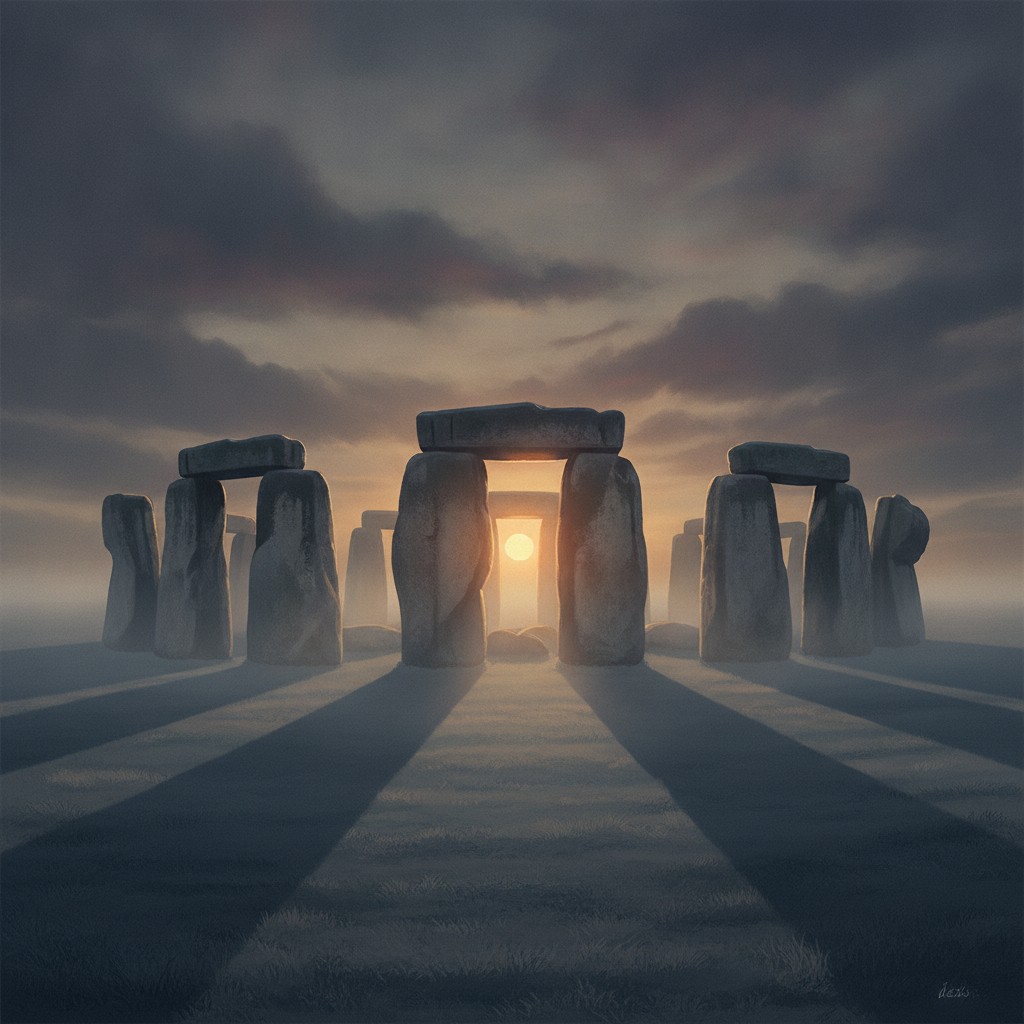
Stonehenge stands on Salisbury Plain in Wiltshire, in southern England, and it is the most studied prehistoric monument on the planet. Archaeologists have excavated it, dated it, scanned the ground around it with ground-penetrating radar and modelled it in three dimensions. On the morning of the summer solstice the sun rises over the outlying Heel Stone and its light runs straight down the processional avenue into the centre of the circle. On the shortest day of the year the sun sets along the same axis in the opposite direction. That alignment is a measured fact, built into the arrangement of the stones themselves. Much of the rest of what we now know about the monument was established only in the past few years, by laboratory methods its builders could not have imagined.
The monument was not raised in a single campaign. It was assembled, dismantled and rebuilt over roughly a thousand years. It began around 3000 BC as a circular earthwork: a ditch and a bank enclosing a ring of pits, later named the Aubrey Holes after the antiquarian who first recorded them. The silhouette we recognise, the towering uprights capped with lintels, came around 2500 BC, when the enormous sarsen stones were raised and locked together with joints cut into rock. The builders used mortice and tenon, and tongue and groove, techniques borrowed from carpentry and applied to stone. Work, rearrangement and repair continued until about 2000 BC. The monument photographed today is therefore the surviving version of a structure its makers kept altering across some forty generations.
You have used your free reads for this month.
Unlock all 208 documented mysteries - in 8 languages, ad-free.
Get full access