Documented

Ten Letters in a Garden: The Shugborough Inscription No One Can Read

2026-06-20 · Unsolved Ciphers · 8 min read

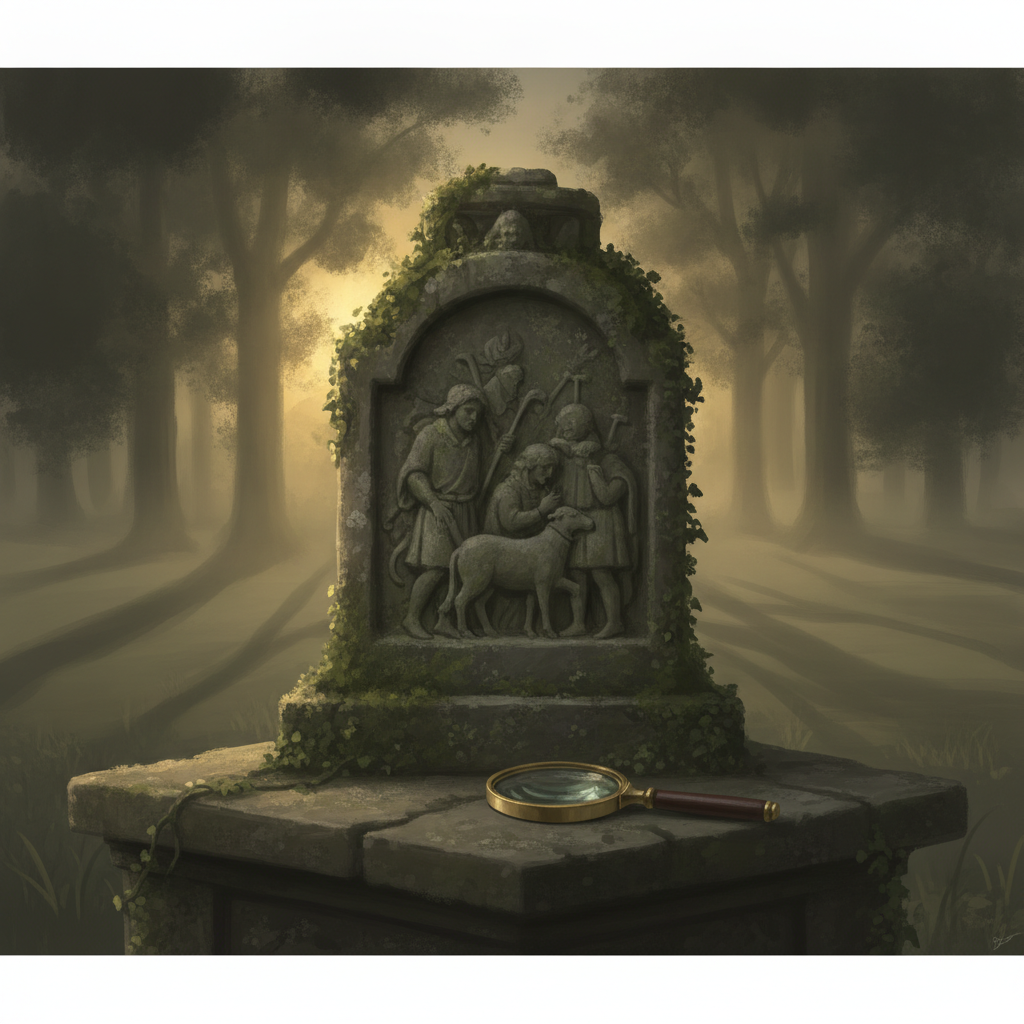
On the grounds of Shugborough Hall in Staffordshire, among clipped lawns and a scattering of neoclassical garden buildings, stands a weathered stone monument known as the Shepherd's Monument. It is not a cathedral or a royal tomb. It is an ornament, put up by a wealthy English family for their own pleasure, and the row of ten letters cut into the stone beneath its carved relief has never been read to anyone's satisfaction. Shugborough lies a few miles east of Stafford, on the edge of Cannock Chase, and the monument sits near the top of most published lists of famous undeciphered inscriptions.

Shugborough had been the seat of the Anson family since 1624. In the middle of the eighteenth century it belonged to Thomas Anson, a Member of Parliament for Lichfield, a traveller and a member of the Society of Dilettanti, the London club of gentlemen with a taste for classical antiquity. He never married and had no children. His younger brother George Anson was a naval officer who in 1740 sailed with a squadron to raid Spanish possessions in the Pacific. The expedition was a disaster in human terms, losing all but one of its ships, and the great majority of the men who sailed died on the way, most of them of scurvy. But in June 1743 George Anson's remaining vessel, the Centurion, captured the Manila treasure galleon Nuestra Senora de Covadonga. He returned to England in 1744 having circumnavigated the globe, and the captured silver was carried through London in a procession of wagons. He became a national figure, later First Lord of the Admiralty, and a very rich man.

Part of that fortune went into the gardens at Shugborough. From the late 1740s onward Thomas Anson filled the park with fashionable structures: a Chinese House completed in 1747, a rustic arch and grotto work attributed to the designer Thomas Wright of Durham, and, in the following decade, a group of monuments by the architect James Stuart, whose measured drawings of Athens had made him famous. Stuart's Doric Temple, Tower of the Winds, Arch of Hadrian and Lanthorn of Demosthenes still stand in the grounds. The Shepherd's Monument belongs to the earlier phase of this programme and is generally dated to between 1748 and 1756.

Its centrepiece is a marble relief carved by Peter Scheemakers, a Flemish sculptor with a busy London workshop who had recently produced the Shakespeare memorial in Westminster Abbey. The relief is not an original composition. It copies a famous painting by Nicolas Poussin, made in about 1638 and now in the Louvre, usually called The Shepherds of Arcadia. In the painting three shepherds and a woman gather at a stone tomb in an idealised landscape, and one of the shepherds traces with his finger the Latin words carved on it: Et in arcadia ego, meaning roughly that even in Arcadia, in paradise itself, death is present. The Shugborough version reverses the composition, so that it reads as a mirror image of Poussin's canvas, and a number of small details differ from the original, including an additional stone structure resting on top of the tomb. Whether the reversal and the changes were deliberate or simply what happened when a sculptor worked from an engraving has never been established.

Below the relief, a mason cut the letters that made the monument famous. On one line, spaced apart, are the eight capitals O U O S V A V V. They are cut in Roman capitals, evenly spaced, with no punctuation and nothing to show where one unit of meaning ends and the next begins. Slightly lower and set outside them are the letters D and M. That is the whole of the inscription. The Anson family left no key to it. No surviving letter, account book or estate paper explains what the sequence means, who chose it, or even who cut it. The D and the M are the least mysterious part, since on Roman tombstones the abbreviation D M routinely stood for Dis Manibus, a dedication to the spirits of the dead, and that reading fits a monument built around the image of a tomb. The eight letters above have no such obvious anchor.

The family dates matter to the arguments that came later, so they are worth setting down plainly. George Anson married Lady Elizabeth Yorke in 1748, the year the monument is thought to have been begun. She died in 1760. George Anson died in 1762. Thomas Anson, unmarried, died in 1773, and Shugborough passed to his nephew George Adams, who took the Anson name. None of them is recorded anywhere as having explained the inscription, and none of their contemporaries is recorded as having asked.

The monument's fame grew alongside a roll call of illustrious failures. Charles Darwin is said to have tried the letters and given up. Charles Dickens is said to have puzzled over them. The potter Josiah Wedgwood, a friend of the family, is said to have made an attempt as well. These stories appear in almost every popular account of Shugborough, and they do a great deal of work in making the puzzle feel important, but the documentation behind them is thin. They rest on tradition and repetition rather than on contemporary records, and the accurate word for them is reportedly.

What is firmly documented is the campaign of 2004. Richard Kemp, then general manager of the Shugborough estate, saw the publicity value of the old riddle and invited veteran codebreakers from Bletchley Park, the British centre where German Enigma traffic was broken during the Second World War, to make a public attempt on the letters. Among them were Oliver and Sheila Lawn, a married couple who had both served at Bletchley. Sheila Lawn favoured a romantic Latin dedication; Oliver Lawn explored more elaborate cipher structures and offered a speculative religious reading of his own. Both presented their ideas as guesses rather than solutions, and neither produced a decryption that scholars accepted. The estate itself passed to the National Trust in 1966 and, after decades of management by Staffordshire County Council, returned to full National Trust care in 2016. The monument is listed at the highest grade of legal protection. The letters remain exactly as the mason left them.

Ad

Conclusions and Open Questions

There is no shortage of proposed answers. There is only a shortage of evidence for them.

The most widely repeated reading treats the eight letters as the initials of a Latin sentence, put forward by the scholar Oliver Stonor in 1951: Optimae Uxoris Optimae Sororis Viduus Amantissimus Vovit Virtutibus, best of wives, best of sisters, a most devoted widower dedicates this to your virtues. It suits the elegiac mood of the carving, but no evidence supports it beyond its own plausibility, and the chronology is awkward: Lady Elizabeth Anson did not die until 1760, several years after the monument is thought to have been finished, which forces its defenders to argue that the letters were added later.

Other Latin readings pull in different directions. Keith Massey, a linguist who worked for the American National Security Agency, proposed a devotional line, Oro Ut Omnes Sequantur Viam Ad Veram Vitam, I pray that all may follow the Way to True Life. Steve Regimbal argued that the letters encode a Latin rendering of the vanity of vanities passage from Ecclesiastes. A.J. Morton set Latin aside and read them as English initials for members of the Anson family and the names of their estates, which would make the monument a private memorial in shorthand rather than a riddle. Each is defensible; none can be proven; and with eight letters almost any phrase beginning with the right sounds can be made to fit.

Others insist the letters are a genuine cipher rather than initials. Dave Ramsden proposed in 2014 that a polyalphabetic scheme conceals the word Magdalen, a reading that draws Mary Magdalene and centuries of religious legend into the frame. George Edmunds argued in 2016 that the letters are map coordinates pointing to Anson treasure buried on the estate. The cipher historian Nick Pelling, who has examined many such claims, remains sceptical of all of them, and his objection is the sharpest in the affair: eight characters are so few that a clever mind can twist them into almost anything, so even a solution that decrypts cleanly proves nothing.

The Latin phrase on the relief has generated its own theories. Et in arcadia ego lacks a verb, and some have treated it as an anagram, rearranging it into I Tego Arcana Dei, begone, I conceal the secrets of God. It is clever wordplay, but the phrase was a commonplace of European art long before Shugborough was built, and nothing indicates the Ansons meant more by it than Poussin did. The 2004 publicity also fed Da Vinci Code era speculation tying the monument to the Holy Grail and to a society called the Priory of Sion. That strand deserves tongs: the Priory was exposed decades ago as a twentieth century invention of a Frenchman named Pierre Plantard.

One quieter theory holds that the cryptographers have asked the wrong question. Every attempt assumes the letters are a message built to be decoded. They may instead be a private abbreviation whose meaning was obvious to Thomas Anson and a few people close to him and opaque to everyone else by circumstance rather than design. On that view there is no lock to pick, and 250 years of failure would say more about our assumptions than about the stone.

What remains unexplained is simple to state. A wealthy, educated family carved a message in the most permanent medium available to them and left no line anywhere explaining it. If the letters record private grief, why encode them; if they are a public statement, why make them unreadable? And can eight characters ever be proven to mean one thing rather than another? Until a document turns up in an archive, every reading remains a guess wearing a scholar's coat.

Free reads left this month: 0

Share this story:

Reader comments (0)
Only active subscribers with verified payment can post comments. Get full access