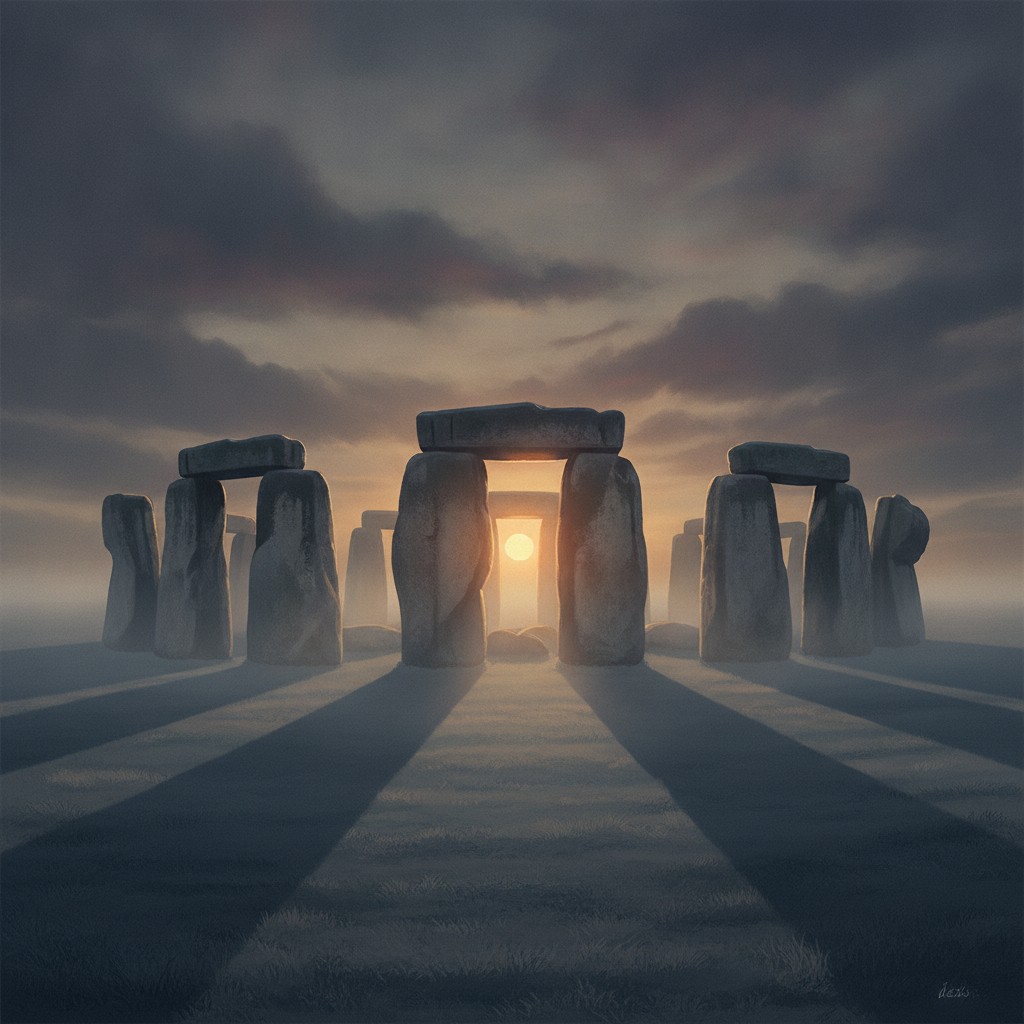
Stonehenge: The Questions Five Thousand Years Have Not Answered
Stonehenge stands on Salisbury Plain in Wiltshire, in southern England, and it is the most studied prehistoric monument on the planet. Archaeologists have excavated it, dated it, scanned the ground around it with ground-penetrating radar and modelled it in three dimensions. On the morning of the summer solstice the sun rises over the outlying Heel Stone and its light runs straight down the processional avenue into the centre of the circle. On the shortest day of the year the sun sets along the same axis in the opposite direction. That alignment is a measured fact, built into the arrangement of the stones themselves. Much of the rest of what we now know about the monument was established only in the past few years, by laboratory methods its builders could not have imagined.
The monument was not raised in a single campaign. It was assembled, dismantled and rebuilt over roughly a thousand years. It began around 3000 BC as a circular earthwork: a ditch and a bank enclosing a ring of pits, later named the Aubrey Holes after the antiquarian who first recorded them. The silhouette we recognise, the towering uprights capped with lintels, came around 2500 BC, when the enormous sarsen stones were raised and locked together with joints cut into rock. The builders used mortice and tenon, and tongue and groove, techniques borrowed from carpentry and applied to stone. Work, rearrangement and repair continued until about 2000 BC. The monument photographed today is therefore the surviving version of a structure its makers kept altering across some forty generations.
The finished sarsen setting had two elements: an outer ring of uprights carrying a continuous circle of lintels, and inside it a horseshoe of five much larger pairs, each carrying a lintel of its own. The smaller bluestones were arranged within and around these, and they were moved more than once. Every rebuilding left traces in the ground, and radiocarbon dates from antler picks abandoned in the ditch and from cremated bone underpin the sequence of phases.
Stonehenge was also a burial ground, and on a large scale. Excavation has recovered the cremated remains of at least 58 people, and the true number of burials at the site is estimated at between 150 and 240. They were deposited over roughly five centuries, which makes Stonehenge one of the largest Neolithic cemeteries known in Britain. The dead were placed there while the monument was still being built and rebuilt around them.
The great uprights are sarsens, blocks of exceptionally hard silica sandstone weighing around 25 tons apiece. For centuries their source was guesswork. The answer arrived in 2020, and it arrived because of an object that had spent sixty years on another continent. During repair work in 1958, engineers drilled a core clean through one of the sarsens, Stone 58, in order to insert a reinforcing rod. Robert Phillips, who worked for the firm that did the drilling, kept the cylinder of stone. He took it with him when he emigrated to the United States, where it stayed, unknown to researchers, until on the eve of his ninetieth birthday he arranged to send it back to Britain. Unlike the protected monument, the returned core could be sampled destructively. A team led by the geoscientist David Nash analysed its chemistry and then compared it, using a non-destructive X-ray survey, with the standing sarsens. Fifty of the fifty-two surviving sarsens matched a single source: West Woods, on the Marlborough Downs, about 25 kilometres to the north. Moving blocks of that weight over that distance would have required hundreds of people, timber sledges and prepared trackways.
The smaller inner stones, the bluestones, are not local at all. More than a century ago the geologist Herbert Thomas traced them to the Preseli Hills of west Wales, roughly 250 kilometres from Salisbury Plain. Modern excavations directed by Mike Parker Pearson and colleagues have located the quarry faces themselves, complete with the stumps of pillars that were levered out and traces of the people who worked there. The Welsh origin of the bluestones is documented. Their route to Wiltshire is not: no sledge, raft, rope or prepared trackway from that journey has ever been recovered.
In August 2024 the picture changed again. Researchers led by Anthony Clarke of Curtin University took mineral grains from the Altar Stone, the large recumbent sandstone slab that lies flat at the centre of the monument, and measured the ages locked inside its zircon, apatite and rutile crystals. The resulting signature did not match Wales. It matched the Orcadian Basin of far northeastern Scotland, at least 750 kilometres away, near the northern end of the British mainland. The finding was reported in the journal Nature, and it is the longest journey ever demonstrated for any stone in a Neolithic monument. The same team also showed that Salisbury Plain was not glaciated during the relevant period. A follow-up study published in 2025 narrowed the likely source area further within that northern basin.
The famous circle is only one part of a much larger prehistoric landscape. The Aubrey Holes, dug when the site was first laid out around 3000 BC, may originally have held bluestones, which would mean the Welsh stones stood on the plain for centuries before being rearranged into the settings visible today. A short walk away, where the avenue meets the river, archaeologists excavated a second, dismantled circle that they nicknamed Bluestonehenge; its stones are long gone. Nearby lies Durrington Walls, a very large settlement where the builders appear to have feasted on great numbers of pigs. Isotope analysis of the animal bones indicates that the pigs were brought there from across Britain.
The people who did all this had no writing, no wheeled transport in any practical sense, no metal tools and no draught animals harnessed to the work in the way a later age would have used them. They nevertheless quarried and dressed 25-ton blocks, stood them on end, lifted lintels onto their tops and cut joints accurate enough that the structure is still standing after five thousand years. That is the documented record, and it is the record that any explanation has to account for.
Conclusions and Open Questions
The solstice alignment is measurement rather than interpretation, and nobody seriously disputes it. But an alignment is not a purpose, and around that one fixed point the explanations compete.
The astronomical reading was pushed furthest by Gerald Hawkins in the 1960s, who argued that Stonehenge functioned as a sophisticated observatory and even as a device for predicting eclipses. Its weakness is precision: critics answered that the finer alignments Hawkins relied on are too loose to carry the argument, and that we risk projecting our own appetite for measurement onto Neolithic builders.
A second reading takes the burials as the key. On this view Stonehenge is a monument to the dead, a domain of ancestors rendered permanent in stone. Its strength is that the cemetery is not in doubt. Its weakness is that it explains the circle without explaining the stones: Neolithic Britain had many burial grounds, and none of the others required hauling rock from Wales, let alone from Scotland.
Timothy Darvill and Geoffrey Wainwright proposed a place of healing, arguing that the bluestones were credited with curative power and that the sick and injured travelled to the circle as pilgrims. Its strength is that it gives a reason for the specific choice of Welsh stone. Its weakness is that the evidence for healing is inferential rather than direct.
Mike Parker Pearson proposed something larger: that building Stonehenge was an act of unification, a shared labour binding scattered farming communities across Britain together, with the work mattering as much as the result. The Durrington Walls pig bones, drawn from across the island, sit well with it. It remains a hypothesis, and an attractive hypothesis is not a proven one.
The transport question divides along different lines. Most researchers hold that people moved the bluestones, overland or by sea and river. A minority position associated with the geologist Brian John holds that glaciers carried them most of the way south during an ice age and left them within reach of the plain. The glacial case was weakened by the 2024 finding that Salisbury Plain was not glaciated in the relevant period, but the human case has its own gap: not one piece of the transport equipment has ever been found. For the Altar Stone, many researchers now think a sea route around the coast more plausible than an overland haul the length of the island. No boat, no record and no direct trace of such a crossing has been recovered.
One theory holds that the assembling was itself the point: that stones gathered from Wales, from the far north of Scotland and from the local downs were deliberately drawn together into one ring, a map of a world made in stone. Some argue it explains why sources so absurdly distant were preferred to good rock lying close by. It fits the new sourcing results, and it rests on nothing beyond them.
What remains unexplained is concrete. We do not know how a 25-ton block was raised on end without pulleys, iron or draught animals. We do not know how a six-tonne slab crossed almost the entire length of Britain. We do not know why these particular distant sources were chosen at all.
And the open questions stay open. Did the monument have one purpose, or did its meaning drift across a thousand years of rebuilding, as a cathedral's does? Were the bluestones standing on the plain for centuries before the sarsens arrived? Did the Altar Stone come by sea, and if so, who sailed it, and why did that voyage leave no trace? Laboratories have finally made the stones confess where they were born. What they were for, the stones are still keeping.