306 Men, No Distress Call: The Vanishing of USS Cyclops
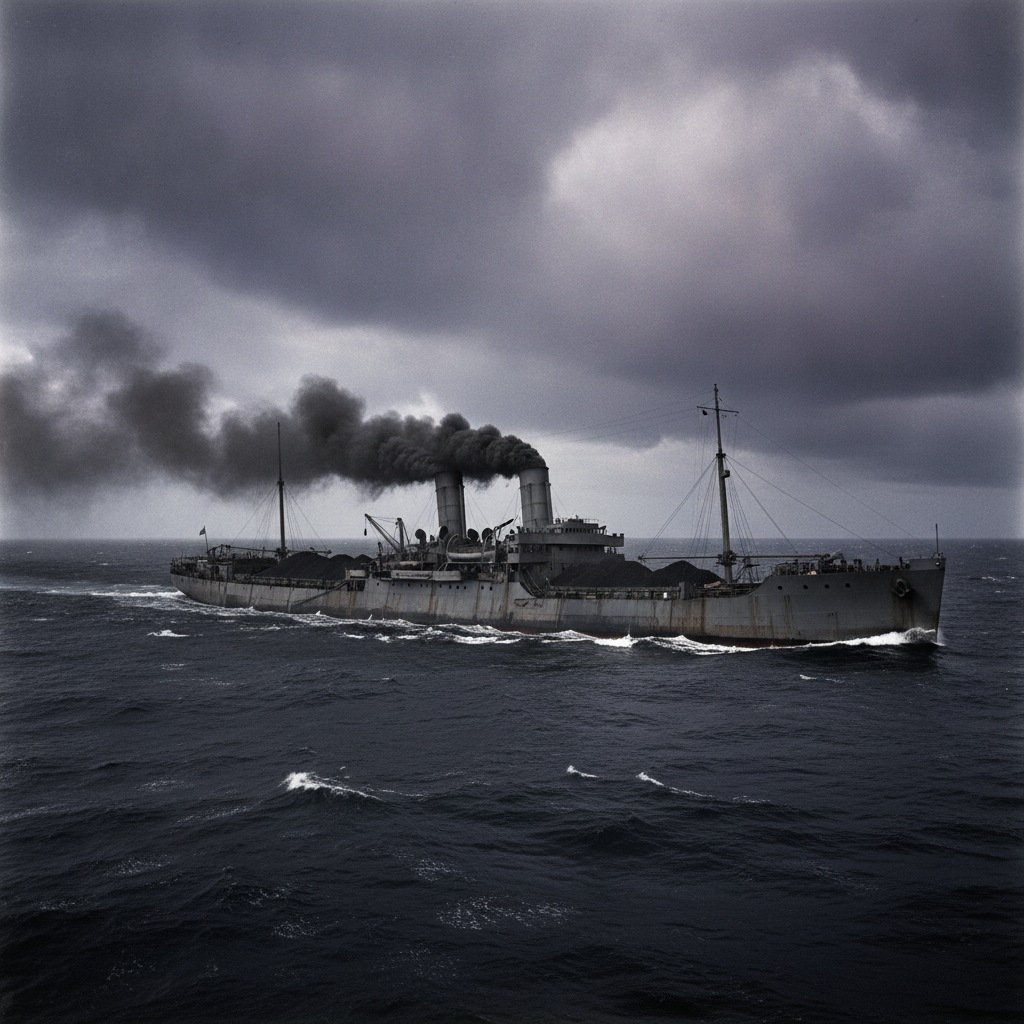
The last men to see the USS Cyclops were the dockhands of Bridgetown, Barbados. On the morning of March 4, 1918, they watched the huge grey collier haul in her lines and turn all 542 feet of her toward the open Atlantic, riding so low in the water that her load line seemed to have disappeared beneath the swell. She was bound for Baltimore, roughly 1,800 miles to the north, with 306 men aboard and about 10,800 long tons of dense Brazilian manganese ore in her holds. She was among the largest vessels in the United States Navy, a floating coal depot built to keep a wartime fleet fed and moving. Somewhere between that warm Caribbean harbor and the cold mouth of the Chesapeake, she ceased to exist. No distress signal was ever received. No lifeboat, no body and no confirmed piece of wreckage has ever been recovered. More than a century later she remains the single largest loss of life in United States naval history not caused by combat.
The voyage had begun far to the south. Cyclops had been serving off the coast of Brazil, and on February 16, 1918 she left Rio de Janeiro loaded with manganese ore, the raw material of munitions steel, urgently wanted by the mills of a country now fully at war. She called at Salvador and then pointed north for Baltimore with, on paper, no further stops scheduled. Aboard were her crew, a number of passengers, and the American consul general at Rio de Janeiro, Alfred L. M. Gottschalk, who was returning to the United States.
On March 3 and 4 she put in unexpectedly at Bridgetown. She was overweight and sitting dangerously deep, and one of her two triple expansion engines was crippled: the starboard engine had a cracked cylinder and had been declared inoperative. A naval survey board that examined her recommended that she be sent back to the United States, while noting that the defect did not in itself make her unseaworthy. Her master took on coal and provisions and pressed north on a single working engine. That departure on the morning of March 4 is the last confirmed sighting of the ship.
Cyclops was not a fragile vessel. Launched in 1910 and named for the one-eyed giant of Greek myth, she was the second of four Proteus class colliers, 542 feet long and displacing some 19,000 tons fully loaded. Her towering coaling gantries made her instantly recognizable, and for years she had done the unglamorous, essential work of carrying fuel to warships wherever the fleet needed her, from northern European waters to the Caribbean. She had weathered heavy seas before, and nothing in her service record set her apart.
Her master was among the more unusual figures ever to hold a United States Navy command. Lieutenant Commander George W. Worley was not, records later showed, who he claimed to be. Investigators from the Office of Naval Intelligence established that he had been born Johan Frederick Wichmann in Sandstedt, in the German kingdom of Hanover, in 1862, and that he had entered the United States by jumping ship in San Francisco in 1878. He took the name Worley from a sailor friend, ran a saloon on the Barbary Coast waterfront, and worked his way into the naval service. By 1918 his reputation aboard Cyclops was poor. Testimony gathered afterward described a captain who berated and cursed his officers over trifles, who prowled the decks at night in his underwear and a derby hat, and who on at least one occasion chased a junior officer around the ship with a pistol. He confined capable officers to their quarters and handed the loading of cargo to inexperienced men.
Cyclops was due at Baltimore around March 13. When she did not arrive, the alarm spread slowly and then urgently. The Navy combed her presumed track with every ship it could spare, and wireless stations along the coast listened for a call that never came. Not a spar, not a slick of oil, not a single lifebelt was recovered, then or since.
On June 1, 1918, Assistant Secretary of the Navy Franklin D. Roosevelt signed the order declaring the ship and all 306 men aboard officially lost. Gottschalk died with them. By grim coincidence the consul general was also of German descent, a detail that would matter a great deal in the months that followed. A naval writer later called her fate one of the deepest mysteries in the annals of the service.
Two facts frame everything that came after. The first is the era. By 1918 wireless telegraphy was standard equipment on a ship of her size, and the sea lanes to the Chesapeake were among the busiest and most closely watched in the world. The second is the weather record. The surviving observations show no single great storm lying across her whole route that week, only unsettled conditions off the Virginia capes. Ships founder, and ships break down and limp into port late. To leave no trace at all was something else.
Two documented postscripts belong to the record. Cyclops was the second of four sister ships, and in 1941 two of the others were lost in similar circumstances. USS Proteus, by then in civilian Canadian service and carrying a heavy load of bauxite, the dense ore of aluminum, disappeared without trace after late November 1941. USS Nereus, sold to a Canadian aluminum company, left Saint Thomas in the Virgin Islands that December, also laden with bauxite, and was never seen again. The second postscript is the silence of the seabed. Expeditions have combed the bottom off Norfolk and the Virginia capes, and sonar contacts have been chased and dismissed, each dissolving into a rock ridge or an unrelated wreck. The hull of the Cyclops has never been located.
Conclusions and Open Questions
The first explanation offered was sabotage, and it came from the wartime press and public of 1918 rather than from any inquiry. Rumor fastened on Worley's German birth and on Gottschalk's supposed German sympathies, and a story took hold that captain or consul had betrayed the ship, that she had been scuttled, captured, or handed to a waiting U boat. The theory had one genuine strength: Worley truly was a German born man concealing his real name. Its weakness is the documentary record. German naval archives, examined after the Armistice, list no submarine and no surface raider anywhere near her track in that period, and no U boat commander ever claimed her, though sinking so large an American vessel would have been a celebrated feat. Berlin denied involvement, and nothing has since contradicted the denial.
The explanation favored by most historians, and the one the Naval History and Heritage Command leans toward, is structural. Manganese ore is roughly twice as dense as the coal Cyclops was built to carry. Poured into holds shaped for coal it concentrates enormous weight low and unevenly, and if it is not carefully trimmed and secured it can shift when the ship rolls. A vessel already overloaded, sitting too deep and running on one engine, could have had her back broken or been rolled over so fast that she went down in a minute or two, faster than any man could reach the wireless. The Command's own wording is that she probably sank in an unexpected storm, while admitting openly that the cause is not known. That admission is the weakness: it is the likeliest story rather than a proven one, and it leans on a storm the meteorological record only partly supports.
A third theory, argued chiefly by naval historians who noticed the pattern, places the fault in the class itself. Three near identical ships, all carrying dense metallic ore, all swallowed on the run between the Caribbean and North America, points to a weakness in the long coal carrying hulls that heavy cargo exposed. Its weakness as proof is that no wreck of any of the three has ever been examined, so the shared defect remains an inference, and German submarines were active in the Atlantic in 1941, offering a competing and untestable explanation for the two later losses.
Popular writers from the 1960s onward folded the Cyclops into the mythology of the Bermuda Triangle, and it is the weakest claim on the list. Her likeliest track and grave lie well to the north of the boundaries usually drawn for the Triangle, in ordinary storm prone waters off the mid Atlantic coast. Skeptics argue, reasonably, that the label survives only because the documented facts leave a vacuum, and that the sea has always been able to swallow ships whole without help from the paranormal.
What remains unexplained is the completeness of the silence. Ships that founder in storms usually leave something behind: floating debris, an oil slick, survivors, a garbled last transmission. Cyclops left nothing, on a busy sea lane, in an era of standard wireless. One theory holds that no single dramatic event is needed, only a convergence of ordinary failures. An overloaded ship, her cargo perhaps badly trimmed by the inexperienced hands Worley preferred, laboring north on one engine and unable to turn to meet a squall safely, might have capsized between one wave and the next. That is speculation and should be labeled as such.
The open questions are few and stubborn. Was the ore properly trimmed and secured, and who supervised the work? Did Worley's conduct amount to madness, to negligence, or to nothing at all? Why does the weather record fail to show the storm that the leading theory requires? And where is she? Until a wreck is found and read, the Cyclops keeps the one thing the sea took from her that March morning and never gave back: the truth of how she died.