Disputed

The Double Flash: What the Vela Satellite Saw Over the Southern Ocean

2026-08-27 · Signals & Sounds · 8 min read

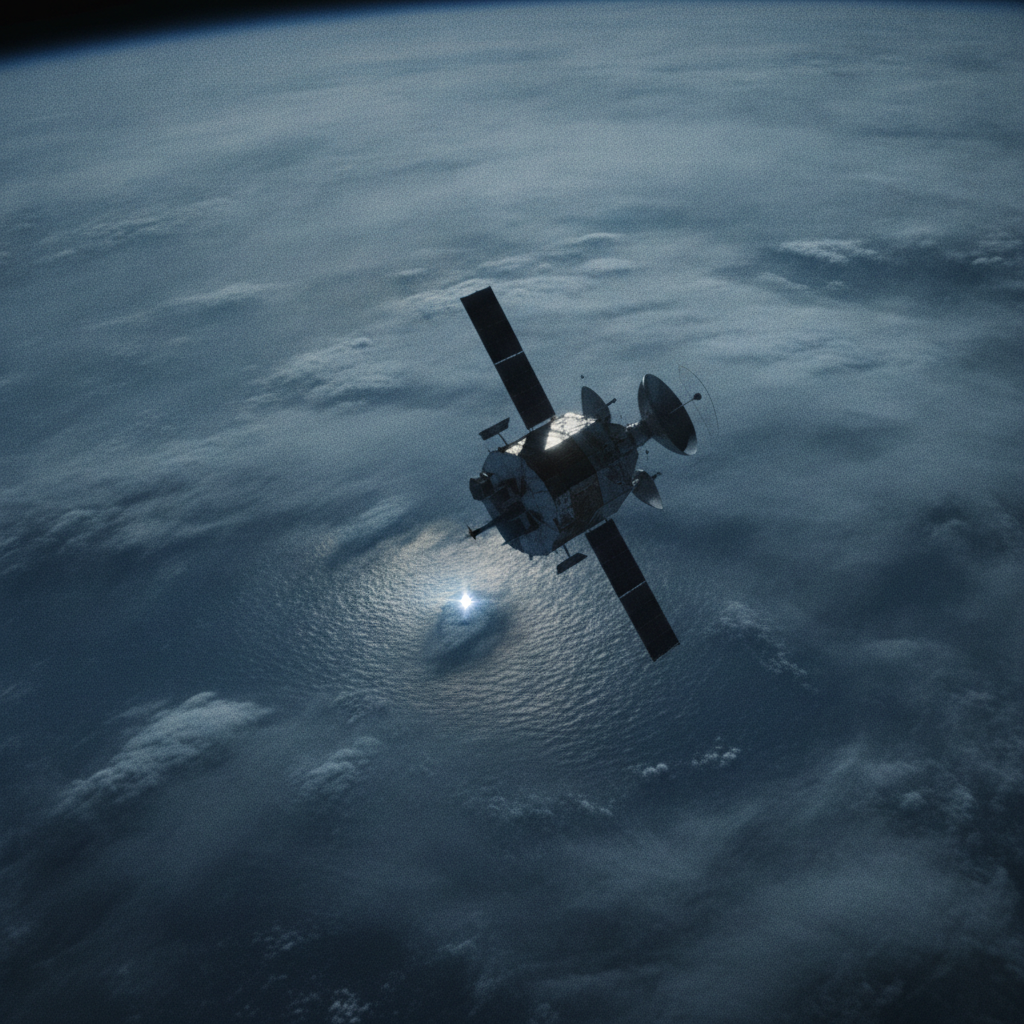
The satellite that saw it was already old. Vela 6911 had gone up in May 1969, into an orbit so high that it could watch nearly half the planet at once, and by the autumn of 1979 it was more than two years past the end of its design life. Its job was simple and enormous: to watch the Earth and the space around it for the light of a nuclear explosion, so that nobody could set one off in the atmosphere without the United States knowing. At 53 minutes past midnight, Greenwich Mean Time, on 22 September 1979, over an empty stretch of the southern ocean between Africa and Antarctica, it recorded exactly that.

The instruments that made the recording were two small silicon light sensors with an odd name. They were called bhangmeters, after the Indian cannabis preparation bhang, on the joke that only someone under its influence would believe such a device could work. What they measured was the shape of light over time. A nuclear fireball has a signature almost nothing else in nature produces: a fierce first spike lasting about a thousandth of a second, then a dip as the expanding shock front turns opaque and hides the fireball behind it, then a second pulse, slower and brighter and far longer, as the shock front thins and the fireball shines back through. That is the double flash. In the sixteen years the Vela satellites had been in service they had recorded it forty-one times. Every one of those forty-one had been a nuclear test.

The forty-second reading pointed at a patch of sea near Prince Edward and Marion Islands, two cold, wind-scoured South African possessions at roughly 47 degrees south and 40 degrees east, where the Indian Ocean runs into the Atlantic. The estimated yield was small, two to three kilotons, a fraction of the bomb dropped on Hiroshima.

The alert reached Washington within hours. President Jimmy Carter noted it in his diary the same day: "There was indication of a nuclear explosion in the region of South Africa - either South Africa, Israel using a ship at sea, or nothing." The three possibilities he set down in a single line that night are, in essence, still the three possibilities today.

What followed was one of the most intensive technical investigations the United States has ever mounted into a single second of data, and it satisfied almost nobody. Air Force aircraft fitted with air-sampling equipment flew repeated sorties across the southern Indian Ocean looking for fission products. They found nothing. The region is among the emptiest and stormiest on Earth and the search area ran to millions of square kilometres, but the absence of debris remained the most damaging fact for the nuclear hypothesis.

Then corroboration began arriving from directions nobody had planned for. On 8 November 1979 John Deutch, then Deputy Secretary of Energy, reported that the Arecibo Observatory in Puerto Rico had picked up an anomalous travelling ionospheric disturbance on the morning of 22 September, a ripple moving from the south-east towards the north-west. Arecibo had never recorded anything quite like it. Disturbances of that kind had been documented after Soviet atmospheric tests in the Arctic in 1961.

The Naval Research Laboratory went to the hydrophones. The United States maintained underwater listening arrays in the Atlantic, and NRL analysts pulled the records from the Missile Impact Location System stations at Ascension Island. What they found, they concluded, were acoustic signals of a type associated with nuclear shots in a maritime environment, arriving from shallow water between Prince Edward and Marion Islands. On its face this was independent confirmation through a completely different physical channel: light from orbit, sound through the sea, both pointing at the same few square kilometres of water.

The White House was not persuaded. Frank Press, Carter's science adviser, had the Office of Science and Technology Policy convene a panel of outside scientists chaired by Jack Ruina of MIT, a former director of the Defense Department's Advanced Research Projects Agency. The panel reported in mid-1980. It found what it called a significant deviation in the light signature from the pattern of a genuine nuclear burst: the satellite's two bhangmeters, which should have agreed closely, had recorded intensities that did not match. It offered an alternative: a small meteoroid could have struck the ageing satellite and knocked loose a cloud of debris, and sunlit fragments drifting across the sensors' field of view could have traced out a false double hump. Its conclusion was carefully worded and quietly devastating: "based on our experience in related scientific assessments, it is our collective judgment that the September 22 signal was probably not from a nuclear explosion."

That verdict did not settle the argument inside the government. It split it. A CIA assessment put the probability that the event had been a nuclear test at ninety per cent or better. The Defense Intelligence Agency, the Defense Department and the Department of Energy largely backed the nuclear reading. Scientists at Los Alamos who had built and flown the Vela sensors insisted the instruments had worked properly. The Naval Research Laboratory's hydroacoustic study, the most detailed piece of independent physical evidence anyone produced, was not seriously examined by the Ruina panel at all.

Ad

One more thread came from the far side of the world. Low levels of iodine-131, a fission product with a half-life of about eight days, were reported in sheep in the Australian states of Victoria and Tasmania in the weeks after the event, downwind of the suspected site. Sheep tested in New Zealand showed no such trace. The finding has been argued over ever since, because the sampling was limited and the levels very low, but the pattern was consistent with fallout carried east on the prevailing winds.

All of this happened at a politically impossible moment. The SALT II arms control treaty had been signed three months earlier and was waiting on the Senate, and Carter had built his presidency and his re-election campaign on non-proliferation. An unambiguous finding that a close partner had tested a nuclear weapon in secret would have detonated inside Washington. Leonard Weiss, then staff director of the Senate subcommittee on energy and nuclear proliferation, argued for years afterwards that the Ruina panel had been convened precisely to produce a reassuring answer, and that intelligence on Israel's nuclear programme was withheld from the scientists who sat on it. Victor Gilinsky, then a member of the Nuclear Regulatory Commission, made the same charge: that politics had shaped the science. Carter himself wrote in his diary on 27 February 1980 that a growing number of American scientists believed the Israelis had conducted a test in the ocean off southern Africa. Neither government has ever confirmed anything of the kind.

The decades since have shifted the weight of expert opinion without producing proof. In 1993 President F. W. de Klerk disclosed that South Africa had built six nuclear devices and dismantled them, and stated that his country had never conducted a test. In April 1997 the Israeli newspaper Haaretz quoted the South African deputy foreign minister Aziz Pahad as confirming that the 1979 flash had been a South African test; within a day his office said he had only been repeating a long-circulating rumour. In 2003 Stansfield Turner, Director of Central Intelligence in 1979, said the Vela detection had been of a man-made phenomenon. In 2016 the National Security Archive researchers William Burr and Avner Cohen published a documentary study concluding that the balance of evidence favoured a weapons test. A 2017 paper in the journal Science and Global Security argued that the meteoroid explanation was far less likely than the Ruina panel had assumed. A 2018 paper in the same journal by Lars-Erik De Geer and Christopher Wright worked through the radionuclide and hydroacoustic evidence and made a detailed case for a nuclear test. In 2022 a re-examination of data from the NASA Nimbus-7 satellite reported a trace in the ozone layer consistent with a shockwave arriving 16 minutes and 44 seconds after the flash.

The United States has never revised its official position. Parts of the file remain classified today.

Conclusions and Open Questions

The nuclear-test explanation rests on convergence. Its strength is that light, sound and arguably fallout all point at the same water at the same hour, and that the Vela sensors had never produced a false double flash in forty-one previous detections. Its weakness is the missing debris: weeks of sampling flights returned nothing, and a low-yield burst near the surface should have left something to find.

The meteoroid hypothesis advanced by the Ruina panel has the virtue of explaining the anomaly in the light curve without requiring a secret test by anyone. Its weakness is arithmetic. The chance of a particle striking that particular satellite and throwing off exactly enough sunlit debris to imitate the one signature the instrument was designed to recognise is very small, and the 2017 analysis put it lower still. It also explains nothing that happened in the ionosphere over Puerto Rico or in the water off Ascension Island.

A third possibility is the least discussed and the hardest to rule out: that an ageing satellite simply malfunctioned, and that Arecibo, the hydrophones and the Australian sheep are unrelated events later assembled into a pattern by people looking for one. Nobody has demonstrated this either.

Attribution is a separate question from detection. One theory, argued by Weiss and others, holds that the test was Israeli, possibly conducted from a vessel at sea. Another holds that it was South African, or a joint undertaking. South Africa's post-apartheid disclosures state that it never tested. Israel has never confirmed or denied that it possesses nuclear weapons at all. No government has produced a document accepting responsibility, and the American files that might settle the question are still, in part, withheld.

What is not in dispute is that an instrument built for one purpose did the thing it was built to do, and that the country which built it has spent more than four decades unable to agree on what it saw.

Free reads left this month: 0

Share this story:

Reader comments (0)
Only active subscribers with verified payment can post comments. Get full access