Documented

The Yuba County Five: Five Men Drove Into the Mountains and Never Came Home

2026-07-04 · Unexplained Deaths · 7 min read

On the evening of Friday, February 24, 1978, five friends from the Yuba City area of northern California drove east to the college town of Chico to watch a basketball game. The car was an old Mercury Montego that belonged to Jack Madruga, who was thirty. With him were Ted Weiher, thirty-two, Bill Sterling, twenty-nine, Gary Mathias, twenty-five, and Jack Huett, twenty-four. Four of the five men lived with developmental disabilities. Mathias, the fifth, had been diagnosed with schizophrenia years earlier, but he had been in treatment and on medication since 1975 and was described by those who knew him as stable.

The five had come together through a program for people with disabilities in Yuba City, and basketball was the thread that ran through their friendship. They belonged to a team called the Gateway Gators, and their own game was set for the next morning: a Special Olympics tournament they had been talking about for weeks. A win would have qualified them for a state final. They planned to be home early.

On the way back from Chico they stopped at a small grocery store, where they were remembered buying soda, candy bars and pies. That stop is the last confirmed sighting of the five men together. From the store they drove into the dark, and none of them reached home. None of them played the game they had waited for.

Their families raised the alarm quickly, and their certainty that something was wrong rested on the men's habits. Relatives told investigators, then and for decades afterward, that all five kept to fixed routines. They did not miss appointments, did not stay out late, and did not take unfamiliar roads. Madruga in particular was known to be protective of his car and careful with money. When the Montego did not appear that night, the families began contacting the police before morning.

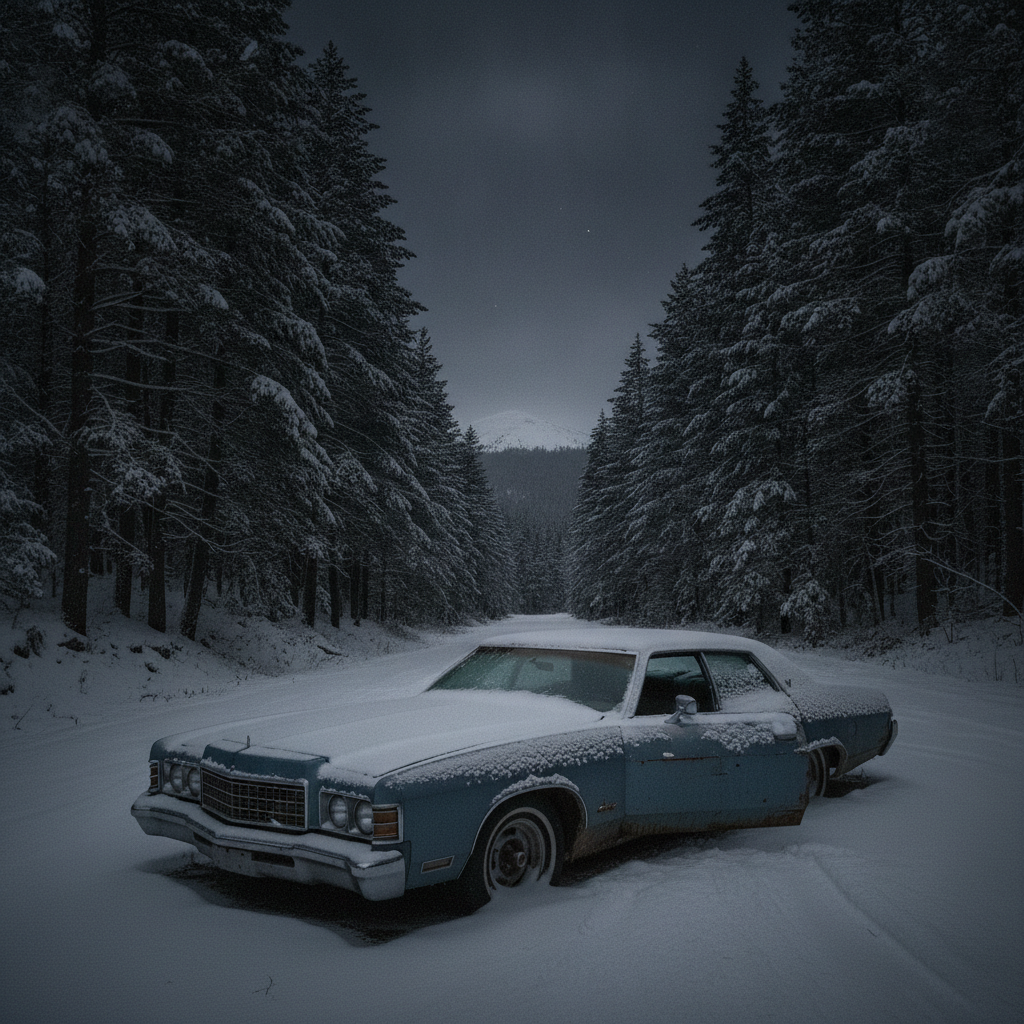
For four days there was nothing. Then, on February 28, a forest ranger found the Montego abandoned on a snowbound road in the Plumas National Forest, high in the Sierra Nevada and roughly seventy miles from any route the men would have taken home. The car was pointing away from Yuba City, deeper into the mountains.

The vehicle itself offered no explanation. It was undamaged and mechanically sound. It held about a quarter of a tank of fuel, enough to have carried the men most of the way home. It had not crashed or slid off the road; it had been stopped and left. It sat so lightly in the snow that investigators concluded a few men could have pushed it free by hand. There were no signs of a struggle, no blood, and no damage to the interior. Inside were road maps and some of the wrappers from the food bought at the store. The keys were missing.

Searchers went into the mountains, but conditions were against them. Snow lay several feet deep across the high country, more weather moved in, and the terrain around the car was steep and heavily wooded. Air and ground searches over the following weeks found no trace of the five men. As spring approached, the search was scaled back and the case went quiet.

One account of that night came from outside the group. A man named Joseph Schons had been on the same mountain road on February 24, trying to reach a family cabin. His car became stuck in the snow, and while attempting to free it he suffered a heart attack. He climbed back inside the vehicle and lay there through the night. At some point he saw headlights behind him and heard voices, including what he described as whistling, and he believed he saw people moving in the beams of the lights, among them the figures of a woman and a baby. He called out for help twice. Both times, he said, the voices stopped and the lights went out. Schons eventually walked out of the mountains and survived. He came forward after reading about the missing men. Investigators noted that he had been in cardiac distress, in shock, and severely cold at the time.

The mountain kept the rest until the thaw. On June 4, 1978, a group of motorcyclists riding through the forest came upon a United States Forest Service trailer, the kind kept stocked as shelter for firefighting crews, about nineteen miles beyond the abandoned car. Inside, on a bed, they found the body of Ted Weiher. He was wrapped in eight bedsheets. The autopsy found that he had died of a combination of starvation and hypothermia. He had lost close to half of his body weight, which had been around two hundred pounds. The growth of his beard indicated that he had lived for roughly eight to thirteen weeks after the night of February 24. His feet were severely frostbitten. His shoes were gone.

Ad

The trailer itself had been well supplied. Investigators found canned food in quantities they estimated could have fed all five men for about a year. There were matches, there was fuel, and there was a propane heater that had not been lit. Heavy winter clothing hung inside. The food locker had not been opened. Among the belongings left in the trailer was a pair of shoes that did not belong to Weiher; they were identified as Gary Mathias's. Someone had drawn the eight sheets over Weiher, including over his head.

The renewed search that followed recovered three more of the men. The remains of Jack Madruga, Bill Sterling and Jack Huett were found in the surrounding forest, spread across miles of rough, snow-covered ground at varying distances from the road and from one another. Their deaths were consistent with exposure. The pattern of the remains indicated that the group had separated after leaving the car and that the men had died apart from one another as they walked.

Gary Mathias was never found. Searches that summer and in the years since have produced nothing. His shoes remained in the trailer beside Ted Weiher. The case has stayed open with the Yuba County Sheriff's Department since 1978, and in October 2020 the department stated publicly that investigators believe Mathias was a victim of foul play. No arrest has ever been made, and no cause has ever been established for the drive into the mountains.

Conclusions and Open Questions

The oldest explanation is also the simplest, and it belongs to the original investigators: that the men made a wrong turn in the dark, probably somewhere past Oroville, and drove up the mountain by mistake. Detectives noted that a Forest Service snowcat had cleared part of that road the day before, cutting a track through drifts four to six feet deep, and the theory holds that the men, once stuck, followed the cleared track on foot because it looked like a way forward. Its weakness is the trailer. It does not explain how a man could remain inside for weeks without opening the food locker, lighting the heater or putting on the coats hanging on the wall, and it does not account for the sheets or for Mathias.

A second theory holds that someone else was involved. The Yuba County Sheriff's Department has said it believes Mathias met with foul play, and supporters of a broader version argue that the route makes sense only if someone who knew that road was directing or compelling the driver. They point to the missing keys and to Madruga's known caution. The weakness is the absence of physical evidence: there were no signs of a struggle at the car or in the trailer, and Schons described people moving and calling on their own rather than under duress.

A third line of thinking, advanced mainly by researchers and writers who have revisited the case, centers on Gary Mathias's medical history. One theory holds that he experienced a psychiatric episode that night and led the group off course. A gentler version holds only that he outlived Weiher, left the trailer wearing Weiher's shoes because his own were worn through, and died somewhere that was never searched. The second version accounts neatly for the exchanged shoes and for his being the one man never recovered. Both are weakened by the fact that nobody who saw the group that evening, at the game or at the store, reported anything unusual about him.

Some argue that the truest failure here was institutional. The investigation was split across at least three sheriff's jurisdictions, and no single agency ever held the complete picture. There is also a persistent but unconfirmed claim that Forest Service employees had reported signs of a heated, occupied trailer in that forest during the winter. If such a report existed and reached the right desk, searchers might have reached Ted Weiher while he was still alive. No document confirming it has ever been produced.

What remains unexplained is the core of the case. Nobody has established why five careful men drove seventy miles in the wrong direction, why they left a working car with fuel in the tank, why they walked into freezing temperatures in street clothes and light shoes, or why a man sheltering in a stocked trailer for weeks did not eat, did not light the heater and did not take the coats. Who covered Ted Weiher with eight sheets, and what became of that person, is unknown. Where the keys went is unknown. And after forty-eight years the largest open question is still the simplest one: where is Gary Mathias.

Free reads left this month: 0

Share this story:

Reader comments (0)
Only active subscribers with verified payment can post comments. Get full access