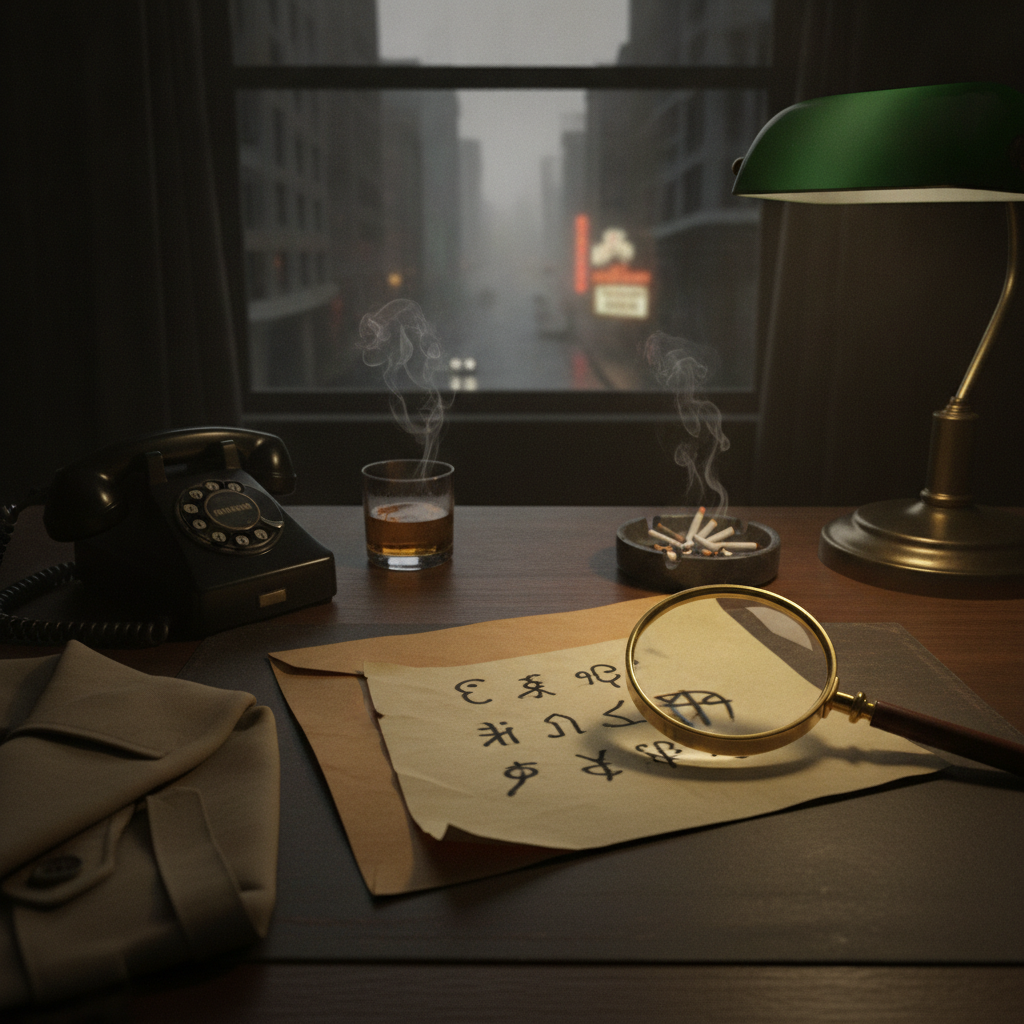
The Zodiac Ciphers: Four Codes, Two Solutions, No Name
On a cold night in December 1968, two teenagers were shot to death beside a car on a dark rural road outside Vallejo, California. There was no robbery and no apparent motive, and nothing connected the killer to the young couple. On the night of July 4, 1969, on another quiet road not far away, a man walked up to a parked car and shot the two people inside. One of them survived. Less than an hour later the gunman telephoned the Vallejo police himself to report the shooting, and the earlier one as well.
Over roughly a year, the same attacker struck seven young people in Northern California and killed five of them. Then he did something almost no killer had done before: he began writing to newspapers. He signed the letters Zodiac and marked them with a crossed circle, a symbol resembling a gunsight. In them he claimed a rising tally of victims, eventually as many as thirty-seven, a figure investigators were never able to support. And he wrapped part of what he wanted to say in cipher.
The first cipher arrived in three pieces. On July 31, 1969, the Vallejo Times-Herald, the San Francisco Chronicle and the San Francisco Examiner each received an envelope containing one third of a cryptogram four hundred and eight characters long, together with a demand that the piece be printed on the front page. If the papers refused, the writer said, he would go on killing. All three published.
The solution came within days, and not from a government agency. Donald Harden, a high school teacher in Salinas, and his wife Bettye worked on the printed sections at home. Bettye's approach was to guess at the writer's vanity: she assumed the message would begin with the word "I" and that he would boast early about killing. Both guesses were correct, and they gave the couple the foothold they needed. The decoded text began, I like killing people because it is so much fun, described killing as the greatest thrill available to him, and claimed that those he killed would become his slaves in an afterlife. It contained no name. The final eighteen characters do not resolve into ordinary language and have never been explained.
The attacks continued while the letters were being printed. On September 27, 1969, at Lake Berryessa, a hooded man wearing the crossed-circle symbol on his chest approached a young couple picnicking by the water, tied them and stabbed them both. The woman died of her injuries; the man survived. Before leaving, the attacker wrote the dates of his earlier crimes on the door of their car.
Two weeks later, on the night of October 11, 1969, he shot a taxi driver named Paul Stine in Presidio Heights, a residential neighborhood of San Francisco. He tore a section from Stine's bloodstained shirt and afterwards mailed pieces of it to the Chronicle, one at a time, as proof that the letters were genuine. The killing moved the case from rural back roads into the middle of a major American city, and it was against that background of public fear that the newspapers went on printing his puzzles.
On November 8, 1969, the Chronicle received a second cipher, three hundred and forty characters long, later known as Z340. It used sixty-three different symbols for the twenty-six letters of the alphabet, with several symbols standing for the same letter, which defeated ordinary frequency analysis. It was also more than a substitution. The underlying text had been rearranged a second time, so that the message ran along shifted diagonals rather than left to right. The FBI worked on it. Professional cryptanalysts worked on it. Amateur codebreakers worked on it for decades. Z340 held for fifty-one years.
The solution came in December 2020, from three men who had never met in person. David Oranchak, an American software developer who had spent years on the problem, worked with Sam Blake, an Australian mathematician, and Jarl Van Eycke, a Belgian warehouse worker and self-taught codebreaker whose program AZDecrypt was among the strongest homophonic cipher solvers available. Blake calculated the many ways the diagonal rearrangement could have been carried out and generated tens of thousands of reordered versions of the ciphertext. Van Eycke's software searched them for text that read as English. A fragment of real language emerged from the noise, and the rest followed. The FBI confirmed the solution within days.
The decoded message opened by mocking the search: I hope you are having lots of fun in trying to catch me. It denied that a caller to a local television program earlier that year had been him, stating that it was not him on the television show. It repeated that the gas chamber held no fear for him and returned to the idea of slaves waiting in an afterlife. Like the first cipher, it contained no name and no information that could identify the writer.
Two more ciphers remain unsolved. In April 1970 the Chronicle received a letter containing a cipher of only thirteen characters, placed directly after the words "My name is". In June 1970 came a cipher of thirty-two characters, sent with a hand-drawn map of Mount Diablo and a claim that the code showed where a bomb had been buried. No bomb was ever found. Neither cipher has ever been read.
Cryptologists regard both as effectively unsolvable, and the reason is arithmetic rather than ingenuity. Thirteen characters provide too little material to confirm any single reading. A cipher that short can be made to yield many plausible names, and there is no way to demonstrate which one, if any, is correct. The same limitation applies to the thirty-two-character message. Whatever the writer put into them, the mathematics of short texts stands between those symbols and any verifiable answer.
No killing after 1969 has ever been confirmed as his, although letters attributed to the writer continued into the 1970s. The case remains open with the San Francisco Police Department, the Vallejo Police Department, the Napa County Sheriff's Office and the California Department of Justice. Two of the four ciphers have been solved, and neither contains a name. No one has ever been charged.
Conclusions and Open Questions
Every competing reading of the case is built around a single fact: the two ciphers that have been solved contain boasting and nothing else. Thousands of hours of professional and amateur work produced a confession and a taunt, but no identifying detail whatsoever.
One view, held by many who have worked on the ciphers, is that the emptiness was deliberate. In this reading the writer was a capable planner who understood that his codes would be published and studied, and who made certain in advance that they gave nothing away. The weakness of this view is the state of the ciphers themselves. Both contain errors, miscounted symbols and patterns that are begun and then abandoned, which point to a cruder mind improvising rather than a designer working to a plan.
A second theory holds that the thirteen-character cipher really does spell his name, exactly as the words in front of it announce, and is a genuine act of arrogance. The weakness here is not plausibility but proof. Because the cipher is too short to produce a unique solution, no proposed reading can ever be confirmed or ruled out, which makes the most tempting possibility in the case also the one permanently beyond testing.
Some argue that the ciphers were never intended to be solved at all, and were only ever intended to be feared: props in a public performance whose purpose was that nobody could be sure whether an answer existed. Against this stands the labor involved. Both solved ciphers carry real, decodable messages, which took effort to construct, and a pure bluff would not have required them.
The 2020 solution also unsettles an old assumption. Z340 fell to three private citizens using home computers, not to any agency, which suggests that its half-century of resistance was never proof of unbreakable design. That should make us cautious in the opposite direction about the two remaining ciphers. Their silence may be evidence only of their length.
Named suspects are a separate matter and deserve care. Over the decades police and private researchers have proposed a number of men, and in 2021 a private group announced that it had identified the killer and named a man who had died years earlier. Law enforcement declined to endorse the claim, no charge has ever been filed against anyone, and no proposed suspect has been confirmed by any agency. One theory is not evidence, and none of these names should be treated as an answer.
What remains unexplained is substantial. The final eighteen characters of the first cipher have never yielded sense. Neither solved message contains the name their author had every apparent motive to withhold, or to reveal. The buried bomb was never found and may never have existed. The claim of thirty-seven victims has never been supported, and it is still disputed which of the many letters signed Zodiac were actually written by him.
The open questions are the ones that were open in 1970. Do the two short ciphers contain a name, and if the answer can never be proven, does it matter what they contain. Did the writer withhold his identity by discipline or was there never anything to withhold. And the oldest question of all remains exactly where it was: after half a century of reading a killer's handwriting, we still do not know who was holding the pen.