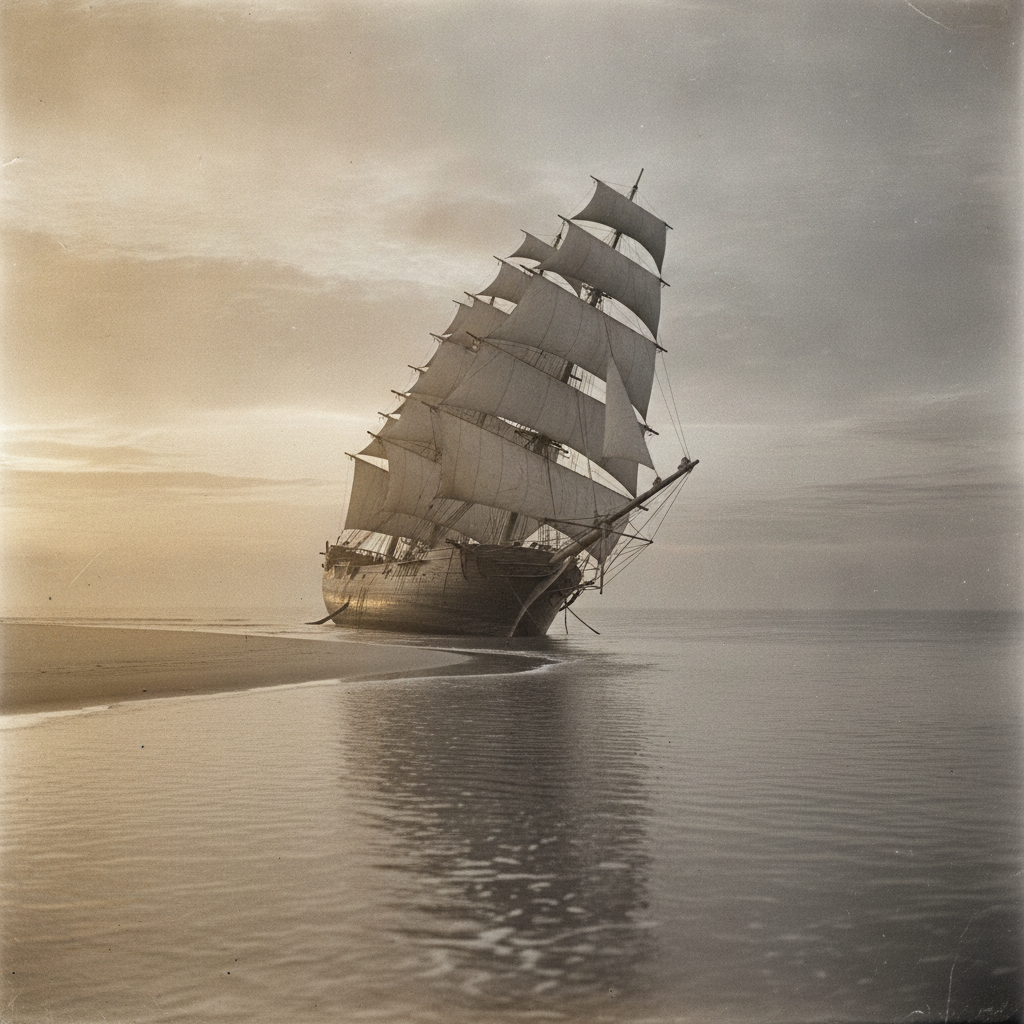
Dinner on the Stove, Nobody Aboard: The Ghost Ship of Diamond Shoals
In the gray first light of January 31, 1921, surfman C.P. Brady of the Cape Hatteras Coast Guard station raised his glass toward Diamond Shoals - the drowned sandbars off North Carolina that generations of sailors had learned to call the Graveyard of the Atlantic - and saw something that did not belong there. A great five-masted schooner sat hard aground with every sail set, the canvas taut and drawing, as if she still meant to go somewhere. She was the Carroll A. Deering of Bath, Maine, a 255-foot wooden coasting schooner launched barely two years earlier by the G.G. Deering Company and named for a son of the family, and she was homeward bound from Rio de Janeiro after delivering a cargo of coal. For four days the sea ran too high for any boat to reach her; she simply stood there under full sail, silent, while the surf worked at her hull. When the crew of the wrecking tug Rescue finally climbed aboard on February 4, they found no one left to save.
What they found instead has fed a century of argument. In the galley, by the boarding parties' accounts, food stood in mid-preparation - spare ribs, pea soup and coffee, in the most-repeated version. The ship's cats were still aboard, alive and unbothered. But the ship's log, the navigation instruments, the chronometer, the papers, the crew's chests and personal effects, both lifeboats and the heavy anchors were gone. The steering apparatus had been wrecked - the wheel smashed, the binnacle stove in, the rudder knocked off its pintles and swinging free. Eleven men had sailed her under Captain Willis B. Wormell, a 66-year-old master with decades of blue-water command behind him. Every one of them had vanished, and in the century since, nothing of them has surfaced - not a body, not a boat, not a scrap of oilskin. It was less a wreck than a tableau: a working ship interrupted between one ordinary minute and the next, then handed over to the weather with the kettle still warm.
The voyage had been troubled from its opening weeks. The Deering cleared the Virginia Capes for Rio in late August 1920 under Captain William Merritt, whose son Sewall shipped as first mate over a crew drawn almost entirely from Scandinavia, most of them Danes. Merritt fell so ill that the schooner had to put in at Lewes, Delaware, where he and Sewall left the ship; the owners coaxed Wormell out of retirement to bring her home. It was on the return leg that the trouble sharpened. At Barbados, Wormell confided to a fellow captain that he did not trust his crew - nearly all of them - and was uneasy in particular about his new first mate, Charles B. McLellan. McLellan, for his part, drank ashore and complained bitterly to another master, Captain Hugh Norton of the schooner Snow, that he could not discipline the men while Wormell undercut him, and that he was doing all the navigation himself because the captain's eyesight was failing. He landed in jail for the outburst, and by later witness accounts he swore he would get Wormell before the voyage was out. Wormell paid the man's fine and sailed with him anyway - the kind of decision a shorthanded master makes on any hard passage, and perhaps the last consequential one of his life.
The final confirmed sighting came three days before the end. On January 28, passing the Cape Lookout Lightship off the Carolina coast, the Deering ran in unusually close, and a thin, red-haired man with a foreign accent - emphatically not Wormell, and carrying none of an officer's bearing, the lightship keeper Thomas Jacobson later reported - hailed through a megaphone that the schooner had lost her anchors in a gale and asked that the news be relayed to her owners. Jacobson also noticed crewmen moving freely about the quarterdeck, ground normally reserved to a ship's officers. His steam whistle happened to be broken, so he could not signal a passing steamer to carry the message ashore.
Washington asked with unusual energy. Five federal departments - Commerce, Treasury, Justice, Navy and State - took up the case, prodded by Commerce Secretary Herbert Hoover, who assigned his assistant Lawrence Richey to run it. There was reason for the alarm: the steamer SS Hewitt, a sulphur freighter, had disappeared in roughly the same waters at roughly the same time, and investigators would go on to count several other vessels lost without explanation from the same sea lanes that winter, until for a season the country half-wondered whether something was preying on its shipping. The captain's daughter, Lula Wormell, pressed the government relentlessly, traveling to Washington and writing letter after letter, convinced her father's ship was one victim among many, and it was in part her persistence that kept the file open when officials might otherwise have let it lapse. Then came the sensation. In April 1921 a Buxton fisherman named Christopher Columbus Gray produced a bottled message, apparently in a hand from aboard the Deering, claiming the ship had been seized by an oil-burning boat and the crew taken below in irons. Wormell's widow at first thought the writing the ship engineer's; handwriting experts split over it, and for a while the note seemed the one hard clue in the whole affair. Then Richey broke it. Gray confessed he had written the message himself, hoping the notoriety would win him a post in the lighthouse service. The single most tangible piece of evidence in the case dissolved into a lie.
The government closed the file in 1922 without a conclusion, and the following year the wreck itself was dynamited where she lay, a hazard to navigation reduced to splinters. What remains is the picture Brady saw at dawn: a ship in perfect trim, sails drawing, dinner on the stove, the cats padding the deck, and eleven names attached to no bodies at all.
Conclusions and Open Questions
Strip the hoax away, and the surviving theories still fight one another to a standstill. Mutiny had the most powerful backers. Senator Frederick Hale of Maine called it plainly a case of mutiny, and Hoover's own investigators concluded privately that it was the likeliest answer. In its favor stand the Barbados threats, McLellan's grievance over discipline and navigation, the captain who had already told a colleague he feared his men, the red-haired stranger who spoke for the ship, and the sailors trespassing on the quarterdeck. Against it stands an awkward fact: mutineers who had seized a vessel would hardly then run her, under full sail, onto shoals every seaman on that coast dreaded - and having done so, they were never afterward seen spending stolen money, hiding out, or confessing on a deathbed anywhere in the world. Piracy and rum-running suited the lawless early years of Prohibition, when fast boats worked that coast by night; but no pirate ever surfaced with plunder from a coal schooner that was riding home empty, in ballast, with nothing aboard worth the killing of eleven men. The soberest reading came from the Coast Guard's own veterans of that coast: caught on the shoals in a mountainous winter sea, the crew took to the boats, and the boats were swallowed in the breakers nine miles offshore. That single explanation accounts perfectly for the missing lifeboats - and not at all for the smashed steering gear, the vanished log and papers, or the stranger at the megaphone three days before the end. And there is the theory that requires no evidence at all, because it feeds on the absence of it. In the decades after the war, popular writers folded the Deering into the growing legend of the Bermuda Triangle, filing her alongside the vanished Hewitt as proof of some patch of ocean that eats ships whole. It is the most seductive reading and the emptiest: the wreck lies well to the north of the fabled triangle, the winter storms off Hatteras need no supernatural help to kill, and every hard fact in the case, from the jailed first mate to the confessed hoaxer, has a stubbornly human shape.
One has to wonder whether the truth is stitched from two theories rather than one - trouble aboard first, catastrophe after. Picture a crew that had already deposed or lost its captain somewhere south of Hatteras, then found itself groping toward a killing coast that Wormell had known and they did not, navigation instruments in unpracticed hands, discipline gone. It is worth remembering that the one object a mutineer or a hijacker would most want gone is exactly the object that was missing - the log, the written record of who did what and when - and that the missing steering gear could as easily be the wreckage of a violent struggle as the work of the surf. None of it can be proved. McLellan's threat, Wormell's fear, the red-haired stranger - each is a thread, and no hand ever tied them into a rope. Nothing documented supports that directly - but then, nothing documented rules it out either, and it would explain the one detail every other theory leaves stranded: a fully rigged ship, driving hard, with no hand on her wheel.
Where was Captain Wormell, three days before the wreck, that a common sailor spoke for his ship? Why were men loitering on the officers' deck? Why would a crew abandoning a vessel carefully strip her of log, papers and instruments - and leave their dinner cooking on the stove? And how does a schooner that has just spoken a lightship, in waters her captain knew intimately, drive herself onto the most notorious shoals on the American coast? The sea usually keeps its secrets whole, taking ship and crew together into the same silence. The Deering's secret is crueler than that. The sea handed back the ship, intact and eloquent and full of clues, and kept only the men.