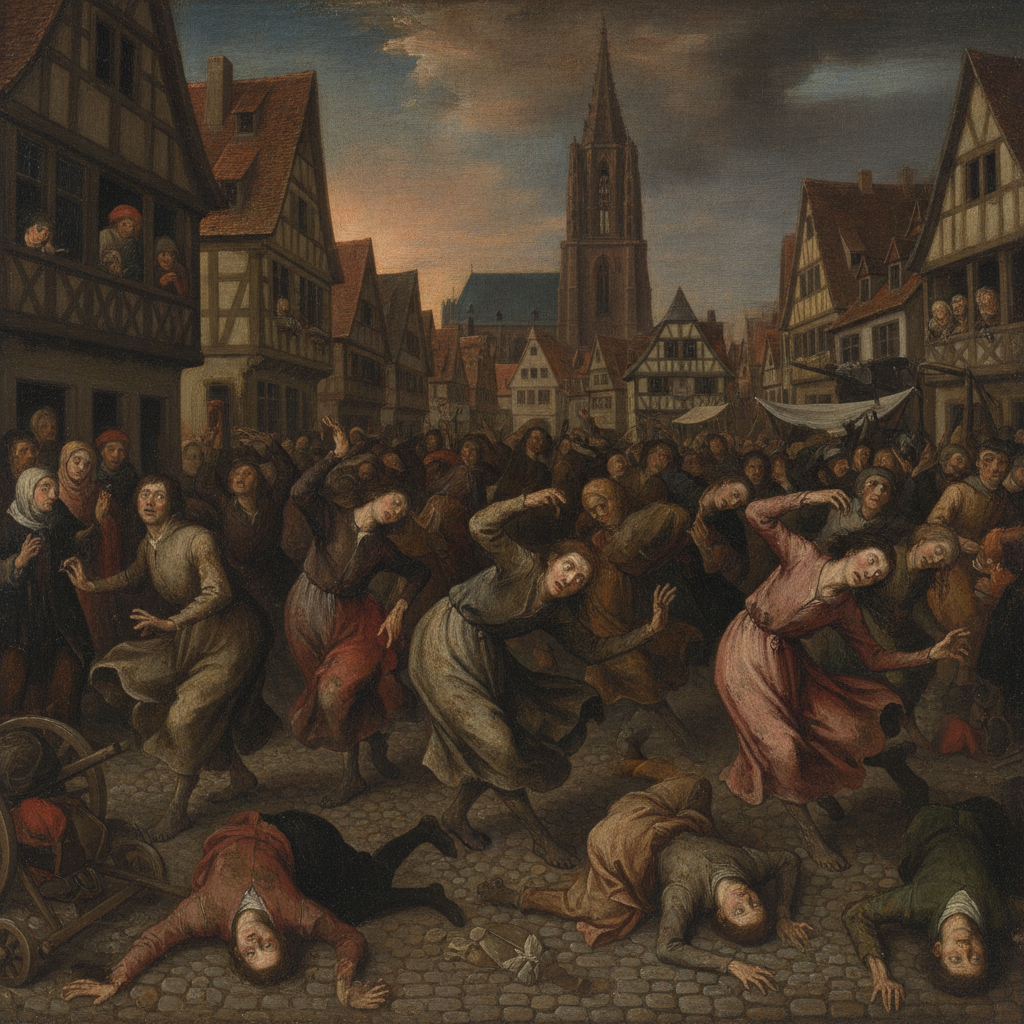
The City That Couldn't Stop Dancing: Strasbourg, 1518
On the morning of 14 July 1518, a woman known to history only as Frau Troffea stepped out of her narrow half-timbered house into a Strasbourg street and began to dance. There was no music, no wedding, no festival, no drink taken. Witnesses described something closer to torment than to joy: a grim, contorted, trance-like persistence, hour after hour, her limbs jerking as though driven by a will that was not her own. Her husband, the chronicles say, pleaded with her to stop. She did not, or could not. She danced until she collapsed in sweat and exhaustion, slept a few hours, then rose and danced again on feet that were already swelling and bleeding. By some accounts she kept it up for four to six days, in the punishing heat of one of the hottest summers the city could remember, while a crowd thickened around her: first to laugh, then to stare, and then, most unsettling of all, to join her.
Within a week roughly three dozen people were dancing. Within a month, chroniclers claimed, as many as 400. Modern scholars sifting the same papers put the number of afflicted somewhere between 50 and 400. Even the low figure would make it one of the strangest public-health events ever set down on paper.
This is not folklore polished smooth by centuries of retelling. The outbreak survives in the minutes of Strasbourg's city council, in cathedral sermons, in the notes of the city's physicians, and in municipal accounts that record, in the dry language of bookkeeping, money paid out to deal with it. Among the officials serving the city during the crisis was Sebastian Brant, the celebrated author of The Ship of Fools, then Strasbourg's chancellor. As John Waller, the historian who has studied the episode most closely, puts it, that the event took place is not in dispute.
The city it struck was already under enormous strain. A succession of harvests had failed, grain prices had climbed to their highest in a generation, and the poor were starving in the streets. Smallpox was abroad, and so was the terrifying new disease of syphilis. The people of the upper Rhine also held a specific and concrete belief: that Saint Vitus had the power to punish those who angered him by afflicting them with a compulsion to dance. The folklore of the region carried a customary remedy as well, which was to lead the stricken in procession to a chapel of the saint and dance the affliction out under his blessing.
Strasbourg's physicians, called in as the numbers grew, ruled out both sin and the stars. This was not, they decided, a punishment sent by God, nor an evil conjunction of planets. They diagnosed hot blood, in the Galenic tradition then taught in every medical faculty in Europe. The prescription that followed was more dancing. The afflicted, the doctors reasoned, would burn the fever out of their blood only by surrendering to it completely and dancing until the sickness had left the body.
And so the authorities did not confine the dancers or send them home. They cleared two guild halls, erected a wooden stage, and hired pipers, drummers and strong men whose task was to keep the stricken upright and moving. It was, in effect, a municipally funded epidemic. The frenzy spread faster than ever.
By the height of August the dancers had spilled across the whole town. Contemporary reports place them in the horse market and the grain market, in the open squares and along the alleys beside the cathedral, moving day and night in the summer heat. Physicians who examined them found no ordinary fever and no wound. The sufferers themselves, when they could speak at all, did not describe pleasure but a horror at what their own bodies were doing, some crying out for help even as their feet refused to stop. It was this visible distress, so unlike revelry, that seems to have convinced the authorities they were watching a disease and not a debauch.
When the cure made everything worse, the council reversed course entirely. Dancing was banned in public and the musicians were dismissed. The afflicted were loaded onto wagons and carried up into the hills to a shrine of Saint Vitus near Saverne. There, in a ceremony that reads more like exorcism than medicine, they were led before a wooden effigy of the saint, given small crosses to hold and red shoes sprinkled with holy water, while priests moved among them with incense and Latin incantations and traced the sign of the cross on their oil-anointed feet. By early September, the dancing was over.
Then there is the question of the dead. Later chronicles, written well after the fact, insist that at the peak the plague was killing as many as fifteen people a day through strokes, heart failure and sheer collapse. It is the detail everyone remembers. Yet the surviving records of Strasbourg from the summer of 1518, the same meticulous municipal papers that note the hiring of musicians and the refurbishing of halls, do not mention a death toll at all. Not a single burial in the city's own paperwork is attributed to the dancing. The most careful modern reconstructions conclude that the contemporary sources say nothing whatever about whether anyone died.
Strasbourg was not the first outbreak of its kind. Episodes of compulsive, uncontrollable dancing had been recorded in the towns of the Rhine and the Moselle for well over a century. A wave of dancing mania rolled up the Rhine from Aachen in 1374, touching Liege, Cologne, Metz and Strasbourg itself, with the stricken said to have hurled themselves through the streets in their hundreds, and smaller episodes flickered across the region in the years between. Strasbourg 1518 was, in effect, the last of the great ones. Nothing on that scale has been recorded anywhere since.
Conclusions and Open Questions
Five centuries of explanations have circled the case without closing it. The earliest came from Paracelsus, the wandering physician, who passed through Strasbourg eight years later and concluded that Frau Troffea had faked the whole thing to spite a husband she despised, and that other lewd and impertinent wives had imitated her out of mischief. The weakness is glaring: the verdict tells us a great deal about Paracelsus and his opinion of women, and almost nothing about what the witnesses actually described, which was not mockery but agony.
In 1952 the Swedish scholar Eugene Backman offered a physical culprit: ergot, the fungus that grows on damp rye and whose alkaloids are chemical cousins of LSD. Its strength is that it supplies a real mechanism, hallucinations and convulsions from a poisoned food supply, entirely plausible after a failed harvest. Its weakness is close to fatal. Ergotism constricts the blood vessels and produces seizures, delirium and the gangrene that medieval Europe called Saint Anthony's fire, which is the opposite of coordinated movement sustained for days. If the bread was tainted, why did only some of those who ate it take to the streets, and none of them lose their toes to rot? Medieval Europe knew ergotism well and recorded its outbreaks under that name; the people who wrote about 1518 described something else.
The explanation most historians now favour belongs to John Waller: mass psychogenic illness, what an older vocabulary called mass hysteria. His argument is that under the convergence of famine, disease and dread, minds already primed by the specific fear of Saint Vitus slipped into a dissociative trance, and that the very sight of dancers spread the affliction like a contagion. It explains why public stages and hired musicians poured fuel on the fire, and why a ritual at the saint's own shrine finally smothered it. Its weakness is that it cannot be tested, and it cannot say why one neighbour danced while the woman beside her did not.
A rival reading comes from the sociologist Robert Bartholomew, who has suggested that the dancers may have belonged to a heterodox religious sect performing an ecstatic ritual rather than being victims of an illness at all. The sources, however, describe people weeping and begging to be released, not devotees in willing rapture, and most scholars find the evidence for a sect far too thin to carry the weight.
Some argue, more provocatively, that the city itself manufactured the epidemic it was trying to cure. The numbers did not truly explode until after the stage was built and the musicians were paid to play, and a public platform, a beating drum and a crowd of onlookers are close to a recipe for suggestion. Had the council simply sent Frau Troffea home to rest in a darkened room, one theory holds, history would record no plague at all. Nothing in the documents can settle it, and the sequence of events may be coincidence rather than cause.
Several things remain genuinely unexplained. Nobody knows how these bodies danced for days on end, who fed them, who gave them water, or when in that ordeal they slept. The death toll is a straight contradiction: if fifteen were dying daily, clerks scrupulous enough to log the wages of drummers should not have missed every funeral, and if nobody died at all, later writers were oddly certain that the streets were strewn with the dead. No one can say why the outbreak faded at the precise moment the city abandoned medicine for penance, or why nothing quite like it has happened again. As belief in the saint's curse faded from the culture, the disease that seemed to obey that belief faded with it, which may be the most unsettling suggestion in the whole file: that the fears a society genuinely holds can be written directly into the bodies of its people.