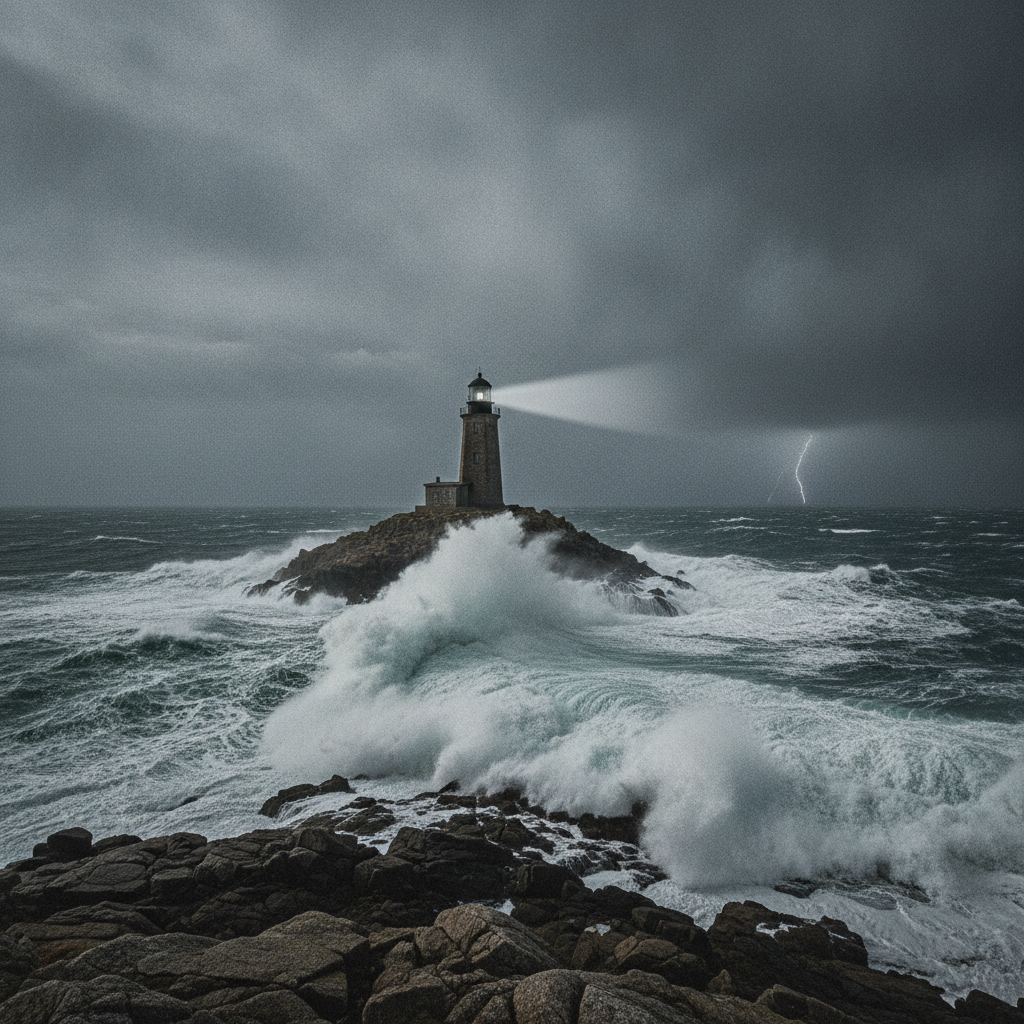
The Lighthouse That Went Dark: Three Keepers Vanish from Eilean Mor
Eilean Mor is the largest of the Flannan Isles, a scatter of bare, uninhabited rocks about seventeen miles west of the Outer Hebrides of Scotland. It is barely half a mile long. In December 1899 a lighthouse designed by the engineer David Alan Stevenson was lit there for the first time, and from that night the station was manned in rotation by keepers of the Northern Lighthouse Board. Living on the rock meant stone stairs, iron cranes and constant watchfulness against the water. Two landings, one on the east side and one on the west, allowed a boat to come in depending on the wind. Each was served by a crane for hoisting stores up the cliff, and each was reached only by long flights of steps, more than a hundred of them, zigzagging up the rock face. The west landing took the full run of the open Atlantic.
In December 1900 three men were on duty. James Ducat, the principal keeper, was an experienced man with a family on the mainland. Thomas Marshall was the second assistant. The third, Donald MacArthur, was not a permanent member of the crew at all. He was an occasional keeper, a local man drafted in to stand a watch because one of the regular keepers, William Ross, had fallen ill and could not take his turn.
The station log was kept in the usual way. Entries were written into the book up to 13 December; after that they were chalked onto a slate for later copying, which was the routine. The last note on the slate was made at 9 a.m. on 15 December. It recorded nothing unusual.
On the night of 15 December the steamer Archtor passed the isles and noted that the light was dark. On that coast, where ships steered by it, this was an alarming observation, but the report never reached the Northern Lighthouse Board. Foul weather then delayed the scheduled relief visit, and so eleven days went by with no one on the mainland aware that anything was wrong.
On 26 December, the day after Christmas, the lighthouse tender Hesperus finally reached Eilean Mor. Captain James Harvie sounded the ship's horn and sent up a flare, the signals that should have brought a keeper hurrying down to the landing with a flag raised in greeting and a box of provisions ready at the top of the stairs. Nothing answered but the wind. Harvie waited and sounded the horn again. No figure appeared on the cliff. The relief keeper, Joseph Moore, was rowed ashore and climbed the steps alone.
Moore found the entrance gate shut and the main door closed. Inside, the kitchen clock had wound down and stopped. The beds were unmade, the ashes cold in the grate. The great lamps stood trimmed, cleaned and filled, ready for a night that nobody had lit. James Ducat, Thomas Marshall and Donald MacArthur were gone. Three keepers had vanished from a rock half a mile long.
There was a further detail inside the tower that would matter later. Two sets of oilskins and sea boots were missing, the gear Ducat and Marshall would have put on to work outside. MacArthur's coat was still hanging on its peg. Standing orders for the station required that one keeper remain with the light at all times.
Captain Harvie would not leave the light dark and the station empty any longer. He put Moore ashore again with a small party of volunteers to keep the lamps burning until a proper relief could be arranged. The lamps that Moore had found waiting were lit that same evening by other hands, and the men who had come to investigate a disappearance now had to live on the rock where it had happened, following the same routine the missing keepers had followed and waiting for a boat in weather that had already shown them what it could do.
Superintendent Robert Muirhead arrived on 29 December. He had personally recruited all three keepers and knew each of them. He climbed down to the west landing and found damage there on a scale that has fed the case ever since. The iron railings around the crane platform were buckled and twisted. Ropes had been torn loose and strewn across the rocks. A lifebuoy lashed to the railings some 110 feet above the water was gone, and turf had been ripped away above that same height. A wooden supply box wedged in a crevice roughly 110 feet up had been smashed out of its place, its contents of ropes and crane handles flung about. A block of stone weighing more than a ton had been shifted.
Muirhead's official conclusion was that the men had gone down to the west landing after their midday work to secure gear ahead of worsening weather, and that an exceptionally large sea had surged up the rock face and swept them away. In his report he described an unusually large roller coming up on the island, a great body of water rising higher than the men stood and carrying them off. He also reasoned out one detail carefully: the wind that day would have pushed men toward the island rather than off it, so the wind alone could not have put them in the water. Only the sea itself, rearing up the western face, could have done that.
No bodies were recovered, then or since. There was no funeral, only a board of inquiry and a light that had to be relit. It has gone on burning ever since.
Much of what people believe they know about Eilean Mor never happened. The half-eaten meal, the toppled chair and the clock stopped by an unseen hand belong to Wilfrid Wilson Gibson's 1912 poem "Flannan Isle," not to the record. So do the log entries quoted everywhere since: a keeper weeping, the sea screaming, a final line reading "God is over all." The researcher Mike Dash, writing in Fortean Times, worked back through the surviving documents and found no trace of them, and concluded that they were invented years after the event. The genuine record is plainer: an ordinary morning entry at nine o'clock, and then silence.
Conclusions and Open Questions
The official verdict, set out by Superintendent Robert Muirhead in his report of 1901, remains the only explanation supported by physical evidence. Every item of damage at the west landing points the same way: buckled railings, a lifebuoy torn from 110 feet up, turf stripped above that line, a supply box smashed from its crevice, a block of stone weighing over a ton moved. That is the signature of water, and of nothing else. Muirhead's case is strengthened by later testimony from the rock itself. A keeper who served on Eilean Mor in the 1950s reported that spray from severe storms could reach the lamp house, roughly 300 feet above the sea. On such a rock, a wave that erases three men is not supernatural. It is rare.
The weakness of the rogue-wave verdict is narrow but real. It does not account for MacArthur's coat, still on its peg, or for the fact that all three men were off station at once when standing orders required one to stay with the light. Muirhead himself did not resolve either point.
One theory, developed by later researchers rather than by the inquiry, tries to close that gap with timing rather than a different cause. On this reading, Ducat and Marshall were caught at the landing by a freak sea while securing the gear, and MacArthur, watching from higher up, threw himself down the steps without pausing for his coat and was taken by the next wave, or by the same one as it climbed the rock. It explains the two dressed men, the one who was not, and why the tower was left empty. Its weakness is that it is entirely a reconstruction. Not one document supports the sequence, and there was no witness to any of it.
Darker theories have grown in the silence. Because MacArthur was remembered by some who knew him as a hot-tempered man, it has been argued that a quarrel on the landing sent all three over the edge, or that he killed the other two and then himself. These remain stories rather than findings. They rest on hearsay about one man's character and on no physical evidence, and they have to disregard the wrecked box, the missing lifebuoy and the ton of shifted stone, which so plainly indicate the sea. More exotic still are the tales that grew in the retelling: a sea serpent that plucked the men from the rock, a ghost ship, foreign spies, abduction by something from beyond the world. Each founders on the same point as the murder theory, that there is no evidence for any of it, and that the damage at the landing already has a violent and obvious author in the ocean.
What is genuinely unexplained is small, specific and stubborn. Why was MacArthur outside without his coat. Why did all three leave the light. Why did the Archtor's report of a dark lighthouse never reach the board that needed it. And what happened in the hours between the ordinary entry chalked up at nine in the morning on 15 December and the dark tower the steamer saw that night. The sea gave back no bodies to answer any of it. What remains is three ordinary men, one of them there only because another man had fallen ill, working on a ledge above the water on a winter afternoon, and a wave that came up out of a grey sea and did not go back empty.