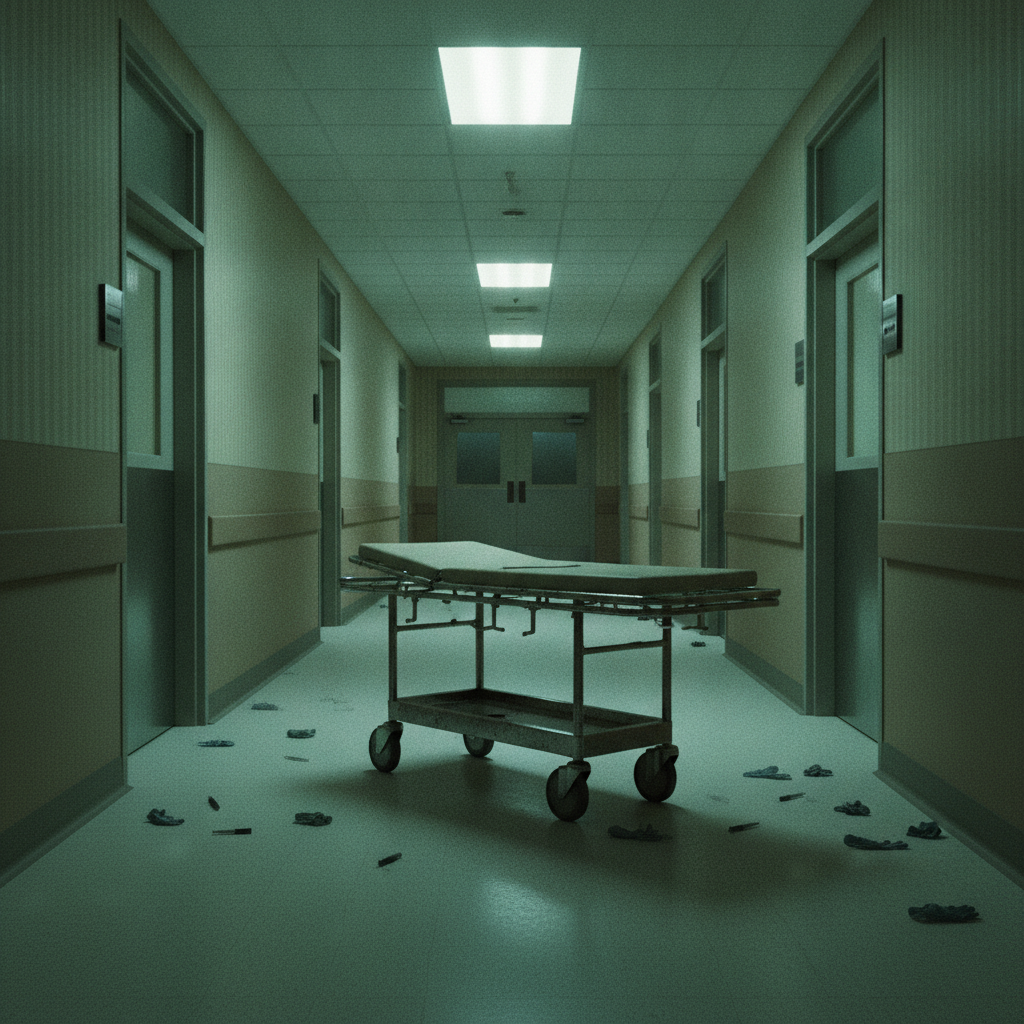
The Toxic Lady: The Patient Whose Blood Knocked Out an Emergency Room
It was a little after eight o'clock on the evening of February 19, 1994, when the doors of the emergency department at Riverside General Hospital swung open and paramedics wheeled in a woman who was, by every ordinary measure, already close to the end. Gloria Cecilia Ramirez was thirty-one years old, a mother of two, and she was dying of advanced cervical cancer. Her heart was racing in a fast, disordered rhythm, her breathing was shallow, and she drifted in and out of awareness. The staff moved the way they had a thousand times before: hooking up monitors, pushing sedatives, readying the paddles to shock a failing heart back into line. For perhaps a quarter of an hour it was another hard night in a busy Southern California emergency room.
The first thing the staff noticed was how she looked and smelled. A thin, oily sheen seemed to coat Ramirez's skin, and a fruity, garlic-like odor rose from her mouth. A registered nurse named Susan Kane drew blood from the woman's arm and, bending close to the syringe, caught a sharp reek like ammonia. In the tube, pale manila-colored crystals appeared to float in the plasma. Moments later Kane's face began to burn, her head swam, and she fainted to the floor.
A medical resident, Dr. Julie Gorchynski, took the same tube of blood, studied it, and was gripped by nausea before she too went down. A respiratory therapist, Maureen Welch, was the third to fall, and when she came to she found she could not fully control the movement of her own limbs. The charge nurse ordered the department cleared. Staff wheeled other patients out into the ambulance bay while a skeleton crew stayed with the dying woman. By the accounts gathered afterward, 23 people reported symptoms and five were hospitalized; 27 of the 37 workers on duty that night described feeling something they could not explain. The complaints ran along similar lines: a burning sensation in the face, dizziness, nausea, shortness of breath, and in a few cases muscle spasms and a loss of coordination. The paramedics who had ridden with Ramirez in the ambulance, breathing the same close air for far longer than anyone in the department, reported nothing at all.
Gorchynski was affected most severely. She spent close to two weeks in intensive care, struggling to breathe, and in the months that followed she developed hepatitis and avascular necrosis, a condition in which bone tissue dies for want of blood supply, in her knees. Ramirez herself could not be saved. After some forty-five minutes of resuscitation she was pronounced dead at 8:50 p.m.
Her body was treated as hazardous material. It was sealed away, and the autopsy was carried out by a team in airtight protective suits breathing filtered air, working inside a specially sealed chamber for fear of what the corpse might release. The coroner's office ultimately attributed her death to cardiac dysrhythmia and kidney failure brought on by her cancer. Her burial was delayed roughly ten weeks by the investigation, until April 20, 1994, when she was laid to rest at Olivewood Memorial Park in Riverside. Her sister, Maggie Ramirez-Garcia, questioned the whole affair, arguing that Gloria might not have died at all "had she not gone into the hospital," and that the institution had never truly accounted for what happened to her or to its own staff.
Within days the incident had become a national story. The newspapers reached for a nickname, and "the Toxic Lady" stuck, a phrase that would trail Gloria Ramirez long after the details had blurred in the public memory. The emergency room itself was scrubbed and reopened within hours. Its air was sampled and found clean, which deepened the strangeness of the case: whatever had felled a third of the staff had apparently left no trace behind. Several of the affected workers later pursued legal claims, and the hospital, a county facility already stretched thin, found itself defending at once its treatment of a dying patient and its inability to say what had sickened its own people.
Investigators combed the department for a conventional culprit. They looked for a leaking gas line, a pesticide, a spilled solvent, an unlucky reaction between two routine drugs. Nothing fit. The search extended to the equipment used on Ramirez that night and to the drugs she had been given, none of which was unusual for a patient in her condition. Every ordinary explanation was raised, tested and set aside. Two formal investigations followed. The California Department of Health Services interviewed the affected workers, took blood samples from them and compared their symptoms; its team included Drs. Ana Maria Osorio and Kirsten Waller. Separately, forensic scientists at the Lawrence Livermore National Laboratory, led by Patrick M. Grant, examined the chemical evidence and published their analysis in the journal Forensic Science International in 1997. The Riverside coroner endorsed the Livermore conclusion.
The physical record, however, was thin from the start. The air in the room had already been replaced by the time it was tested. Ramirez's blood and tissue samples were compromised by the circumstances of the resuscitation and the delay before anyone thought to preserve them, and no laboratory ever reproduced the reaction that was later proposed to explain the night. Most of what is known comes from documents rather than specimens: incident reports, sworn statements from the staff, the coroner's findings, the state health investigation and the peer-reviewed Livermore paper. The events themselves are not in dispute. They are recorded in detail, by many witnesses, within hours of happening. It is the cause that has never been established.
More than three decades later, the case is officially closed and practically unresolved. No single account has ever satisfied both the scientists who studied the evidence and the workers who lived through the night. The hospital that could not save Gloria Ramirez was also unable to explain what happened in the room where she died.
Conclusions and Open Questions
The first official explanation came from the California Department of Health Services, whose investigators concluded that the staff had most likely suffered mass sociogenic illness, in plainer language a wave of collective anxiety spreading through a frightened, enclosed room. They noted that those affected were predominantly women and that blood tests taken afterward came back essentially normal. The theory has a genuine strength: fainting, nausea and hyperventilation really can ripple through a group under acute stress, and no toxic gas or contaminant was ever captured in the air of that room despite exhaustive searching. Its weakness is what the staff themselves insisted upon. Trained emergency workers do not routinely faint at the sight of a patient's blood, and some of the injuries were not the kind that anxiety produces. Gorchynski's dead bone was visible on a scan.
The competing explanation came from Patrick M. Grant and his colleagues at Lawrence Livermore, who assembled a chemical chain of considerable intricacy. Ramirez, they proposed, had been using dimethyl sulfoxide, or DMSO, a solvent sold cheaply as a degreaser and used by some as a folk remedy for pain. Oxygen from the mask paramedics had placed on her could have converted that DMSO into dimethyl sulfone, a compound that can crystallize at room temperature, which would account for the crystals in the tube. The electric shocks of defibrillation, together with conditions inside the sealed blood tube, could then have transformed that sulfone into dimethyl sulfate, a lethal alkylating agent. Grant suggested that low pressure inside the vacutainer might have let the toxin vaporize at body temperature. The strength of the theory is that it accounts in one sweep for the crystals, the odors and the way the sickness clung to whoever handled the blood tube. Its weakness is the chemistry. Many organic chemists have called the reaction sequence implausible at body temperature in the few minutes available, no dimethyl sulfate was ever detected in Ramirez or in the room, and her family denied that she used DMSO at all. No one observed her applying it.
A third position, argued by those who find both accounts incomplete, is that the truth is a collision of the two: a faint but real chemical irritant coming off the blood, unpleasant rather than catastrophic, amplified by fear in a sealed room full of exhausted people. One theory holds that whatever rose from her body was real but dispersed before the air was ever tested. Some argue further that the sociogenic verdict was convenient for a county hospital facing compensation claims from its own staff, though no evidence of suppression has surfaced and the state investigators worked independently of it.
What remains unexplained is specific. Nobody has accounted for why the worst harm clustered around the three people nearest the blood itself while colleagues an arm's length away were unaffected, or why the paramedics who spent far longer beside her in a confined ambulance reported nothing. Nor has anyone explained the pattern of severity, in which one resident developed hepatitis and dying bone while most who reported symptoms recovered within hours.
The open questions are unlikely to be settled now. Could the proposed reaction sequence be reproduced in a laboratory under conditions resembling that room, and has anyone tried? Was there a real irritant that testing arrived too late to catch? At the center of the case is not a curiosity but a young mother who died frightened and in pain, surrounded by people who were themselves suddenly falling ill and could not understand why. Her family was never given an answer they could accept, and neither were the staff who fell that night.