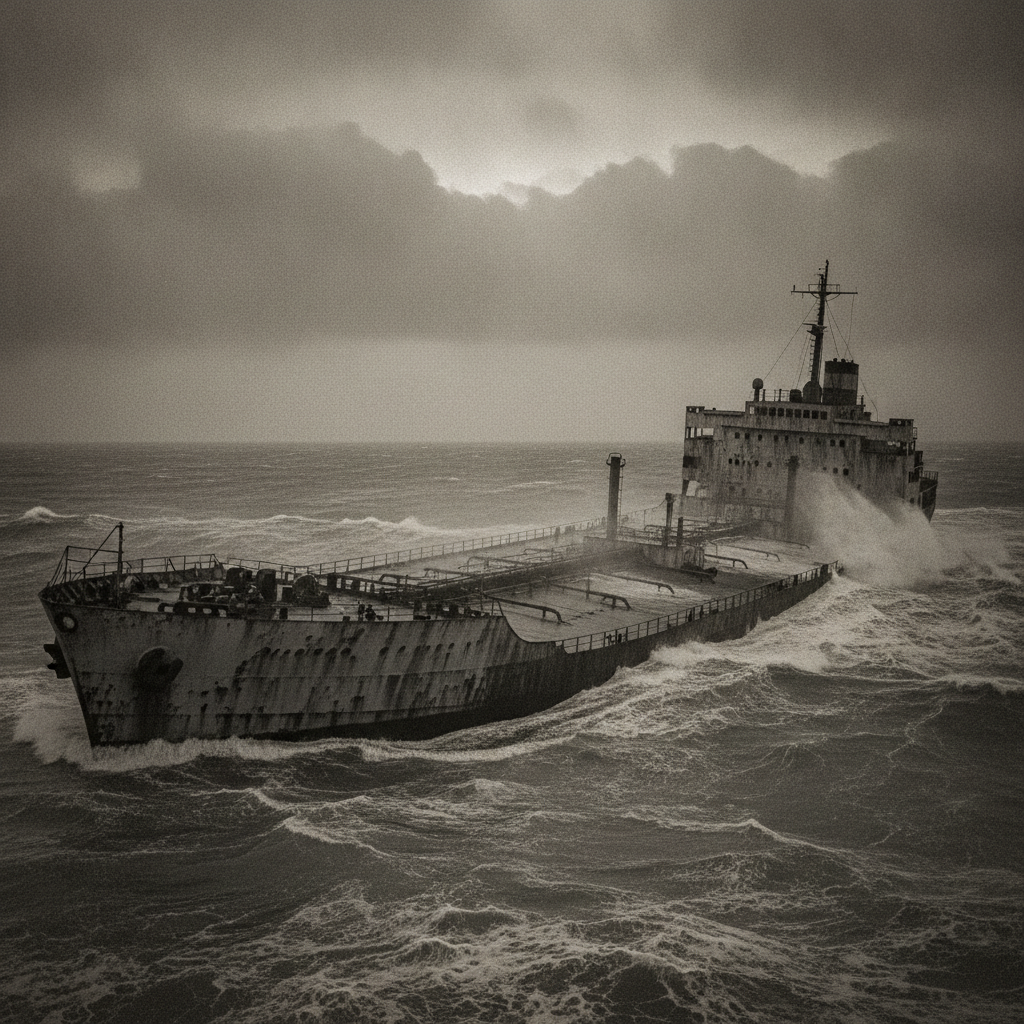
Thirty-Nine Men and a Tank of Molten Sulphur: The Vanishing of the Marine Sulphur Queen
On the evening of February 2, 1963, the tanker Marine Sulphur Queen came down the ship channel at Beaumont, Texas, and turned out into the Gulf of Mexico. Her main deck was warm to the touch. Beneath it, in a single tank longer than a city block, lay 15,260 tons of sulphur, held liquid at roughly 255 degrees Fahrenheit by a lattice of steam coils, and the heat rose through the steel all day and all night. Thirty-nine men were aboard. The master was Captain James V. Fanning. The passage ahead was routine: east across the Gulf, around the Florida Keys, then north to Norfolk, Virginia. Two days out she sent a short radio message. It was the last anyone heard from her. No wreck, no lifeboat and no body has ever been recovered.
She had not begun life carrying sulphur. She was launched on March 8, 1944 at the Sun Shipbuilding and Dry Dock Company yard in Chester, Pennsylvania, as the Esso New Haven, a T2 tanker of the class the United States turned out in the hundreds to keep the war supplied with oil. She was 504 feet long, with a beam of 68.2 feet, and measured 10,642 gross tons. Like every T2 she had been built at speed, and like every T2 she carried a reputation that seafarers summed up in two words: weak back. Under load, at a point already thinned by corrosion, a T2 hull could split across the middle. Several of them had done exactly that.
In 1960 she was rebuilt for a cargo almost nothing else afloat was carrying. Molten sulphur cannot be shipped in the many small compartments a tanker normally uses, because each one would need its own heating system and each one would cool. So the conversion, carried out by the Bethlehem Steel Company, went at the ship's insides with cutting torches. The transverse bulkheads of the centreline tanks were removed and a single steel tank was built inside the hull: 306 feet long, 30.5 feet wide, 33 feet high, itself divided internally into four compartments. It sat inside a void space with a clearance of about two feet at the sides and bottom and three feet under the weather deck. A ship designed to carry oil in a grid of small, mutually supporting boxes had become a ship carrying one enormous, heavy, hot, shifting mass, with the original transverse strength cut away to make room for it. She was owned by the Marine Sulphur Transport Corporation and operated under charter by Marine Transport Lines.
What happened aboard her over the next three years was recorded in detail, and it is not reassuring reading. Fires broke out beneath and alongside the sulphur tank so regularly that officers stopped sounding the general alarm for them. On one occasion the ship sailed from a New Jersey harbour with a fire still burning. Sulphur escaped through cracks in the structure, caked in the spaces below the tank and shorted out electrical generators. Temperature gauges did not work. A steam coil had ruptured. Packing around the propeller shaft was worn. A drydock inspection scheduled for January 1963 was postponed because the owners were behind on deliveries and wanted the ship kept working. One newly signed crewman told his wife the vessel was a floating garbage can.
She left Beaumont on February 2 with the sulphur loaded and the coils running. On February 4 she transmitted a routine radio message placing her at 25 degrees 45 minutes north, 86 degrees west, roughly 200 miles west of the Florida Keys. A winter storm was working across her track. Seas were running around 16 feet and northerly winds were measured between 25 and 46 knots. The message contained nothing unusual. There was no report of damage, no request for assistance, and no indication that anyone aboard believed the ship was in danger.
She was reported missing on February 6. The Coast Guard search ran for nineteen days across the Straits of Florida and the eastern Gulf and found nothing for more than two weeks. Then, on February 20, a United States Navy torpedo retriever boat working about twelve miles southwest of Key West sighted and recovered a fog horn and a life jacket stencilled with the ship's name. Over the following days more material came up: in total eight life jackets, five life rings, two name boards, a shirt, a piece of an oar, a storm oil can, a gasoline can, a cone buoy and the fog horn. That is the entire physical inheritance of the Marine Sulphur Queen. There were no bodies. There was no lifeboat or raft that had been launched and used. There was no hull.
The Coast Guard Marine Board of Investigation convened at Beaumont on February 20, 1963, and published its findings on March 17, 1964. The Commandant of the Coast Guard concurred in the conclusion that the vessel apparently was lost on 4 February 1963 on its approach to, or in the vicinity of, the Straits of Florida. The Board went through the ship's construction, her conversion, her fire record and her maintenance history, and it named four possible causes of the loss. It declined to rank them. Its final sentence on the question was blunt: in the absence of survivors or of any part of the vessel, the exact cause of the loss cannot be determined.
The families did not let the matter rest there. Within weeks relatives filed suit under the Jones Act and the Death on the High Seas Act, alleging that the ship had been unseaworthy, initially seeking 2.5 million dollars; by 1969 the claims had grown to 20 million. The owners and the charterer asked the courts to exonerate them, or at least to limit their liability to the value of the vessel, which was nothing, because the vessel was gone. On April 25, 1972, more than nine years after she sailed, the United States Court of Appeals for the Second Circuit ruled. It found the ship structurally unsound, found that the cargo tank had been installed off the true centreline in a way that created a dangerous centre of gravity, and found that the owners had failed to inspect and maintain her properly. It denied them exoneration and held them liable for unseaworthiness. It also declined to award punitive damages, on a plain and rather chilling ground: no one knows how the ship was lost.
There is a second story attached to the Marine Sulphur Queen, and it arrived almost immediately. In February 1964, writing in Argosy magazine, Vincent Gaddis published the article that coined the phrase Bermuda Triangle, and he put the missing tanker near the top of his list of the region's victims. In his telling she had sailed into the unknown. He offered no mechanism and made no use of the Coast Guard record. The framing stuck. For decades the ship appeared in paperbacks and television specials as an unexplained disappearance in a haunted patch of ocean, often with the claim that only a lifeboat had ever been found.
Conclusions and Open Questions
The Board's four candidate causes are still the four candidates, and each of them explains part of the case while leaving another part open.
The first is an explosion in the cargo tank. Its strength is the ship's own history: sulphur dust and the gases that come off hot sulphur are flammable, fires had been routine aboard her, and a detonation would account for the complete absence of a distress call, because there would have been no time to make one. Its weakness is that nothing recovered from the water ever demonstrated an explosion. The theory rests entirely on the fire record and on the plausibility of the chemistry.
The second is hull girder failure, the T2 weak back. This is the theory with the most engineering behind it. The class was known to split amidships, the corrosion aboard this particular ship was documented in detail, and the conversion had removed the transverse bulkheads that would have resisted exactly that failure. The difficulty is physical: ships that break in two frequently leave something behind, and in this case no part of the hull was ever located, either floating or on the bottom.
The third is capsizing through synchronous rolling. The storm was real, the seas were high, the court found the centre of gravity to be dangerously placed, and a tank 306 feet long holding a liquid cargo gives that cargo an enormous free surface to slosh across. A ship in that condition can go over faster than a radio operator can key a message. Against it, the Board had no survivor, no data recorder and no wreck, and therefore no way to test the idea at all.
The fourth is a steam explosion. If cold sea water entered the void space around a tank held at 255 degrees, the result would be violent and would be specific to this one strange ship. The problem is that the theory needs a hull breach to begin with, which pushes the question back a step rather than answering it.
The Bermuda Triangle explanation has not aged well and does not require weighing against the others. The ship's last known position was west of the Florida Keys, in the Gulf of Mexico, outside the boundaries most versions of the Triangle draw for themselves, and the claim that only a lifeboat was found is contradicted by the Coast Guard's own inventory of recovered gear, which was displayed during the public inquiry.
What remains is an unusual kind of unsolved case. This is not a mystery of the sort where nothing is known. A great deal is known. A federal appeals court examined the evidence and held, as a matter of law, that the Marine Sulphur Queen should never have been at sea. And in the same judgment it recorded that nobody can say what actually killed her. Thirty-nine men went into the Gulf of Mexico on a ship that the record says was already failing, and the sea returned eight life jackets, a shirt and a fog horn.