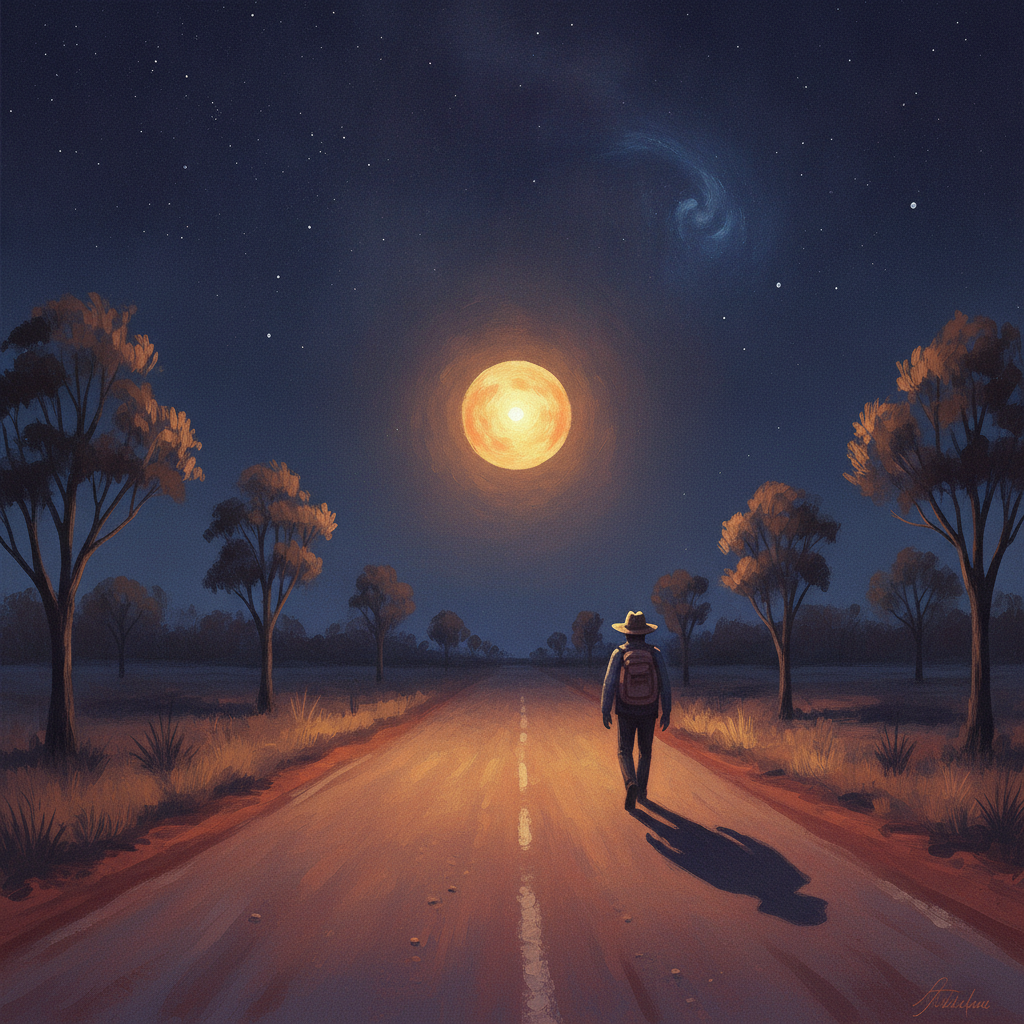
The Light That Follows: A Century of Min Min Sightings in the Australian Outback
The Channel Country of far western Queensland is a landscape built for seeing things a long way off. It is flat, largely treeless, cut by shallow braided riverbeds that fill perhaps once a decade, and it holds heat all day and sheds it all night. The town of Boulia, on the Burke River, has a few hundred residents and a very great deal of horizon. For well over a century, people crossing this country after dark have reported the same thing. A light.
The reports are unusually consistent. Witnesses describe a fuzzy, disc-shaped glow that appears to hover just above the horizon line. It is most often white, but many accounts describe it shifting through red and green and back again. Its brightness varies enormously, from a dim smudge no larger than a distant lamp to a light strong enough to throw shadows on the ground. It makes no sound. And then there is the detail that has kept the story alive for a hundred years: it appears to follow. Stockmen, drovers, truck drivers and tourists have all described a light that matched their pace, held its distance, and stayed with them for kilometres. Some accounts describe travellers firing rifles at it, whereupon the light vanished and then reappeared, unchanged, a short time later.
The name comes from a building that no longer exists. Min Min was a tiny settlement with a hotel, a staging post on the coach route running east from Boulia towards Winton. By the early twentieth century the hotel had burned and the site was reduced to ruins and a small burial ground. In 1918 a stockman riding past those ruins reported a glow rising from the ground near the graves and travelling after him. That account was repeated across the district, the name of the abandoned settlement attached itself to the phenomenon, and the Min Min light entered Australian folklore.
But 1918 is only the date the name stuck. Stories of mysterious travelling lights in this country are told in several Aboriginal Australian cultures, and those accounts long predate European settlement. The detail varies between groups, and much of it remains the knowledge of the communities that hold it rather than material for outsiders to catalogue. What is clear is that the core element is old: a light that appears in open country at night and takes an interest in whoever is out there. Any account of the Min Min light that begins in 1918 begins in the middle of the story.
There is also a claimed written record from 1838, in a settler account titled Six Months in South Australia, although researchers disagree over whether that passage describes the same phenomenon or a different one.
The sightings are not confined to Boulia. Reports have been logged in a broad band running from Brewarrina in western New South Wales north into Queensland, with the densest cluster in the Channel Country. Comparable accounts come from Yunta in South Australia and from the Pilbara in Western Australia. What those places share is not geology and not vegetation. It is flatness, dryness, and a very long clear line of sight.
Boulia has made the light its own. The town runs the Min Min Encounter, a purpose-built visitor attraction that retells the sightings, and the light appears on signage across the district. For a small town in a region losing population, the light is an economic asset as well as a story.
The most serious scientific engagement with the phenomenon came from someone who was not looking for it. Jack Pettigrew, a professor at the University of Queensland's Vision, Touch and Hearing Research Centre, spent long stretches of the 1980s and 1990s camped in the Diamantina country at night, studying the letter-winged kite, a nocturnal bird of prey that breeds in the region during rodent plagues. He saw the light himself, more than once, and described it as having fuzzy edges in rapid motion, like a swarm of bees.
His explanation was optical. Pettigrew proposed that the Min Min light is a Fata Morgana, a specific and dramatic form of inverted mirage. On a still, cold night in flat country a dense layer of cold air settles against the ground with warmer air above it. That boundary bends light downward. Light that would ordinarily shoot off into space above the horizon is instead trapped and guided along the curve of the earth, travelling far beyond the point at which its source should have dropped out of sight. When it finally reaches an observer, the source is delivered as a compressed, elevated, unstable image sitting just above the horizon. A glowing disc with blurred edges that shimmers and shifts as the air layers move.
In 1992 Pettigrew tested this directly. On a cold, calm night with the inversion in place, he had a vehicle driven roughly ten kilometres away from his camp, to a position where its headlights were well below the horizon and could not be seen by any ordinary line of sight. Observers at the camp kept radio contact. When the headlights were switched on, a light appeared on the horizon with the classic characteristics of a Min Min. When the headlights were switched off, it vanished. It was, as far as anyone had managed, a Min Min light made to order.
Pettigrew published the account in 2003 in the journal Clinical and Experimental Optometry, under the title "The Min Min light and the Fata Morgana: An optical account of a mysterious Australian phenomenon".
The model accounts for a great deal. It explains why the light hovers rather than rising or setting, because a mirage image is pinned to the horizon. It explains the fuzzy edges and the colour shifts, because the image is being carried through unstable air. It explains the following behaviour without requiring any intent at all, because the mirage image is generated at the observer's own position, so it moves when the observer moves, stops when the observer stops, and holds its apparent distance indefinitely. And it explains the historical change in the reports. The oldest accounts, including the earliest European ones, describe lights that stay still, which is what a campfire refracted over the horizon would do. Reports from the motoring era describe lights that travel, which is what headlights on a distant road would do. Pettigrew calculated that under strong ducting conditions the source could lie tens or even hundreds of kilometres away, including highways more than three hundred kilometres distant.
He also noted that the terrain of the Channel Country makes the necessary conditions unusually common: extreme daily temperature swings, low humidity, and almost no relief to break up the air layers. He was blunt about the local reception, observing that a town whose visitors come for a mystery has little incentive to have it solved.
Conclusions and Open Questions
Pettigrew's mirage model is the only explanation for the Min Min light that has been published in a peer-reviewed journal and then demonstrated in the field, and any competing account has to clear that bar. It is not, however, a complete answer, and Pettigrew never claimed that it was.
The most obvious limit is that a mirage needs a source. The model works beautifully where there is a road, a homestead, a camp or a mine somewhere over the horizon. It works far less well for sightings reported from country where no artificial light existed at the time, and it requires atmospheric conditions that are common in the Channel Country but not universal. Some witnesses also insist on details the model does not cover: lights seen at close range, lights that changed elevation, and encounters lasting a quarter of an hour with a glow that behaved less like a projected image than like an object.
The main rival explanation is biological. In his book The Min Min Light: The Visitor Who Never Arrives, the Australian researcher Fred Silcock argued, after roughly a decade of work, that the lights are barn owls, and that the barn owl is intrinsically bioluminescent rather than merely contaminated by luminous fungus picked up in tree hollows. The theory has the virtue of explaining silent, low, moving lights in open country. Its weakness is decisive. No such owl has ever been captured, photographed under controlled conditions, or measured, and no known biological light source is remotely bright enough to cast a shadow on the ground.
A geophysical family of theories has also been offered, invoking piezoelectric discharge from rock under strain, or marsh gas igniting over wetlands. Pettigrew considered these and set them aside. The Channel Country lacks the geological conditions the piezoelectric model requires, and it is dry channel and gibber plain rather than the permanent swamp that marsh gas needs. Ball lightning is sometimes proposed as well, but ball lightning is documented in bursts of seconds, not in encounters that witnesses measure in minutes.
One theory holds that the Min Min light is not a single phenomenon at all, but a famous name that has absorbed several unrelated things: mirages, distant vehicles, planets low on the horizon, animals, and ordinary misidentification. That would explain the inconsistency between reports better than any single mechanism can. It would also be very close to untestable.
What remains genuinely unexplained is how little hard data exists after a century of sightings. No spectrum of a Min Min light has ever been recorded. No sighting has been matched, in real time, to a measured temperature inversion and an identified source. Nobody has instrumented the roads around Boulia across a full season and correlated reports against traffic, weather and the structure of the air, which is the experiment the question actually requires and which nobody has funded.
The open questions are therefore narrow, and they are answerable. How many well-documented sightings come from places with no possible light source within ducting range? Do reports cluster on the nights when meteorological data show a strong surface inversion? And why, if the answer is as ordinary as headlights over the horizon, do experienced bushmen who have driven that country for fifty years still insist that what they saw was something else?