Fire From the River: The Unsolved Mystery of the Naga Fireballs
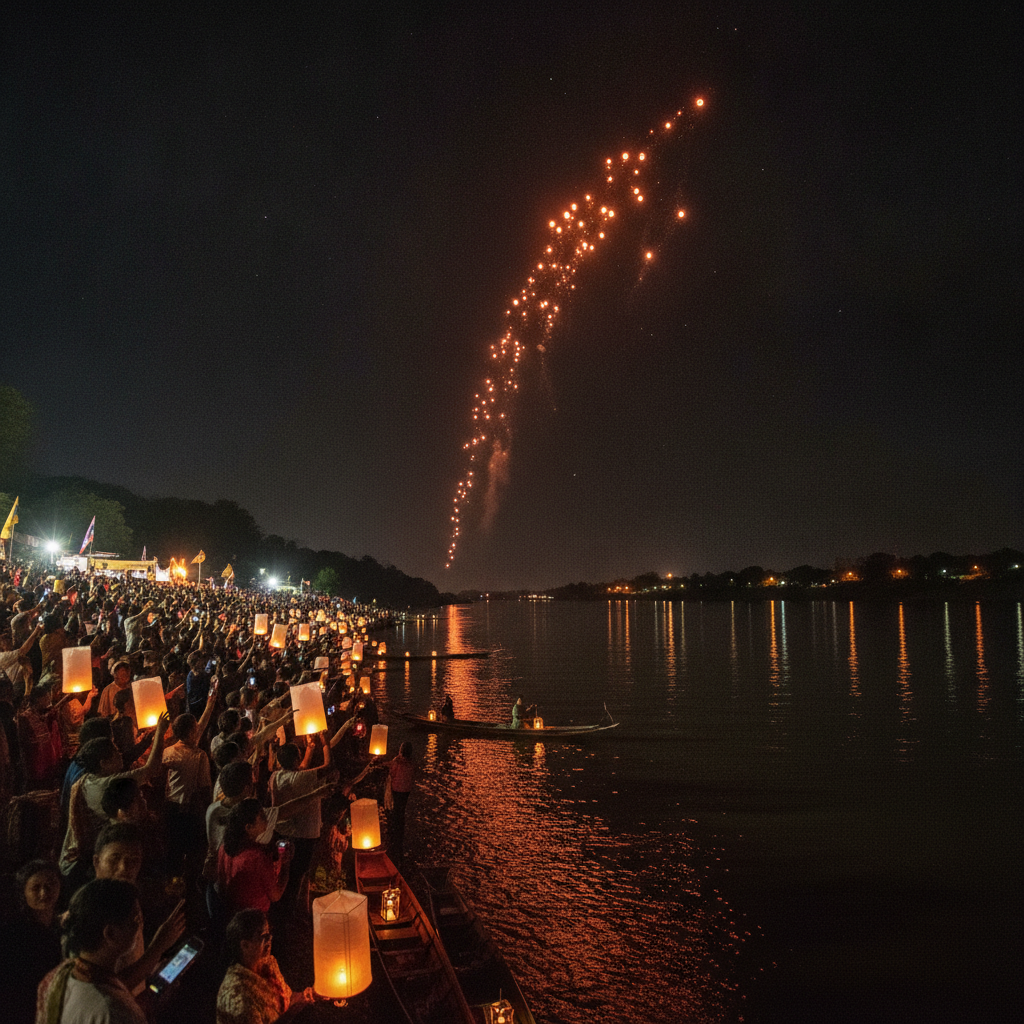
The moon is full over the Mekong and the water has gone black and glassy. It is the last night of the Buddhist Lent, the festival called Wan Ok Phansa, and along a two hundred and fifty kilometer stretch of riverbank in Thailand's Nong Khai province the crowd has grown into the hundreds of thousands. Families staked out their patch of mud in the afternoon. Monks murmur at the water's edge. Children are lifted onto shoulders. Everyone is watching the same thing: the surface of the river, and the darkness just above it.
Then it begins. A single reddish orb detaches from the water without a sound, hangs for an instant, and climbs. There is no splash, no arc of a launched object, no smoke trailing behind it. It rises straight up, twenty meters, fifty, a hundred, and then it is gone, swallowed by the night sky as cleanly as it appeared. Before the first has vanished a second is rising a hundred meters downstream, then a third, then a scatter of them, and the crowd roars.
The people who live here call them bang fai phaya nak, the fireballs of the Naga, the great serpent that local folklore places in the depths of the Mekong. In the Buddhist telling the lights are the serpent's offering, breathed up from the riverbed to honor the Buddha as he returns to the mortal world at the close of the Lenten retreat. Monks bless the water. Boats carrying candles drift downstream. The entire night is built around the expectation that the river will answer.
The counts vary from year to year. On a quiet night witnesses report a few dozen. On a good one the tally runs past a thousand. Thai PBS once counted more than eight hundred in a single evening. The orbs are usually described as reddish or pinkish, sometimes no larger than a spark, sometimes swollen to the size of a basketball. They do not explode, they make no sound, and they are not seen to fall back into the water. Observers standing close to the bank report feeling no heat from them.
Their behavior is consistent from witness to witness. They do not drift sideways like paper lanterns and they do not scatter sparks like fireworks. They lift vertically at a measured pace and they hold their color from the moment they leave the water until the moment they wink out. Photographs are plentiful and settle nothing, because a glowing dot against a black sky looks much the same whether it came from a riverbed, a rifle barrel, or a fault in the camera.
The timing is the detail on which nearly every account agrees. The lights keep to the lunar calendar. They appear on the single night of Wan Ok Phansa or within a day or two of it, and for the rest of the year they are largely absent from the same stretch of river.
The phenomenon is not new. Elders in Phon Phisai, the district most closely associated with the sightings, describe watching the lights as children, and say their own grandparents watched them before that, carrying the tradition back generations beyond any modern record. The poetic name that now travels the world, the Phaya Nak or Naga lights, is more recent than the sightings themselves. It appears to have taken hold only around the middle of the 1980s.
Around the festival the riverside towns fill with pilgrims and tourists. Food stalls line the banks, illuminated boat processions move on the water, fireworks go up from the towns, and grandstands are put in place for the crowds who come to watch the black river. That audience has become one of the most important sources of income in the province, and the local authorities promote the event heavily each year.
In 2002 the Thai television channel iTV broadcast an investigation that became a national story. Its crew had crossed to the Laotian bank, the far side of the river from the worshippers, and returned with footage the network said told a different story. At least some of the fireballs, the report argued, were tracer rounds, AK-47 ammunition fired into the night air by soldiers on the Lao side, each burning arc greeted by a cheer from the Thai crowd on the opposite bank.
The reaction was immediate. Local politicians in Nong Khai spoke of suing the network for more than twenty million dollars. Residents held a protest march. The Lao ambassador to Thailand, Hiam Promjan, said his country was shocked by the accusation. To a devout community the broadcast was not skepticism but sacrilege, and the affair ended without any finding that both sides accepted.
Scientists followed the journalists. Jessada Denduangboripant, a biologist at Chulalongkorn University known in Thailand for testing popular beliefs, analyzed footage of the events and concluded that what the cameras had recorded was consistent with flares or bullets fired from across the water, the light appearing to rise out of the river because of the low viewing angle and the distance involved.
Thailand's Science Ministry took a different approach. A team that included the deputy permanent secretary, Saksit Tridech, went to the river with instruments and came back proposing phosphine, a flammable gas that can ignite on contact with air, seeping up from the marshy riverbed and burning at the surface. The team could not close the central gap in its own proposal. Phosphine is normally produced under tightly controlled industrial conditions, and no mechanism was identified that would generate it naturally in river mud in anything like the quantity required.
That is where the documented record stops. In more than half a century of argument, through a national broadcasting scandal, a government field study and many documentary crews, there is no published instrumental track of a single fireball from the riverbed to the point where it disappears: no spectrum, no thermal reading, no triangulated altitude. What exists is hundreds of thousands of eyewitnesses, a great deal of video shot from one bank, and the same night on the calendar, every year.
Conclusions and Open Questions
Four explanations dominate the argument, and each of them breaks on a different point.
The tracer-fire explanation, advanced by the iTV crew in 2002 and supported by Jessada Denduangboripant, has the advantage of a mechanism that certainly exists. Rifles are real, tracer rounds glow and rise, and soldiers on a quiet border have been known to fire them. Its weakness is chronology and description. The sightings are reported generations before automatic rifles reached the banks of the Mekong, and witnesses close to the water describe a slow, silent, vertical ascent rather than the crack and flat trajectory of a bullet.
The phosphine and methane explanation, proposed by the Science Ministry team under Saksit Tridech, has the advantage of accounting for lights that emerge from the water itself. Its weakness is chemistry. Methane does not ignite spontaneously at river temperatures. Phosphine that does ignite on contact with air tends to leave a puff of smoke and a lingering smell, and witnesses report neither. Nor has anyone explained how gas pockets accumulate on the bed of a deep, fast, cold river, survive the rise through meters of moving water, and ignite precisely at the surface, only in late October.
A third idea, raised occasionally, treats the orbs as a natural plasma or a form of ball lightning discharged from the water. It would account neatly for the silence and the steady glow. Its weakness is that plasma of that kind requires electrical potentials that are not present in a warm tropical river, and the idea has few serious defenders.
A fourth possibility, which some researchers consider the most honest, is that there is no single answer: a genuine natural phenomenon in some years, salted with the occasional flare fired by a prankster or a bored sentry in others. One theory holds that this is exactly why the eyewitness evidence pulls in so many directions at once, and why neither side of the argument can ever be entirely defeated.
Some argue that the question has not been settled because too many people benefit from leaving it open. A phenomenon that fills hotels and food stalls along a hundred and sixty miles of riverbank is one a region has reason to keep mysterious, and a definitive debunking would be costly. This is an open theory and not a finding. Centuries of sightings cannot be manufactured by a tourism office, and no evidence of organized staging has ever been produced. It does mean, though, that the question is not being asked in a neutral room.
What remains genuinely unexplained is narrower than the debate suggests, and harder to dismiss. Nobody has accounted for the calendar: a natural process that keeps to a lunar religious date is either a very long coincidence or a sign that the cause is not natural at all. Nobody has accounted for the silence and the reported absence of heat at close range. And nobody has measured anything.
The open questions are practical ones. Would a single night of continuous instrumented observation, with synchronized cameras on both banks, thermal imaging and spectrometers, settle the source in one season? Has anyone tested riverbed sediment at Phon Phisai for phosphine precursors? Why, after more than fifty years of publicity, has no team attempted a controlled triangulation? Until someone follows one orb from the water to its vanishing point with instruments rather than opinions, the Mekong keeps its answer.